

 Haris Khan
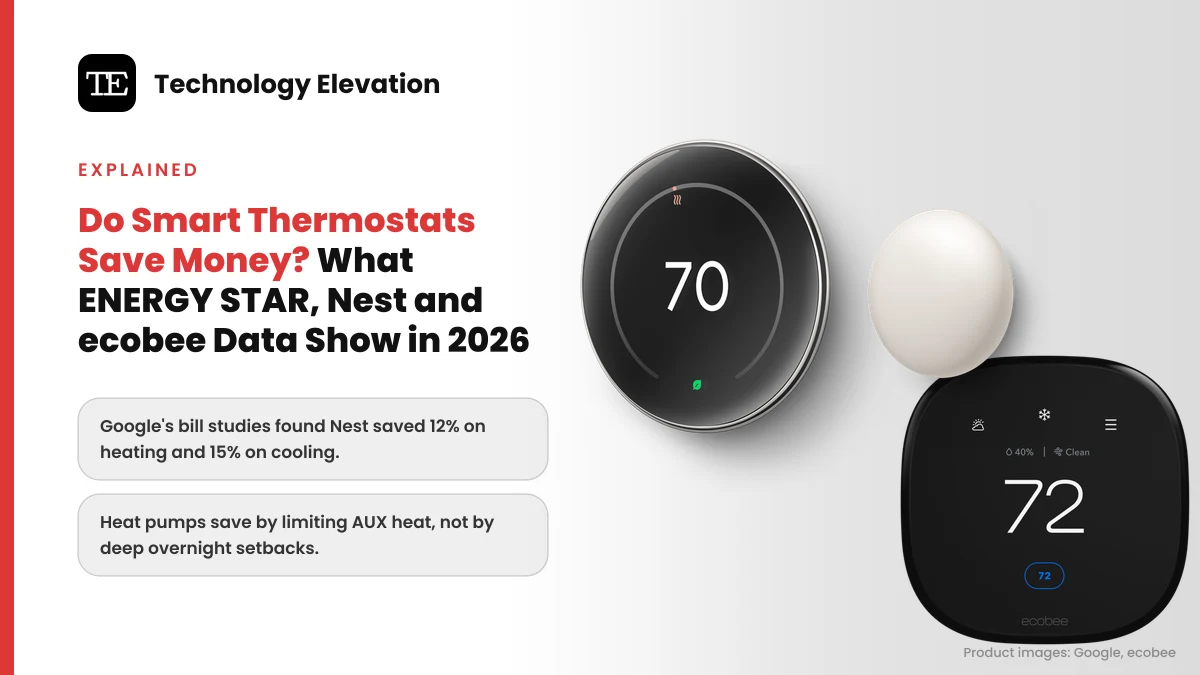
Walk past most hallway thermostats in November and you will see the same number on the screen at 3 a.m., at noon and at 7 p.m. Nobody changed it, because nobody remembers to. That steady number, held day and night in an empty house, is where a smart thermostat finds its money.
So do smart thermostats save money? Yes, in most homes, but by less than the box suggests. The honest range from official and maker field data is roughly 8% to 15% off your heating and cooling, not the 26% or 31% you see in adverts.
The stakes are real. ENERGY STAR says almost half of the average American household’s annual energy bill goes to heating and cooling, more than $900 a year. A few percent of that, every year, adds up.
We read the ENERGY STAR certification rules, Google’s and ecobee’s published savings studies and their support pages, then worked out when the savings show up, when they do not, and why heat pump homes need a different approach.
Smart thermostats save about 8% to 15% on heating and cooling for most homes
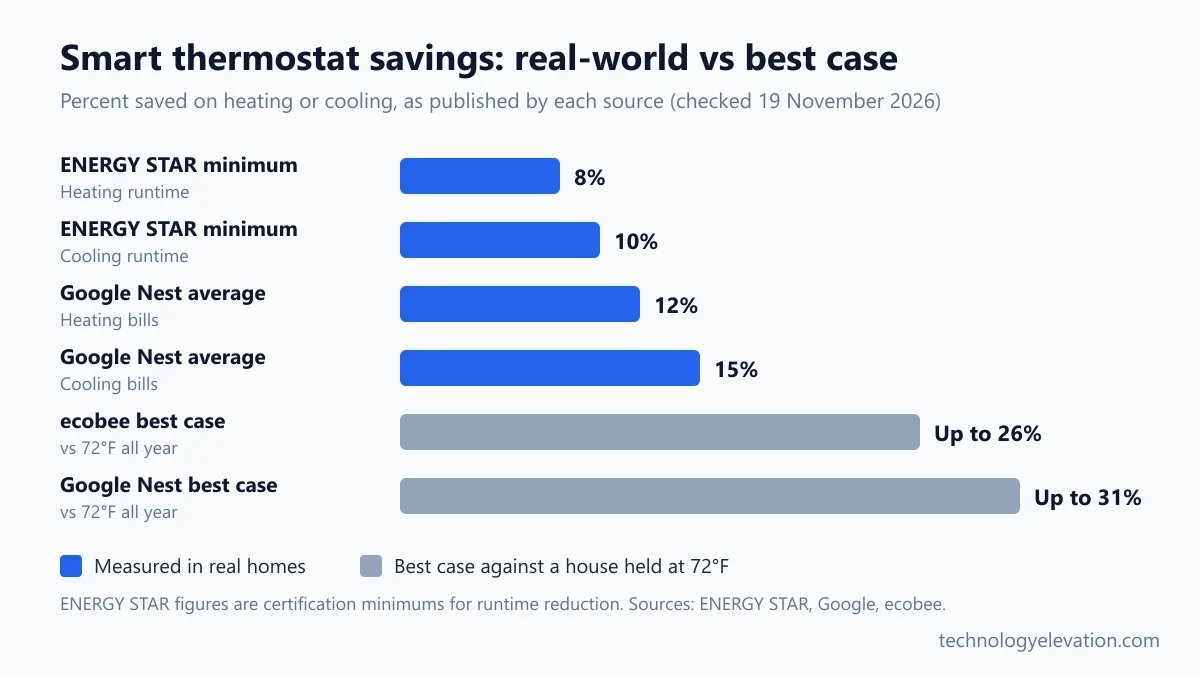
Smart thermostats do save money for most homes. ENERGY STAR certification requires at least 8% less heating runtime and 10% less cooling runtime in real homes, and Google’s bill studies found Nest thermostats saved an average of 12% on heating and 15% on cooling.
The headline numbers you will run into, and what each one really means:
- ENERGY STAR minimum: 8% less heating runtime and 10% less cooling runtime, measured across hundreds of real homes.
- ENERGY STAR dollar estimate: about $100 a year for homes with high heating and cooling bills or homes that sit empty for much of the day.
- Google Nest field average: 12% on heating bills and 15% on cooling bills, from before and after bill comparisons.
- Google Nest best case: up to 31% on heating and cooling, against a house held at 72°F all year.
- ecobee best case: up to 26% on heating and cooling, also against a 72°F hold, or up to $284 a year by ecobee’s own maths.
| Source | Figure | Compared with | How to read it |
|---|---|---|---|
| ENERGY STAR (EPA) | 8% heating, 10% cooling runtime | Certification minimum from a year of field data | The floor a certified model must beat |
| ENERGY STAR (EPA) | About $100 a year | High-bill or often-empty homes | A realistic best-fit estimate |
| Google Nest | 12% heating, 15% cooling | Bills before and after install | Average real-world result |
| Google Nest | Up to 31% | 72°F held all year | Industry baseline, not typical |
| ecobee | Up to 26% | 72°F held all year | Maker’s best case |
Apply Google’s averages to ENERGY STAR’s $900 figure and you get roughly $108 to $135 a year. Our arithmetic, not a promise, but a fair middle for a typical house.
ENERGY STAR certifies savings from real homes, not lab tests
ENERGY STAR only certifies a smart thermostat after its maker sends a year of real usage data from hundreds of customer homes. EPA software measures how much less the heating and cooling ran, and the result must clear 8% for heating and 10% for cooling.
The detail matters. The ENERGY STAR smart thermostat criteria use the lower 95% confidence limit of the weighted national average. In plain words, the maker cannot pass by getting lucky with a sample of high savers.
A second test protects ordinary users. The 20th percentile homes, the ones that save less than most, still have to show at least 4% less heating runtime and 5% less cooling runtime.
Certified models must also keep working as a basic thermostat when the internet drops, read temperature to within 2°F, and draw no more than 3 watts on average in standby. A thermostat that saves on the furnace but burns power on its own screen would miss the point.
Google says the Nest Learning Thermostat became the first smart thermostat to earn ENERGY STAR certification, in February 2017. Today the label is the quickest filter when you shop, since every certified model has already proved savings in the field.
The “up to 26%” and “up to 31%” claims assume a house held at 72°F
The biggest savings claims compare a smart thermostat with a house kept at 72°F around the clock, all year. Few homes run that way, so those figures are a ceiling. Google itself says its 31% figure may not represent the typical customer experience.
Google’s savings page is unusually frank about this. It calls the 72°F hold an industry baseline for comparison, then publishes its field results separately: 12% on heating and 15% on cooling, from two independent studies of real bills across 41 US states in 2015, confirmed by an updated assessment in 2024.
ecobee’s claim works the same way. Its savings page says customers in North America saved up to 26% on heating and cooling costs, based on an internal analysis from April 2021 against a 72°F setting. ecobee then multiplies 26% by an average heating and cooling cost of $1,091 to reach “up to $284” a year.
Neither number is false. Both describe the best homes in the sample. If your old thermostat already dropped the heat at night, your starting point is nowhere near a flat 72°F, and your savings will be smaller.
Smart thermostats save the most in homes that sit empty or never had a schedule
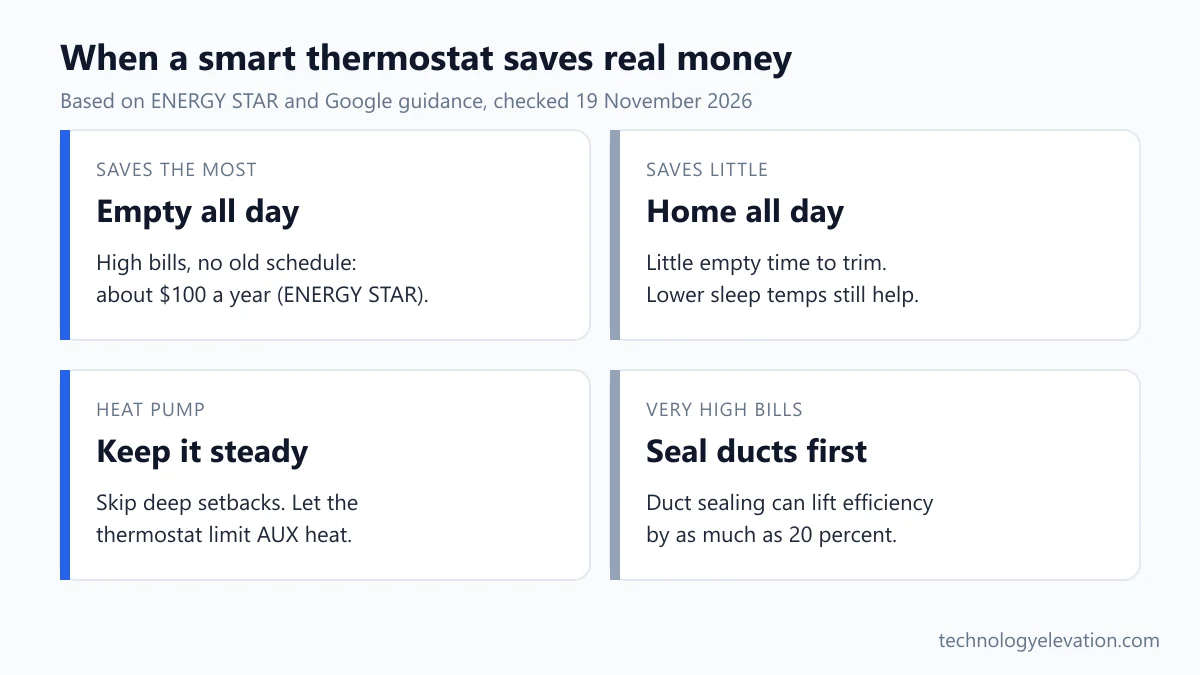
Savings are real and large when the house is empty for long stretches, the old thermostat held one temperature all day, and bills are high. ENERGY STAR singles out exactly those homes, high-bill and often-empty ones, as the households that can save about $100 a year.
Think of two couples on the same street. One works from home and keeps the living room at 70°F all day. The other leaves at 7:30 a.m. and gets back at 6 p.m. The second house has ten empty hours a day for a smart thermostat to trim, and the first has almost none.
Four situations make the savings most likely:
- Nobody ever programmed the old one. Google notes that many programmable thermostats are simply left at one temperature all the time.
- Your days are irregular. Geofencing, which uses your phone’s location to tell when you leave, sets back the temperature on days a fixed schedule would miss.
- You run central air for months. Google’s average cooling saving, 15%, beats its heating figure.
- Your utility pays for flexibility. Demand response programs add rewards on top of the energy you save.
The common thread is wasted runtime. A smart thermostat cannot make your furnace more efficient. What it does is stop it running when nobody needs the heat.
Savings shrink when you already set back the heat or live in a mild climate
A smart thermostat saves little if you already turn the heat down at night and when you leave, if someone is home all day, or if your heating and cooling bill is small to begin with. In those homes, convenience is the real gain, not money.
Disciplined manual users are the clearest case. If you already drop the heat every night by hand, a learning thermostat mostly automates a habit you have. You might gain a little from Eco temperatures on days you forget, but not 12%.
Small bills shrink the dollars too. Ten percent of a $300 annual heating and cooling bill is $30, which can take years to cover the price of the thermostat.
Comfort settings can also cancel the savings. Google says its Adaptive Eco feature on the Nest Learning Thermostat (4th gen) will run your system while you are away, so the house can get back to your comfort temperature within an hour. Comfortable, yes. Cheaper than letting the house drift, no.
And people undo their own savings. Bump the temperature up two degrees every evening because the schedule feels chilly, and the thermostat will learn that you like it warm.
Heat pump homes save by avoiding auxiliary heat, not by deep setbacks
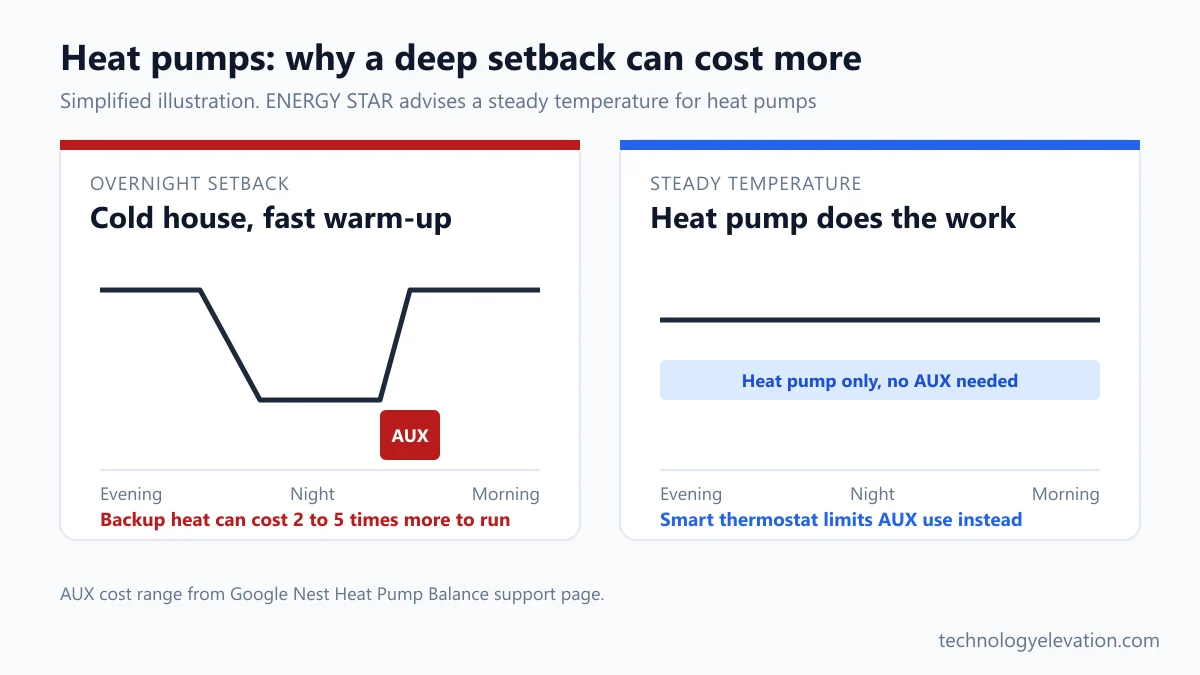
With a heat pump, the savings come from keeping the backup heat off, not from turning the temperature down at night. ENERGY STAR says heat pumps do not save energy by turning it down when you are away or asleep, and recommends a steady temperature.
The reason is the backup. Many heat pump systems have auxiliary (AUX) heat, often electric resistance heat, that kicks in when the house needs to warm up fast. Google’s Heat Pump Balance page says AUX heat can cost about 2 to 5 times as much as running the heat pump.
So a big morning recovery from a cold setback can switch on the expensive backup and wipe out the overnight saving. ENERGY STAR’s advice for heat pumps is to pick a comfortable temperature and leave it there, and to set the system to Heat or Cool rather than Auto, so it does not flip modes on odd days.
Where a smart thermostat earns its keep is in managing that backup. Google’s Heat Pump Balance lets you choose more comfort, more savings or a balance, then adjusts the lockout temperature (the outdoor temperature below which AUX heat is allowed) for you. Running the heat pump longer, Google notes, can be cheaper than using AUX heat.
ENERGY STAR also requires certified thermostats to report electric resistance heat use for heat pump homes. When you shop for one of the best smart thermostats for a heat pump, check that it supports your number of AUX stages.
A smart thermostat pays for itself in one to three years in the right home
At ENERGY STAR’s estimate of about $100 a year for high-bill or often-empty homes, a $129.99 Google Nest Thermostat pays for itself in about 16 months. A $279.99 Nest Learning Thermostat (4th gen) takes nearly three years at the same rate.
Those are list prices from Google’s own store. Black Friday prices are lower, and a utility rebate can cut the cost again, which shortens the payback.
| Thermostat | US list price | Payback at $100 a year | Payback at $50 a year |
|---|---|---|---|
| Google Nest Thermostat | $129.99 | About 1.3 years | About 2.6 years |
| ecobee Smart Thermostat Enhanced | $199.99 | About 2 years | About 4 years |
| Nest Learning Thermostat (4th gen) | $279.99 | About 2.8 years | About 5.6 years |
The $50 column is our own lower case for a home that already uses some setbacks. Add installation costs if you hire a pro.
Pricier models are not automatically better savers. They mostly add comfort features such as included room sensors, voice assistants and bigger screens. If saving money is your only goal, the cheaper certified smart thermostats reach payback fastest. Black Friday week is a good time to buy, as long as you know how to tell Black Friday 2026 tech deals that are real from the fake ones.
Rebates and demand response programs add savings on top
Many utilities offer rebates on ENERGY STAR certified smart thermostats, and some pay you to let the thermostat ease off during peak demand. ecobee says its Community Energy Savings feature can earn up to $125 in rewards, on top of energy savings.
Start with the ENERGY STAR Rebate Finder. Enter your zip code and it lists rebates from local partners on certified products, smart thermostats included.
Demand response is the second layer. Google’s Rush Hour Rewards, run with Renew Home and your energy company, typically shifts your temperature by up to 4°F, usually for 3 to 4 hours, during high-demand events, often with a pre-cooling or pre-heating period first. You can leave the program in the Google Home app, though unenrolling can take up to 24 hours.
ecobee’s Time of Use feature works on price rather than events: it preheats or precools the house when energy is cheaper, to use less during peak hours. That only pays if your utility actually charges more at peak times, so check your bill before you switch it on.
Seven settings that turn a smart thermostat into real savings
To get real savings, set sensible Eco temperatures, keep the schedule, accept small automatic tweaks, place room sensors where people actually sit, and, on a heat pump, let the thermostat manage auxiliary heat. Most of the money comes from settings you choose in the first week.
- Set your Eco (away) temperatures wider than feels natural, but safe for pets and plants.
- Turn on presence sensing or geofencing so the thermostat switches to Eco when everyone leaves.
- Lower your schedule by 1°F in winter, or raise it by 1°F in summer, and compare the next month’s energy report.
- Accept Seasonal Savings on a Nest, which trims the schedule by about 2°F in total, a fraction of a degree a day, in early winter and summer.
- Review Savings Finder suggestions in the Google Home app, or ecobee’s Schedule Assistant, when your routine changes.
- On a heat pump, turn on Heat Pump Balance (Nest) or set a sensible AUX lockout, and avoid deep setbacks.
- Put any room sensor in the room you use most, not in the hallway next to the thermostat.
Step 3 is easier than it sounds. Google points out that most people cannot tell 70°F from 69°F, and that the temperature difference between your nose and your toes is likely more than 1°F.
Step 4 has limits. Google says Seasonal Savings is available in the US and Canada (except Quebec), only on thermostats set to English (US), and not for every home every season.
The rest of your smart home can help too. A thermostat that supports Matter, the cross-brand smart home standard, can join routines with your other devices, and home assistant devices make Eco mode a voice command away. If the thermostat keeps dropping offline, look at your Wi-Fi coverage, since a mesh Wi-Fi system can fix a weak signal in the hallway.
Leaky ducts and old equipment can cost more than any thermostat saves
When heating bills are very high, fix the house before blaming the thermostat. ENERGY STAR says sealing and insulating ducts can improve heating and cooling efficiency by as much as 20%, more than most smart thermostats save on their own.
A thermostat only decides when the system runs. If warm air leaks into the attic on the way, a perfect schedule still heats the attic. ENERGY STAR’s heating and cooling advice lists duct sealing, a yearly tune-up and a smart thermostat side by side for that reason.
Equipment age matters too. ENERGY STAR says replacing old heating and cooling equipment with certified models can cut the annual energy bill by nearly $140 depending on where you live, but it advises fixing big air leaks in the house and ducts first.
Small electric loads are a separate job. A thermostat controls the furnace and AC, not the space heater in the home office. An energy-monitoring plug from the best smart plugs shows what that heater really costs per day.
Ready to buy? Match the model to your wiring and your home. The best smart thermostat picks for 2026 sort the current models by C wire needs, Matter support and room sensors.
Frequently asked questions about smart thermostat savings
How much money does a smart thermostat save per year?
ENERGY STAR estimates about $100 a year for homes with high heating and cooling bills or homes that sit empty for much of the day. Google’s field studies found Nest thermostats saved an average of 12% on heating and 15% on cooling bills.
Are smart thermostat savings claims of 26% or 31% realistic?
Those figures are best cases measured against a house held at 72°F all year. Google says its up to 31% figure may not represent the typical customer experience, and its real-world average is 12% on heating and 15% on cooling.
Do smart thermostats save money with a heat pump?
Yes, but mainly by limiting expensive auxiliary heat rather than through deep setbacks. ENERGY STAR advises a steady temperature for heat pumps, and Google says AUX heat can cost about 2 to 5 times as much as running the heat pump.
Is a smart thermostat worth it if I work from home?
Usually less so, because the house is rarely empty and there is little runtime to trim. You can still save with a lower sleep temperature, Eco mode in unused hours and demand response rewards from your utility.
How long does a smart thermostat take to pay for itself?
At ENERGY STAR’s estimate of about $100 a year, a $129.99 Google Nest Thermostat pays for itself in about 16 months. A $279.99 Nest Learning Thermostat (4th gen) takes nearly three years, and rebates shorten both.
Does an ENERGY STAR label matter on a smart thermostat?
Yes, because certified models must prove savings with a year of field data from hundreds of real homes. The ENERGY STAR Rebate Finder also lists utility rebates on certified models, so the label can lower the price as well.
Last checked and sources
Last checked on 19 November 2026 by Haris Khan. We read the ENERGY STAR certification criteria and advice pages, Google’s and ecobee’s published savings figures and support articles, and kept only what those sources state; dollar paybacks are our own arithmetic from their figures.
- ENERGY STAR: Smart Thermostats product page, Smart Thermostat Key Product Criteria, Heat and Cool Efficiently, Air-Source Heat Pumps, Rebate Finder
- Google Store: Nest thermostat savings page, Nest Thermostat and Nest Learning Thermostat (4th gen) list prices
- Google Home and Nest Help: Heat Pump Balance, Seasonal Savings, Savings Finder, Eco Temperatures, Adaptive Eco, Optimize energy savings, Improve energy savings
- Google Blog: Google Home updates, November 2026
- ecobee: Savings page, eco+ features page, Smart Thermostat Enhanced list price
We update this guide when ENERGY STAR changes its criteria or makers publish new savings data.


GIPHY App Key not set. Please check settings