

 Abdullah Kabeer
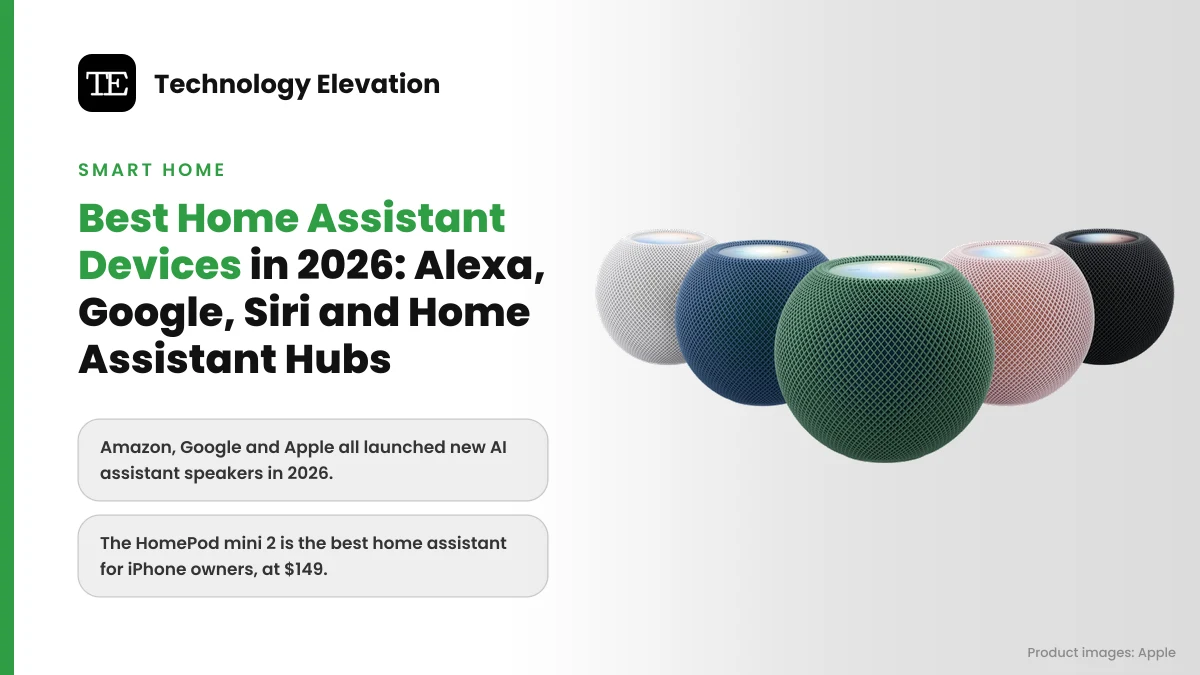
Most homes end up with a voice assistant in the kitchen first. Someone wants a timer while their hands are covered in dough, then the lights get added, then a lock, and two years later the little speaker on the counter runs half the house. Picking the best home assistant devices is really about choosing which company gets to run that house.
The choice got more interesting in 2026. Amazon, Google and Apple all launched new speakers this year, each built around a new AI version of its assistant. Amazon’s newest Echo Dot is also the first Echo Dot with a built-in smart home hub, which used to be a feature reserved for pricier models.
Then there is the other meaning of “home assistant.” Home Assistant is also the name of a free, open-source smart home platform that runs on a small box in your home instead of in someone’s cloud. We cover its official hardware too, because plenty of people searching for a home assistant actually want that.
Prices moved a lot this year as well, so every price below is a launch or list price.
The best home assistant device for most homes is the Echo Dot (2026)
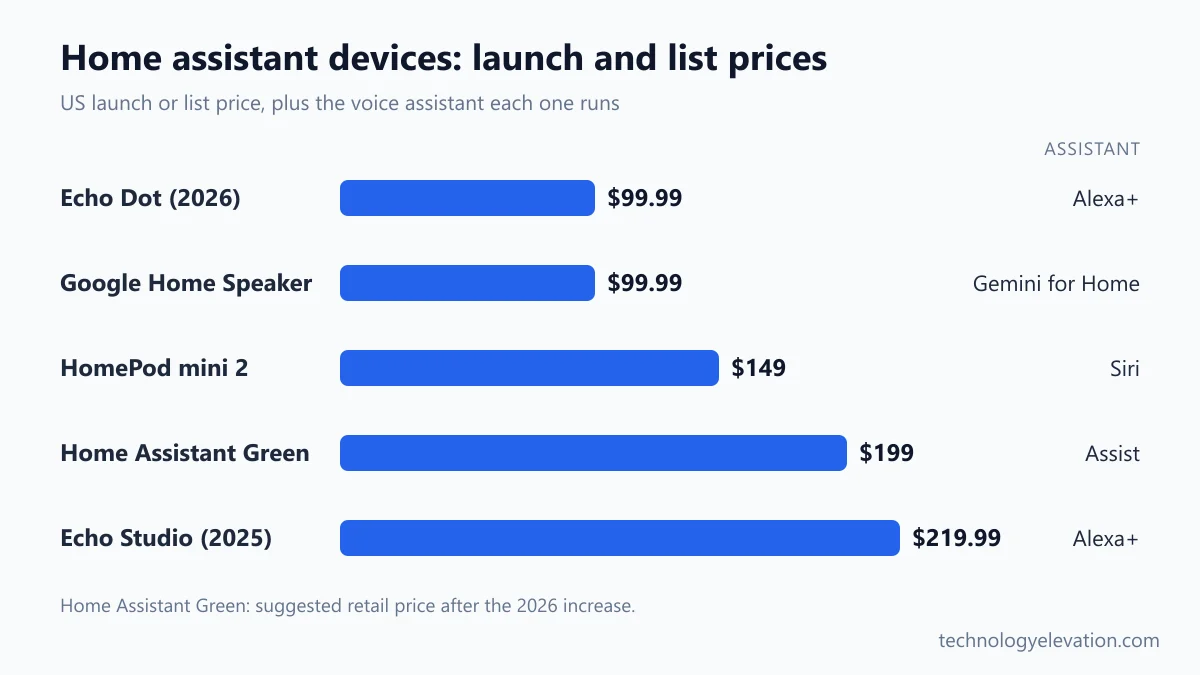
The Amazon Echo Dot (2026) is the best home assistant device for most homes. It launched at $99.99 with a built-in smart home hub, an eero Wi-Fi extender and Alexa+, which is free with Prime. Google and Apple households should pick their own brand’s speaker instead.
Every pick, by the job it does best:
- Best overall: Amazon Echo Dot (2026)
- Best for Google homes: Google Home Speaker
- Best for iPhone homes: Apple HomePod mini 2
- Best sound: Amazon Echo Studio (2025)
- Best for a private, local smart home: Home Assistant Green, with the Home Assistant Voice Preview Edition
| Model | Assistant | Smart home radios | Released | Launch or list price |
|---|---|---|---|---|
| Amazon Echo Dot (2026) | Alexa+ | Zigbee, Thread, Matter | October 2026 | $99.99 |
| Google Home Speaker | Gemini for Home | Thread, Matter | June 2026 | $99.99 |
| Apple HomePod mini 2 | Siri | Thread | October 2026 | $149 |
| Amazon Echo Studio (2025) | Alexa+ | Zigbee, Thread, Matter | October 2025 | $219.99 |
| Home Assistant Green | Assist (local) | Add-on USB radios | 2023 | $199 list |
Treat those prices as a ceiling. Amazon runs deep discounts around Prime Day and Black Friday.
Amazon Echo Dot (2026): the best home assistant overall
The Echo Dot (2026) is the best home assistant for most people because it does the most for the money. It is a decent small speaker, a smart home hub, a Wi-Fi extender and an Alexa+ device in one $99.99 ball that fits on any shelf.
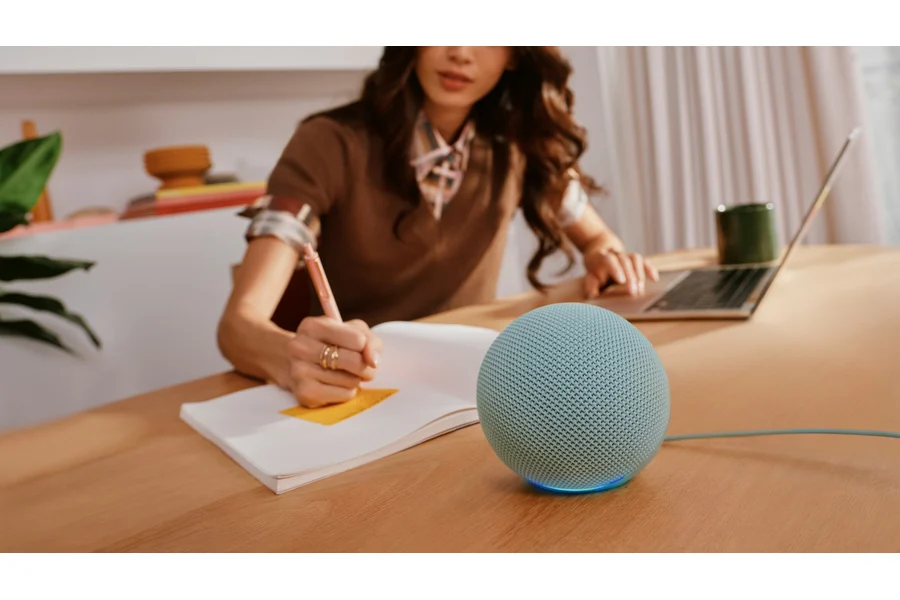
Key specs: Amazon AZ3 processor with an AI accelerator, built-in smart home hub with Zigbee and a Thread border router, Matter support, built-in eero Wi-Fi extender covering up to 1,000 square feet, 50% more bass than the previous Echo Dot. It shipped on October 28, 2026, at $99.99.
The hub is the headline. Zigbee and Thread are low-power wireless networks that many smart bulbs, door sensors and locks use instead of Wi-Fi. Until now, you needed a bigger Echo or a separate hub to talk to them. The new Dot handles both, plus an eero extender for the back bedroom where streaming always buffers.
Alexa+ is the other reason to buy now. Amazon’s new assistant handles follow-up questions and longer requests much better than the old Alexa. Prime members get it free. Everyone else pays $19.99 a month for the full version.
The honest catch is the price jump. The fifth-generation Echo Dot launched at $49.99, so this one doubles the entry price. And at 50% more bass, it still sounds like a small speaker. Buy it for control and voice, not for parties.
Check the Amazon Echo Dot (2026) price on Amazon
Google Home Speaker: the best home assistant for Google homes
The Google Home Speaker is the best home assistant for homes built around Google. It is Google’s first new speaker in years, launched at $99.99, runs Gemini for Home, and doubles as a Thread border router and Matter hub for your devices.
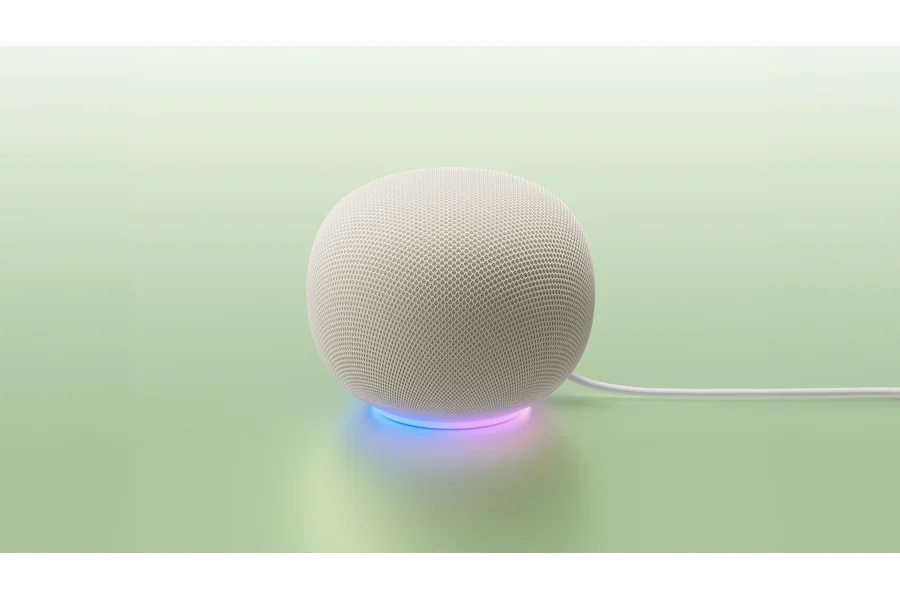
Key specs: 58 mm full-range driver with 360-degree sound, three far-field microphones, hardware mic mute switch, Thread 1.3 border router, works as a hub for Matter with Google Home, Wi-Fi 6, Bluetooth 5.4. It reached stores on June 25, 2026, at $99.99.
Gemini is the real upgrade. Continued Conversation keeps the microphone open for a moment after each answer, so you can ask a follow-up without saying “Ok Google” again. With kids asking five questions in a row, that saves a lot of shouting.
The speaker also fits neatly into a Google living room. You can pair up to two of them with a Google TV Streamer for surround sound, and it controls Google Home compatible cameras, thermostats and lights from the same app you already use.
Now the catch. Basic smart home control, timers and quick answers are free, but the best Gemini features are not. Gemini Live and camera history search sit behind Google Home Premium, which starts at $10 a month in the US. If you never plan to pay, the Echo Dot gives you more free smart home features.
Check the Google Home Speaker price on Amazon
Apple HomePod mini 2: the best home assistant for iPhone homes
The HomePod mini 2 is the best home assistant for iPhone owners. It launched at $149 in October 2026 with Apple’s S10 chip, a Thread radio, built-in temperature and humidity sensors, and a light-up top that pulses with your music.
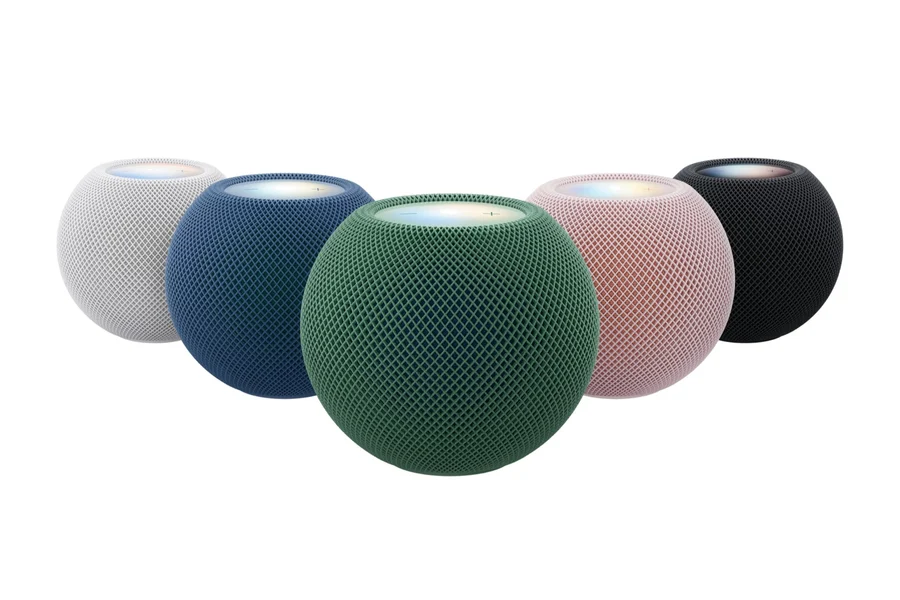
Key specs: Apple S10 chip, one full-range driver with dual passive radiators, three-microphone array, Thread, temperature and humidity sensors, Ultra Wideband chip, Wi-Fi 6E, five colors. Available from October 30, 2026, at $149.
Handoff is the everyday magic here. Hold your iPhone near the speaker and the song moves over. The Ultra Wideband chip makes that work by sensing exactly where the phone is.
The sensors are underrated. The HomePod mini 2 reads room temperature and humidity, and the Home app can use those readings as automation triggers. Turn on a fan when the bathroom hits a set humidity, for example.
Siri is the weak spot, for now. Apple’s new Siri AI arrives in a future software update, and it needs the home owner to have an Apple Intelligence iPhone or iPad. Until then, Siri still trails Alexa and Gemini on long or tricky questions.
Price is the other gripe. The original HomePod mini launched at $99 and rose to $129 in June 2026. Paying $149 for the new one makes sense only if your house already runs on Apple Home.
Check the Apple HomePod mini 2 price on Amazon
Amazon Echo Studio (2025): the best sounding home assistant
The Echo Studio (2025) is the best sounding home assistant you can buy without stepping up to Sonos. Its 2025 redesign is 40% smaller than the original, adds Dolby Atmos spatial audio, and runs Alexa+ on Amazon’s faster AZ3 Pro chip, at $219.99.
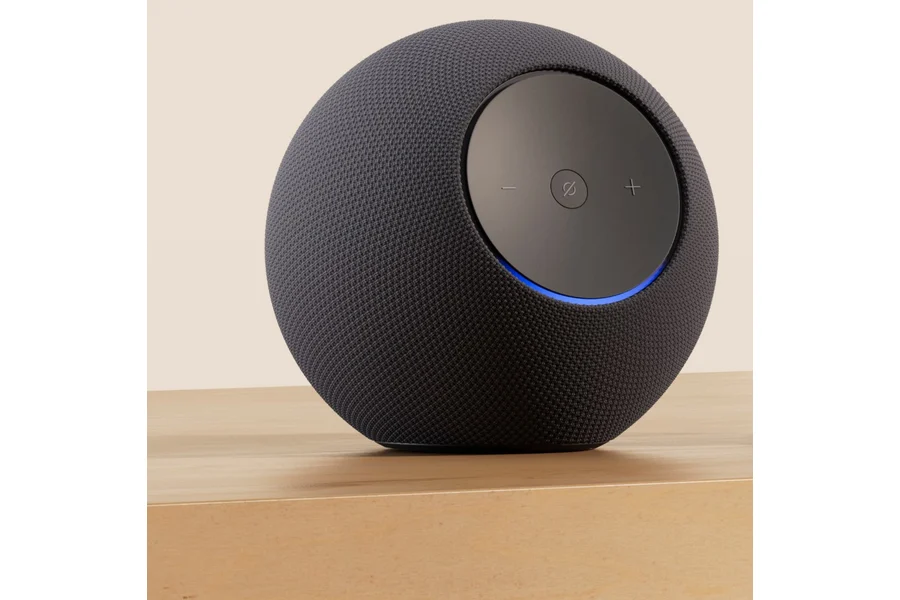
Key specs: one high-excursion woofer and three full-range drivers, Dolby Atmos and spatial audio, Advanced Room Adaptation, AZ3 Pro processor, built-in Zigbee, Thread and Matter smart home hub, Alexa+ included with Prime. Launched October 29, 2025, at $219.99. A version with a built-in camera, the Echo Studio with Home Camera, followed in October 2026 at $249.99.
The old Echo Studio was a big cylinder. The new one shares the rounded Echo Dot look and fits on a bookshelf.
Sound is the reason to buy it. Three full-range drivers fire in different directions, the woofer fills a living room, and Room Adaptation tunes the output to where you place it. For music in a main room, it is a big step up from any Dot.
Pick the camera-free model unless you have a clear use for the camera. The Home Camera version adds remote Live View for $30 more, and for most living rooms that is one more lens to think about.
Check the Amazon Echo Studio (2025) price on Amazon
Home Assistant Green: the best device for a private, local smart home
Home Assistant Green is the best device for people who want their smart home to run locally, without Amazon, Google or Apple in the middle. The $199 box runs the free Home Assistant platform and controls thousands of devices from almost every brand.
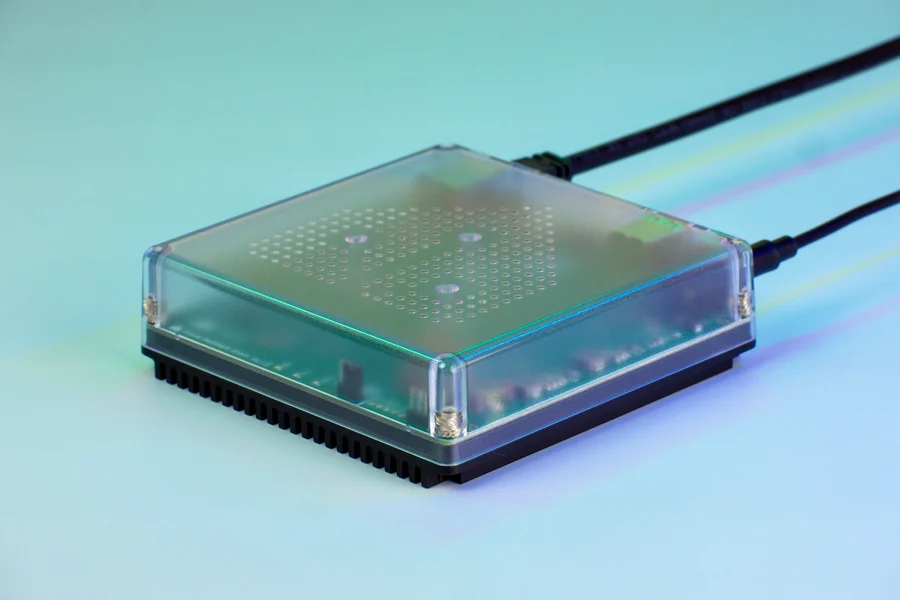
Key specs: Rockchip RK3566 quad-core 1.8 GHz processor, 4GB of memory, 32GB of eMMC storage, Gigabit Ethernet, two USB 2.0 ports, about 1.7 watts at idle. Suggested retail price: $199.
Think of Green as a tiny always-on computer that sits next to your router. It ships with Home Assistant installed, so you plug in Ethernet and start adding devices. Automations run on the box itself, so your motion lights still work when the internet goes down.
Mixing brands is where it shines. Home Assistant can run Hue bulbs, Ring doorbells, an Ecobee thermostat and a pile of cheap Zigbee sensors in one dashboard. It can also pass devices to Alexa, Google or Apple Home, so the family keeps using their favorite voice assistant.
The catch is radios. Green has no Zigbee, Thread or Z-Wave chip built in. Add the Home Assistant Connect ZBT-2 ($49 list) for Zigbee or Thread, one protocol at a time, or the Connect ZWA-2 ($69 list) for Z-Wave and Z-Wave Long Range.
Price has climbed too. Green launched at $99 in 2023, and Nabu Casa, the company behind it, raised the suggested price to $199 in 2026 after memory costs nearly doubled the cost of building one. A Raspberry Pi or an old mini PC can run the same software for less, if you enjoy setting things up.
Add a voice: the Home Assistant Voice Preview Edition ($69 list) is a small speaker with two microphones, a physical mute switch and a 3.5 mm audio jack. It talks to your Home Assistant server and needs no paid cloud plan. As the name says, it is still a preview, with fewer skills than Alexa or Gemini.
Check the Home Assistant Green price on Amazon
Home Assistant Connect ZBT-1 owners should know about its replacement program
The Home Assistant Connect ZBT-1, the previous Zigbee and Thread stick, is out of production and has a known fault. Nabu Casa found that units from its first production run can overheat and fail in some USB ports, and it offers free replacements.
Home Assistant’s official ZBT-1 notice says a faulty voltage regulator is to blame. A failed unit stops responding, and the outer case may look deformed. Older SkyConnect-branded sticks are not affected.
Nabu Casa’s instructions are simple:
- Look for “ZBT-1” on the white label on the back.
- If yours works, keep it plugged in where it is. You can request a replacement later.
- If it stops working or the case looks deformed, contact the retailer you bought it from for a free replacement.
- Nabu Casa covers replacements for 60 months on verified purchases.
We do not recommend buying a ZBT-1 second hand or from old stock. The ZBT-2 replaced it in November 2025 and is the stick to buy.
Ecosystem, hub radios and subscriptions decide the right home assistant
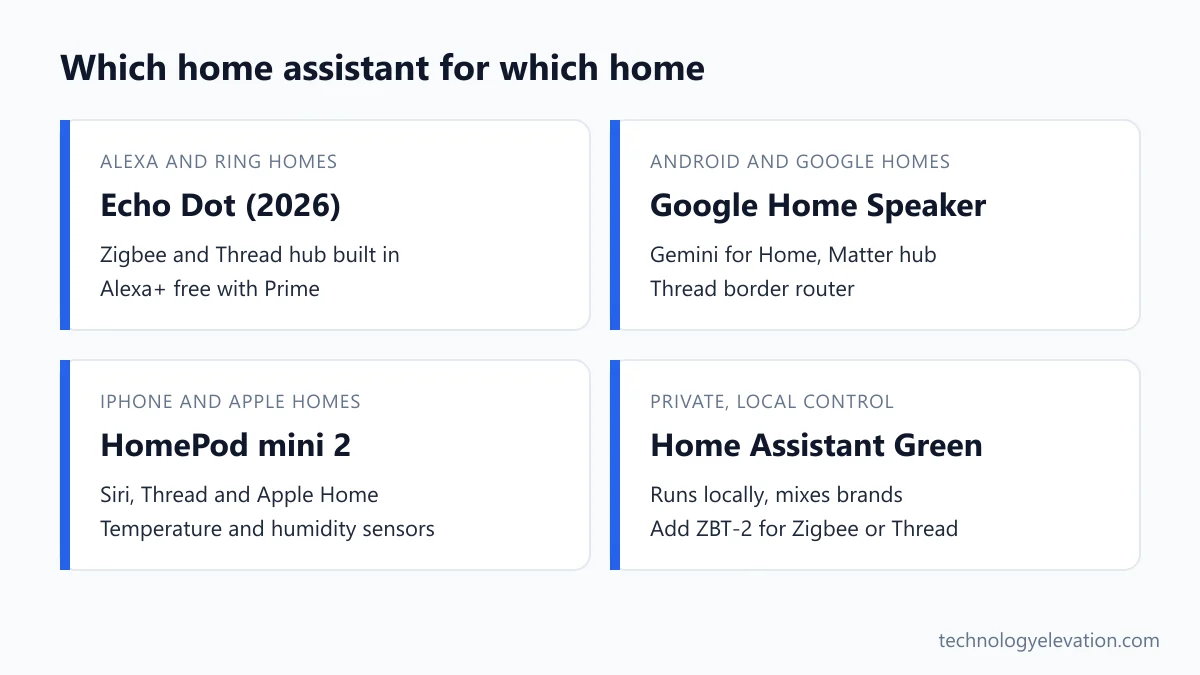
Choose a home assistant by ecosystem first, then hub radios, then subscription costs. Match the phone and devices you already own, check the speaker speaks Zigbee, Thread or Matter, and price in any monthly AI plan before comparing sticker prices.
- Match your phone and apps. iPhone homes run best on HomePod. Android and Chromecast homes suit Google. Everyone else, and anyone with Ring or Fire TV gear, does well with Alexa.
- Count your smart home devices. If you own Zigbee bulbs or sensors, the Echo Dot (2026) can run them directly. Google and Apple speakers work as Thread border routers but not Zigbee hubs.
- Look for Matter. Matter is the shared standard that lets a smart plug or bulb work with Alexa, Google and Apple. Buy Matter devices and you can switch assistants later without replacing everything.
- Decide where the speaker goes. Kitchens and bedrooms suit a small speaker. A living room used for music deserves an Echo Studio or a stereo pair.
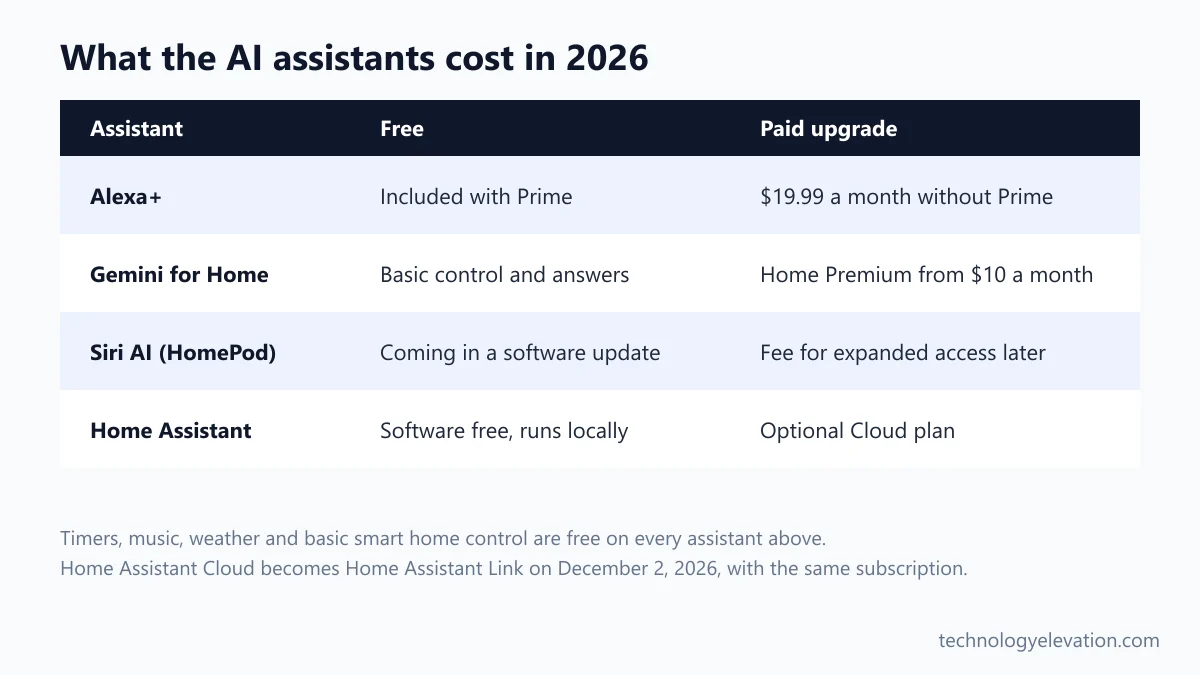
- Price the AI plan. Alexa+ is free with Prime and $19.99 a month without. Google’s Gemini Live needs Google Home Premium from $10 a month. Siri AI arrives in a software update, though Apple says expanded access will cost a fee later.
- Want a screen? Recipes, doorbell video and photo frames are easier on a smart display than on a speaker.
Wi-Fi matters more than most people expect. Voice assistants send every request to the cloud, so a weak signal means slow answers. If a speaker in the far bedroom keeps saying “sorry, I’m having trouble,” a mesh Wi-Fi system fixes that more reliably than a new speaker.
Smart home devices that work best with a home assistant
The devices that get the most out of a home assistant are smart lights, light switches, door locks and video doorbells. Each one turns a voice command or routine into something you would otherwise get up for, and most new models support Matter.
Lights are the natural first step. A few smart lights in the living room let you dim everything with one sentence. In rooms where guests flip switches, smart light switches work better, because nobody can accidentally cut power to a smart bulb.
Locks and doorbells come next. Keyless entry door locks can lock themselves at bedtime as part of a routine. A video doorbell can announce visitors through every speaker in the house, which beats running downstairs for a parcel that is already on the step.
Subscriptions and 2026 price rises change the real cost
All three big assistants now have an AI version, and two charge for some features. Alexa+ is free only with Prime, Google keeps Gemini Live behind Google Home Premium, and Apple says Siri AI will charge for expanded access later.
The basics stay free everywhere. Timers, music, weather, shopping lists and switching lights on and off work on every speaker here without a plan. Home Assistant software is free too, and its optional Home Assistant Cloud plan becomes Home Assistant Link on December 2, 2026, with the same subscription.
Hardware prices climbed as well. Amazon raised Echo prices in August 2026, blaming memory costs: the Echo Dot (5th Gen) went from $49.99 to $79.99 and the Echo Dot Max from $99.99 to $119.99. At those prices, the hub-equipped Echo Dot (2026) is the better buy unless an older model is on a deep sale.
Apple did the same in June 2026, moving the original HomePod mini from $99 to $129 and the full-size HomePod (2nd generation) from $299 to $349.
Frequently asked questions about home assistant devices
What is the best home assistant device right now?
The Amazon Echo Dot (2026) is the best home assistant device for most homes. It launched at $99.99 with a built-in Zigbee and Thread smart home hub, an eero Wi-Fi extender and Alexa+, which is free with Prime.
Is Alexa, Google or Siri the best smart home assistant?
Alexa is the best smart home assistant for most people because it supports the widest range of devices. Google’s Gemini for Home is the stronger choice for Android and Chromecast homes. Siri suits households that already use iPhones and Apple Home.
What is Home Assistant Green?
Home Assistant Green is a small hub made by Nabu Casa that runs the free, open-source Home Assistant smart home platform. It controls devices from many brands locally, without a cloud account, and has a suggested retail price of $199.
Do I need a hub for my smart home?
Not always. Many smart speakers now include a hub, such as the Echo Dot (2026) with Zigbee and Thread. You only need a separate hub like Home Assistant Green if you want local control or devices from many brands in one app.
Does the Google Home Speaker need a subscription?
No. Smart home control, timers, reminders and quick answers are free. Gemini Live and camera history search need Google Home Premium, which starts at $10 a month in the US.
Can Home Assistant work with Alexa and Google?
Yes. Home Assistant can share its devices with Alexa, Google Home and Apple Home, so you keep using your usual voice assistant. The optional Home Assistant Cloud plan makes the Alexa and Google connection easier to set up.
Is the Home Assistant Connect ZBT-1 safe to use?
Working ZBT-1 sticks can stay in use, but some units from the first production run can overheat and fail. Nabu Casa offers free replacements through the original retailer for 60 months. The ZBT-2 replaced it in November 2025.
Last checked and sources
Last checked on 15 November 2026 by Abdullah Kabeer. We compared the voice assistant speakers and smart home hubs on sale in the US using manufacturers’ spec sheets, launch announcements and price notices, then checked hub support against independent reviews. Discontinued models were left out or flagged.
- Amazon, new Alexa devices announcement, October 28, 2026 (aboutamazon.com)
- Amazon, Echo Dot Max and Echo Studio launch, September 30, 2025, and Alexa+ pricing
- Google, Google Home Speaker announcement (blog.google) and Google Store spec sheet
- Apple Newsroom, HomePod mini 2 announcement, October 13, 2026, and HomePod mini tech specs
- Home Assistant, product pages for Green, Connect ZBT-2, Connect ZWA-2, Voice Preview Edition and Yellow (home-assistant.io)
- Home Assistant, Connect ZBT-1 issue and replacement notice, October 2, 2024
- Nabu Casa, Home Assistant Green pricing change and Cloud to Link rename (nabucasa.com)
- Fortune and TechRepublic reporting on Amazon’s August 2026 price increases; MacRumors on Apple’s June 2026 HomePod price changes; Matter Alpha for Echo Dot (2026) radio support
We update this buying guide when Amazon, Google, Apple or Nabu Casa launch, discontinue or reprice a model.
Technology Elevation is reader-supported. As an Amazon Associate, we earn from qualifying purchases. When you buy through links on this page, we may earn a small commission at no extra cost to you.


GIPHY App Key not set. Please check settings
3 Comments