

 Abdullah Kabeer
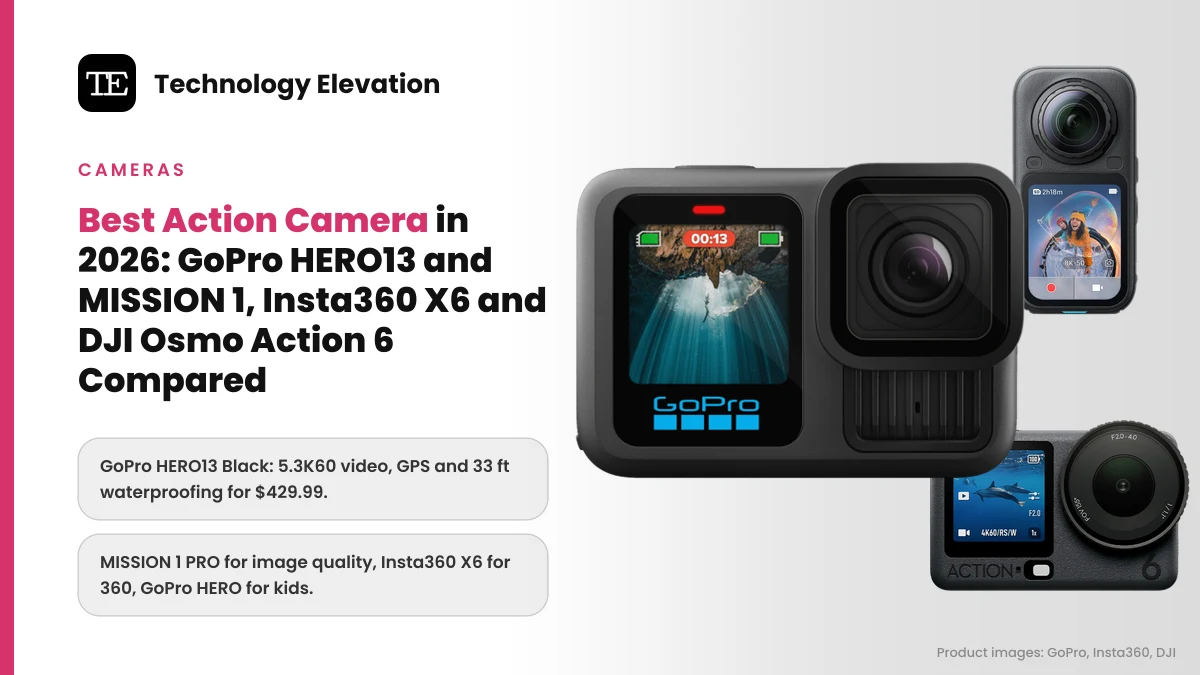
Ride a chairlift on any busy ski weekend and count the helmets. Plenty of them have a small black box stuck to the front, and the owners will spend the evening scrolling through footage they barely remember shooting. Picking the best action camera in 2026 is about making sure that footage is worth the scroll: steady, sharp in bad light, and easy to get off the camera.
The market looks very different from two years ago. GoPro’s biggest launch of 2026 was not a new HERO at all. It was a new line of compact cinema cameras.
GoPro priced the MISSION 1 PRO at $699.99 and the MISSION 1 at $599.99, both built around a 50MP 1-inch sensor, and put them on shelves on May 28, 2026. Insta360’s new flagship is the X6, a 360 camera with 1-inch 360 imaging, and DJI’s Osmo Action 6 brings a variable aperture.
We compared the official specs, US list prices and launch details of every current model from GoPro, Insta360 and DJI, then sorted them by the job they do best. That includes the question most buyers get stuck on: a standard camera or a 360 one.
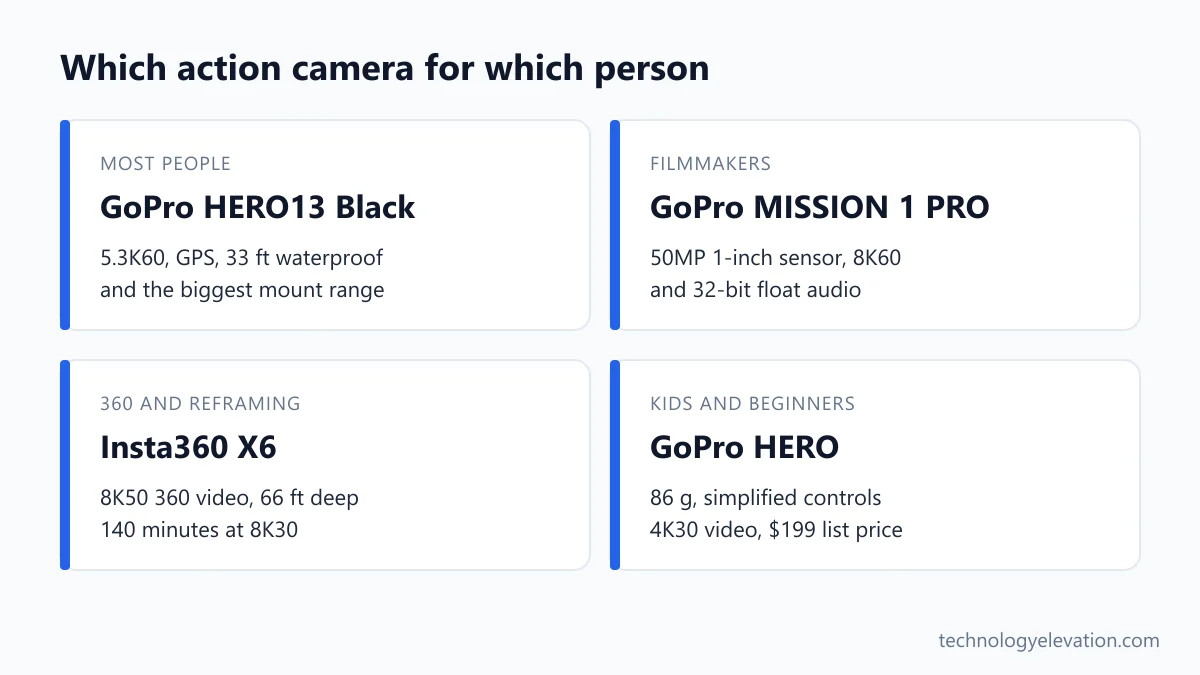
The best action camera for most people is the GoPro HERO13 Black
The GoPro HERO13 Black is the best action camera for most people. It shoots 5.3K60 and 4K120 video, is waterproof to 33 feet without a case, has built-in GPS, and works with GoPro’s huge mount range. GoPro sells it for $429.99 with an Enduro battery included.
Every pick, by the job it does best:
- Best overall: GoPro HERO13 Black
- Best image quality and best for filmmakers: GoPro MISSION 1 PRO
- Best 360 camera: Insta360 X6
- Best 360 camera with GPS: GoPro MAX2
- Best for vlogging: Insta360 Ace Pro 2
- Best for low light and diving: DJI Osmo Action 6
- Best tiny hands-free camera: Insta360 GO Ultra
- Best on a budget and for kids: GoPro HERO
| Model | Type | Top video | Waterproof (no case) | Launch or list price |
|---|---|---|---|---|
| GoPro HERO13 Black | Standard | 5.3K60 | 33 ft (10 m) | $429.99 |
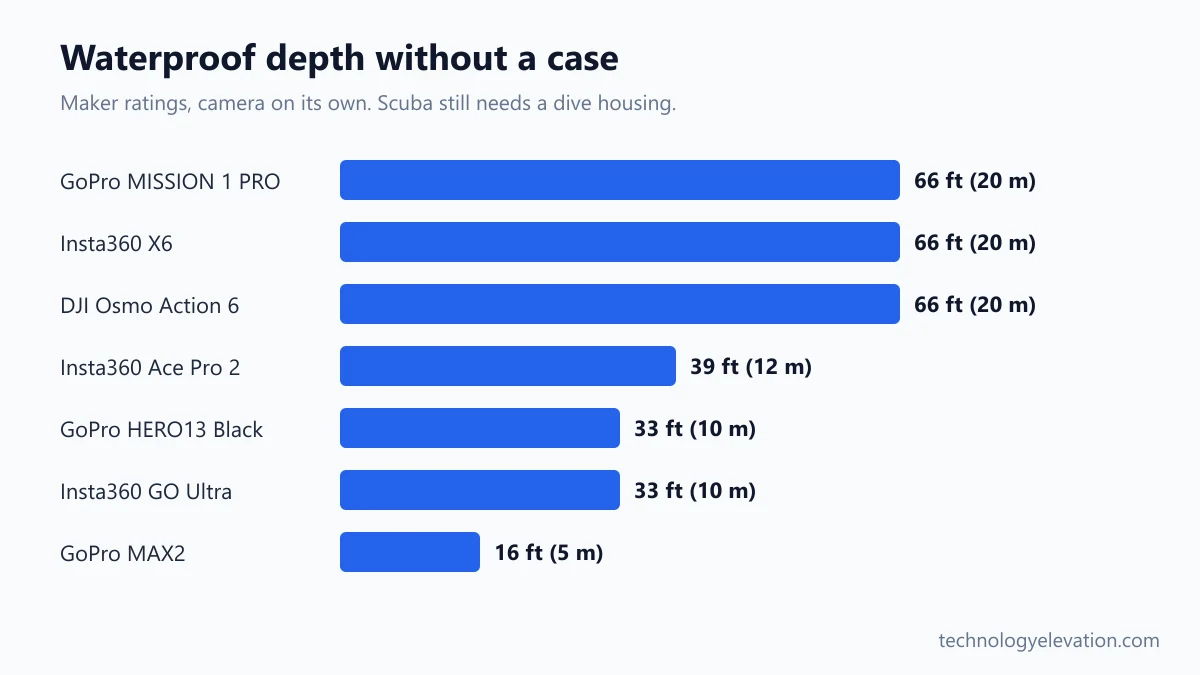
| GoPro MISSION 1 PRO | Standard, 1-inch sensor | 8K60 | 66 ft (20 m) | $699.99 |
| Insta360 X6 | 360 | 8K50 360 | 66 ft (20 m) | $699.99 |
| GoPro MAX2 | 360 | 8K 360 | 16 ft (5 m) | $499.99 |
| Insta360 Ace Pro 2 | Standard, flip screen | 8K30 | 39 ft (12 m) | $419.99 |
| DJI Osmo Action 6 | Standard, variable aperture | 8K30 | 66 ft (20 m) | Retailer pricing |
| Insta360 GO Ultra | Mini, magnetic | 4K60 | 33 ft (10 m) | $449.99 |
| GoPro HERO | Mini, standard | 4K30 | Waterproof | $199 |
Black Friday lands on November 27 this year, and camera bundles with extra batteries and mounts tend to appear around it. Treat the prices above as the ceiling, not what you will pay.
GoPro HERO13 Black: the best action camera overall
The HERO13 Black wins because it does every action camera job well and nothing badly. You get 5.3K60 video, 27MP photos, HyperSmooth 6.0 stabilization, GPS telemetry and a bigger battery, all in the shape that fits almost every mount ever sold.
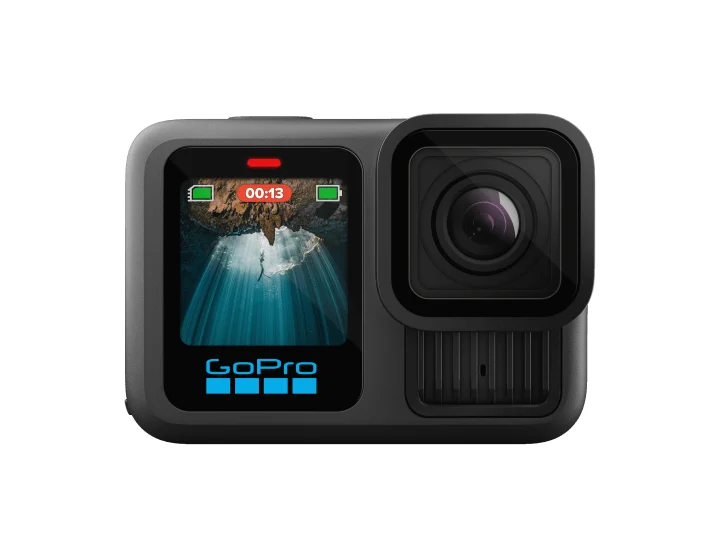
Key specs: 5.3K60, 4K120, 2.7K240 and 1080p240 video, 27MP photos, 10-bit color with HLG HDR, waterproof to 33 ft (10 m), 1900mAh Enduro battery, built-in GPS, HyperSmooth 6.0, magnetic mounting plus built-in mounting fingers. GoPro sells it for $429.99, including the battery.
Mounts are the quiet reason a GoPro still makes sense. Helmet, chest, handlebar, surfboard, dog harness: if a mount exists, someone made it for a HERO first.
The 1900mAh battery is new for this model, and GoPro rates it at up to 2.5 hours of continuous recording at 1080p30 and over 1.5 hours at 4K30 and 5.3K30. The new battery uses a connector made for the HERO13 Black, so it will not work in an older GoPro you keep as a backup.
HB-Series lenses are the other upgrade. The Ultra Wide, Macro and Anamorphic lens mods snap on, and the camera detects which one is fitted and switches settings for you. Most people will never buy one. Mountain bikers who want a taller, wider view often do.
The honest catch is low light. Dusk, forest trails and indoor skate parks are where small sensors fall apart, and GoPro itself pitches the 1-inch MISSION 1 series as its low-light option.
Buy the GoPro HERO13 Black now on Amazon
GoPro MISSION 1 PRO: the best action camera for image quality
The MISSION 1 PRO is the best action camera for image quality and the one to buy if you edit seriously. Its 50MP 1-inch sensor, 8K60 video and 32-bit float audio put it closer to a cinema camera than a HERO, at $699.99.
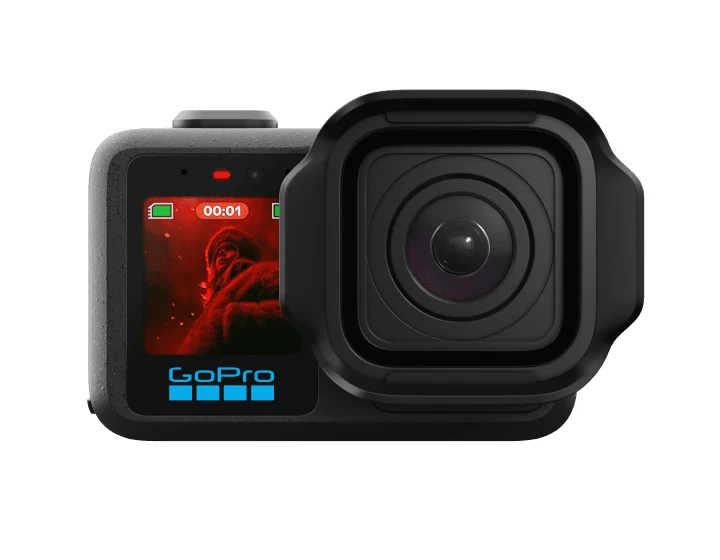
Key specs: 50MP 1-inch sensor, GP3 processor, 8K60 and 4K240 16:9 video, 8K30 Open Gate (4:3), 1080p up to 480 fps with a 960 fps burst mode, f/2.8 lens, 2.59-inch rear OLED touchscreen and 1.4-inch front screen, waterproof to 66 ft (20 m), 2150mAh Enduro 2 battery, 207 g. Launch price $699.99, on sale since May 28, 2026.
Open Gate is the feature that matters for creators. The camera records the full 4:3 sensor area, so one clip can be cropped into a wide YouTube shot and a vertical phone video without losing much detail.
Battery and heat were always the weak spots of small cameras. GoPro says the MISSION 1 series records up to 5 hours at 1080p30 in Endurance mode, over 3 hours at 4K30 and up to 1.5 hours at 8K30, with an operating range of -4°F to 113°F.
The cheaper MISSION 1 ($599.99) uses the same sensor and 50MP photos but tops out at 8K30, 4K120 and 1080p240, with 4K120 Open Gate. Most people will not miss the difference. A third model, the MISSION 1 PRO ILS, takes Micro Four Thirds lenses but is only weatherproof, so it needs a housing for water.
The catch is size and price. At 207 g it is heavier than a HERO13 Black on a helmet, and it is overkill if your clips go straight to a group chat.
Buy the GoPro MISSION 1 PRO now on Amazon
Insta360 X6: the best 360 camera for reframing later
The Insta360 X6 is the best 360 camera you can buy. Two square Sony sensors deliver what Insta360 calls 1-inch 360 imaging, it records 8K50 360 video, it is waterproof to 66 feet, and its new 2600mAh battery runs 140 minutes at 8K30.
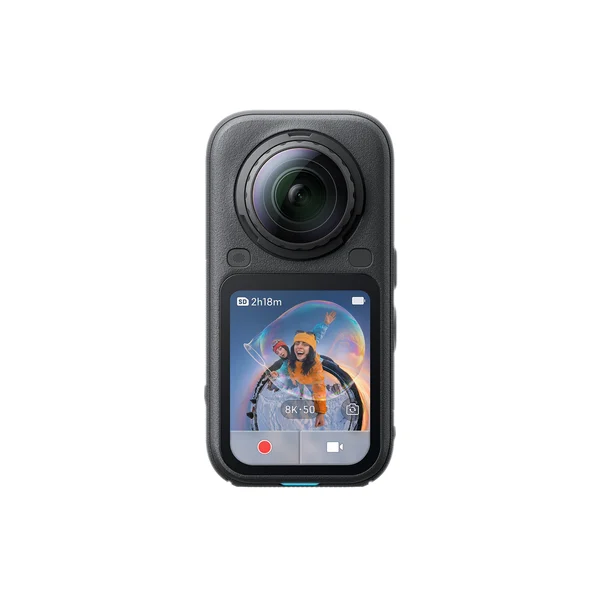
Key specs: 8K50 360 video, 5K60 and 4K120 flat single-lens video (170° view at 5K30), 120MP 360 photos, 10-bit color and I-Log, 2.32-inch OLED screen at up to 1200 nits, replaceable lenses, IP68 and waterproof to 66 ft (20 m), 2600mAh battery, 196 g, rated down to -4°F. US list price $699.99.
A 360 camera changes how you shoot. You stop aiming. You hit record, hold the camera up on a selfie stick, and pick the angle later on your phone. The stick disappears from the final video because it sits in the blind spot between the two lenses.
The X6 adds things that annoyed X5 owners. The screen is now a bright OLED, the battery runs 51% longer than the X5’s, and a 0 to 80% charge takes 24 minutes on a 30W charger.
The Insta360 X5 is still sold as the cheaper option, at a $549.99 list price. It records 8K30 360 video, is waterproof to 49 ft (15 m) and weighs 200 g. If you shoot mostly in daylight, it is the value pick.
The catch with any 360 camera is editing time. Every clip needs reframing before you can share it. Insta360’s AI tools do a decent first pass, but expect to spend evenings in the app.
Buy the Insta360 X6 now on Amazon
GoPro MAX2: the best 360 camera for GoPro owners
The GoPro MAX2 is the best 360 camera for anyone already invested in GoPro gear. It records true 8K 360 video, has six microphones, tool-free replaceable glass lenses and built-in GPS, which GoPro says no other 360 camera has. It launched at $499.99.
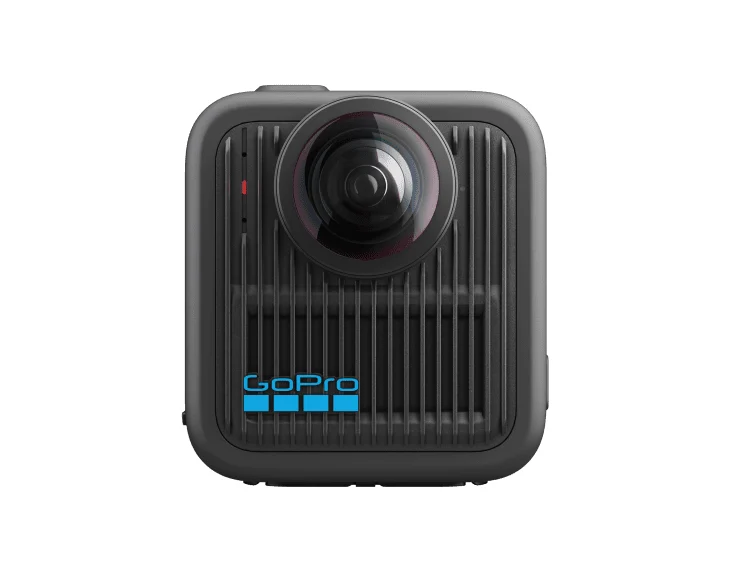
Key specs: True 8K 360 video with 10-bit color and GP-Log, 5.6K60 and 4K100 360 slow motion, 4K60 single-lens mode, 29MP 360 photos, six microphones, twist-off replaceable glass lenses, 1960mAh cold-weather Enduro battery, built-in GPS, waterproof to 16 ft (5 m). Launched September 2025 at $499.99.
GPS is the reason to pick MAX2 over the X6. Cyclists and skiers can overlay speed and altitude on their clips in GoPro’s Quik app, and the camera works with GoPro’s subscription for cloud backup.
The twist-off lenses matter more than they sound. A scratched lens on a 360 camera ruins the stitch line where the two images join, and on MAX2 you can swap a lens by hand on the side of a trail.
The catch is water. At 16 feet, MAX2 is fine for snorkeling and splashes, not diving. The X6 goes four times deeper without a case.
Buy the GoPro MAX2 now on Amazon
Insta360 Ace Pro 2: the best action camera for vlogging
The Insta360 Ace Pro 2 is the best action camera for vlogging. Its 2.4-inch screen flips up to face you, its 1/1.3-inch 8K sensor handles low light well, and a 180-minute battery covers a full day of travel clips. It lists at $419.99.
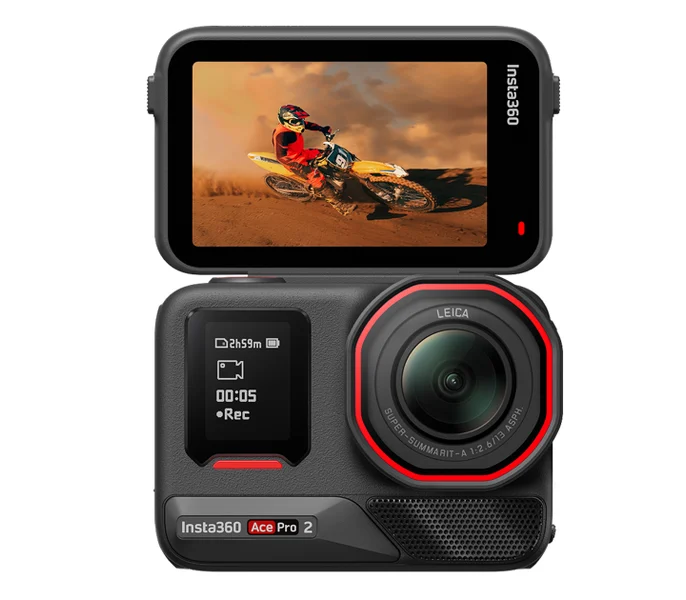
Key specs: 1/1.3-inch 8K sensor, Leica lens, 8K30 video, 157° field of view, 2.4-inch flip touchscreen at 850 nits, waterproof to 39 ft (12 m), 1800mAh battery rated at 180 minutes, 0 to 80% in 18 minutes, 182 g, microSD up to 1TB. US list price $419.99.
A flip screen is the feature that separates a vlogging camera from a POV camera. Talking to the lens while you walk, you can see that you are in frame without guessing.
Audio is better than most action cameras too. A wind guard comes in the box, and the camera connects to Bluetooth headsets and earbuds for voice capture. Insta360 notes that from July 2026 it moved the Ace Pro 2 from three microphones to two, and says the change does not affect normal use.
The catch is storage. The Ace Pro 2 has none built in, so it records only to a microSD card, and 8K clips fill one quickly.
Buy the Insta360 Ace Pro 2 now on Amazon
DJI Osmo Action 6: the best action camera for low light and diving
The DJI Osmo Action 6 is the best action camera for dim light and diving. DJI’s first action camera with a variable f/2.0 to f/4.0 aperture pairs a new 1/1.1-inch square sensor with 20 m waterproofing and a 4-hour battery.
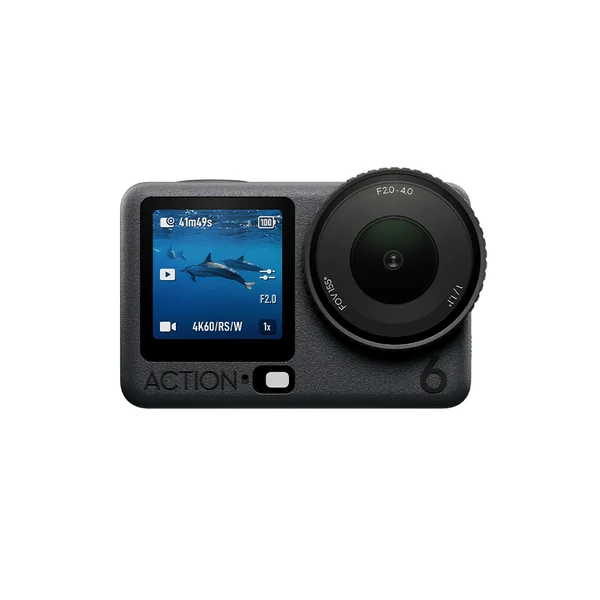
Key specs: 1/1.1-inch square sensor, f/2.0 to f/4.0 variable aperture, 8K30 and 4K120 video, waterproof to 66 ft (20 m), 1950mAh battery rated at 240 minutes (1080p24, lab test), 64GB built-in storage (50GB usable) plus microSD up to 1TB, 1.46-inch front and 2.5-inch rear screens, 149 g.
The variable aperture is the headline. Wide open at f/2.0, the lens lets in more light for dawn surf sessions and night streets. Stopped down to f/4.0, you get sharper detail in bright snow.
The square sensor helps vertical video. You can shoot a frame that crops cleanly into both a wide and a tall version, a little like GoPro’s Open Gate.
Built-in storage is a small luxury. Forget the microSD card at home and you still have 50GB to shoot on.
The catch is frame rate at the top end. 8K stops at 30 fps in 16:9, while the MISSION 1 PRO reaches 8K60. Whoever you buy from, check that the seller offers a US warranty.
Buy the DJI Osmo Action 6 now on Amazon
Insta360 GO Ultra: the best tiny hands-free camera
The Insta360 GO Ultra is the best tiny action camera for hands-free POV clips. The 53 g camera clips magnetically to your clothes or a cap, shoots 4K60 video on a 1/1.28-inch sensor, and runs up to 200 minutes with its Action Pod.
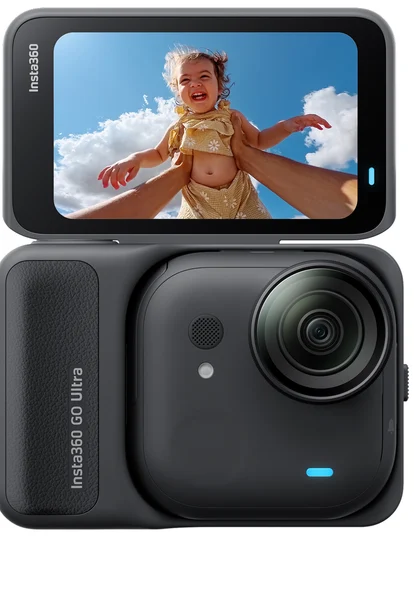
Key specs: 1/1.28-inch sensor, 4K60 video, 50MP photos, 156° field of view, 53 g camera (108.5 g with the Action Pod), waterproof to 33 ft (10 m) without the pod, 70 minutes of runtime alone or 200 minutes with the Action Pod, 0 to 80% in 12 minutes, Apple Find My support, microSD storage. US list price $449.99.
The GO Ultra solves a problem bigger cameras cannot. Nobody wants a 200 g block on their chest while cooking, playing with a toddler or walking the dog. A thumb-sized camera on a magnetic pendant just disappears.
The Action Pod is the battery booster. Clip the camera in and total runtime goes from 70 to 200 minutes.
Apple Find My support is a nice touch for a camera this small. Drop it on a ski run and you can track it from an iPhone.
The catch is runtime and depth. Seventy minutes alone is short, and the 33-foot rating applies to the camera on its own, not to the Action Pod.
Buy the Insta360 GO Ultra now on Amazon
GoPro HERO: the best cheap action camera for kids and beginners
The GoPro HERO is the best cheap action camera and a safe first camera for kids. At 86 g it is GoPro’s lightest, shoots 4K30 video and 12MP photos, works with GoPro mounts and launched at a $199 list price.
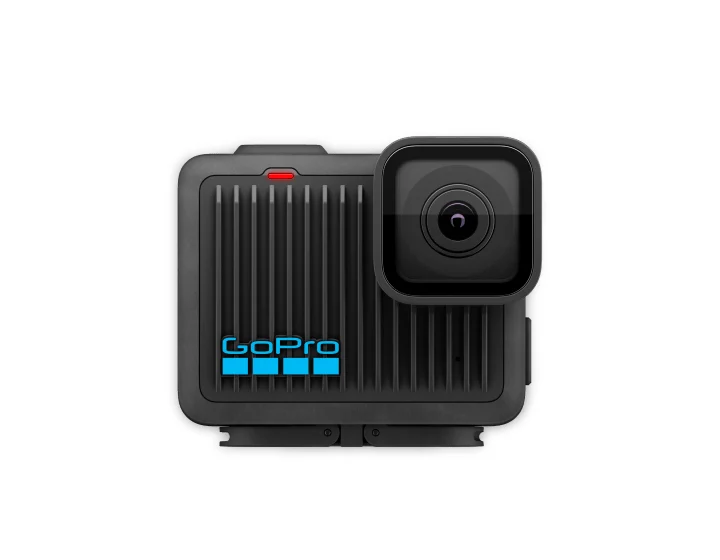
Key specs: 4K30 and 1080p30 video, 2.7K60 and 1080p60 slow motion, 12MP photos, 86 g, built-in battery, waterproof, compatible with 35 GoPro mounts and accessories. GoPro’s list price is $199.
Simple controls are the point. GoPro stripped the menus back compared with the HERO13 Black. For a ten-year-old on a bike, that is a feature.
GoPro says the HERO is 46% lighter and 35% smaller by volume than the HERO13 Black. On a kid’s helmet, that weight difference is easy to feel.
The catch is the built-in battery. You cannot swap in a spare, so a long day at the beach needs a power bank.
Buy the GoPro HERO now on Amazon
360 vs standard action cameras comes down to how you edit
Choose a standard action camera if you want to shoot, trim and share fast. Choose a 360 camera if you enjoy editing and want to reframe shots later. Standard cameras also mount more easily, go deeper underwater and produce smaller files.
A standard camera points one way. What it sees is what you get, which is perfect for helmet POV, dive footage and dashboard clips.
A 360 camera records everything around it. You choose the view later, add tracking that follows a friend, or make the selfie stick vanish for a drone-like shot. The price is time. Every clip has to be reframed before it is shareable.
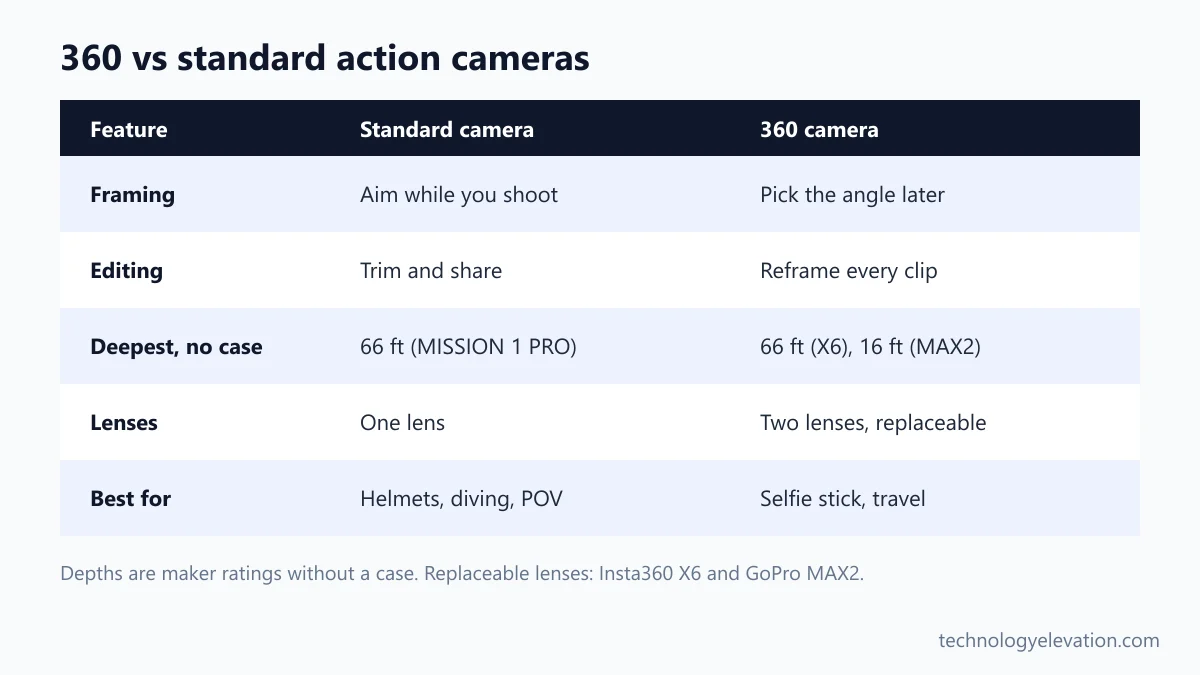
Lenses are the other difference. 360 cameras have two bulging lenses that are easy to scratch, which is why both the X6 and MAX2 now use replaceable lenses. A standard action camera has one flatter lens, often with a replaceable cover.
A good rule: if you have never edited a video on your phone, start with a standard camera. Plenty of people buy a 360 camera and never touch the reframing.
Sensor size, waterproofing and battery decide the right action camera
Pick an action camera by matching four things to how you shoot: sensor size for low light, waterproof depth for water sports, battery life for long days and mounting for where the camera will live. Resolution matters less than most people think.
- Decide where it goes. Helmets and chest mounts suit a HERO13 Black or Osmo Action 6. Clothing and caps suit the GO Ultra. Selfie sticks suit a 360 camera.
- Check the sensor size. Bigger sensors, such as the 1-inch MISSION 1 series and the 1/1.1-inch Osmo Action 6, handle dusk and indoor light far better than smaller ones.
- Match the waterproof depth to the sport. Snorkeling needs 16 feet. Scuba needs a dive housing for most cameras, even those rated to 66 feet.
- Look at real battery life. Makers test at room temperature, often at 1080p. Cold weather and 4K cut that number.
- Count the accessories. GoPro’s mount ecosystem is the largest. Insta360 and DJI use their own quick-release systems, plus adapters.
- Budget for a memory card. GoPro requires a microSD card rated V30 or faster, and most cameras need one before they will record.
Resolution is the spec that gets oversold. 8K looks great on a spec sheet, but most clips end up on a phone screen. What 8K and Open Gate really buy you is room to crop.
Weekend riders who want to film a commute or a trail can also get away with a bike phone mount for recording and the phone they already own. An action camera earns its place when the ride gets rough, wet or cold.
Accessories make or break an action camera
The right accessories matter more than the camera upgrade. A spare battery, a fast microSD card, a mount for your sport and a small tripod handle most needs. 360 cameras also need a selfie stick, and divers need a housing.
- Spare battery: two is better than one in the cold. The HERO13 Black needs its own 1900mAh Enduro battery, and MISSION 1 cameras use the Enduro 2.
- microSD card: buy a V30 card or faster from a known brand. A slow card can stop high-resolution recording partway through a clip.
- Selfie stick: essential for any 360 camera and the trick behind the invisible-stick shot.
- Tripod: a compact travel tripod turns any action camera into a time-lapse rig.
- Dive housing: needed for scuba depth on most models, and for the MISSION 1 PRO ILS in any water.
Action cameras also make popular presents, and they sit near the top of most lists of tech gifts for 2026. Add a memory card to the box, because a new camera that cannot record on Christmas morning is a rough start.
Other cameras worth considering instead of an action camera
An action camera is the wrong tool for some jobs. For family trips and city breaks, a compact travel camera often takes better photos. For aerial shots, a drone works better. For sit-down YouTube videos, a vlogging camera with a bigger sensor wins.
Travelers who mostly shoot photos should look at the best travel cameras, which offer optical zoom that no action camera has. Small pocket options also appear among the mini travel cameras.
Want the classic overhead shot of a beach or a mountain trail? A 360 camera on a long stick can fake it, but one of the beginner drones does it properly. And if you talk to the camera at a desk more than you ride, a YouTube camera with a larger sensor and proper autofocus will serve you better.
Frequently asked questions about action cameras
What is the best action camera in 2026?
The GoPro HERO13 Black is the best action camera for most people in 2026. It shoots 5.3K60 video, is waterproof to 33 feet, has GPS and works with the widest range of mounts. The MISSION 1 PRO is better for image quality.
Is a 360 camera better than a regular action camera?
A 360 camera is better only if you enjoy editing. It lets you choose the angle after shooting and hide the selfie stick. A regular action camera is faster to use, easier to mount and usually goes deeper underwater.
Which action camera is best in low light?
The GoPro MISSION 1 PRO and MISSION 1 are the best in low light, thanks to their 1-inch sensor. The DJI Osmo Action 6 is close behind, with a 1/1.1-inch sensor and an f/2.0 to f/4.0 variable aperture.
Do action cameras need a memory card?
Most do. GoPro cameras need a microSD card rated V30 or faster before they will record. The DJI Osmo Action 6 has 50GB of usable built-in storage, so it can record without a card.
Can I take an action camera scuba diving?
Yes, but most need a dive housing for scuba depths. The MISSION 1 PRO, Insta360 X6 and DJI Osmo Action 6 are waterproof to 66 feet without a case, which covers snorkeling and shallow dives. Deeper dives need the maker’s housing.
What is the best action camera for kids?
The GoPro HERO is the best action camera for kids. It weighs 86 g, has simplified controls, shoots 4K30 video and fits standard GoPro mounts. Its list price is $199, and it often sells for less.
What is the difference between the GoPro MISSION 1 and MISSION 1 PRO?
The MISSION 1 PRO adds higher frame rates and 8K Open Gate. It records 8K60, 4K240 and 8K30 Open Gate, while the MISSION 1 tops out at 8K30, 4K120 and 4K120 Open Gate. Both use the same 50MP 1-inch sensor.
Last checked and sources
Last checked on 19 November 2026 by Abdullah Kabeer. We compared the published specs, launch announcements and US list prices of current action and 360 cameras from GoPro, Insta360 and DJI using the manufacturers’ own pages and press releases, and checked the CPSC recall database for each brand.
- GoPro, MISSION 1 Series pricing announcement (April 20, 2026) and MISSION 1 Series tech specs (gopro.com)
- GoPro, HERO13 Black product page and Forest Green edition announcement with US pricing (June 24, 2025)
- GoPro, MAX2 and LIT HERO launch announcement (September 23, 2025)
- GoPro, HERO camera announcement with $199 MSRP (January 30, 2025)
- Insta360, X6, X5, Ace Pro 2 and GO Ultra product and spec pages, and the Insta360 US store for list prices
- DJI, Osmo Action 6 product and spec pages (dji.com)
- US Consumer Product Safety Commission recall database (no recalls listed for these brands)
We update this buying guide when GoPro, Insta360 or DJI launch, discontinue or significantly change a model.
Technology Elevation is reader-supported. As an Amazon Associate, we earn from qualifying purchases. When you buy through links on this page, we may earn a small commission at no extra cost to you.

GIPHY App Key not set. Please check settings