

 Abdullah Kabeer
Ask ten interior designers what software they open every morning and you will hear SketchUp, AutoCAD, Revit, Enscape, D5 Render and Photoshop, often all in the same week. The best laptop for interior design is the one that runs your particular mix without stalling halfway through a client walkthrough.
Software decides the hardware, so we started there. We read the official system requirements from Trimble, Autodesk, Chaos, Chief Architect, D5 and Epic Games, then matched laptops on sale in the US in November 2026 to those numbers.
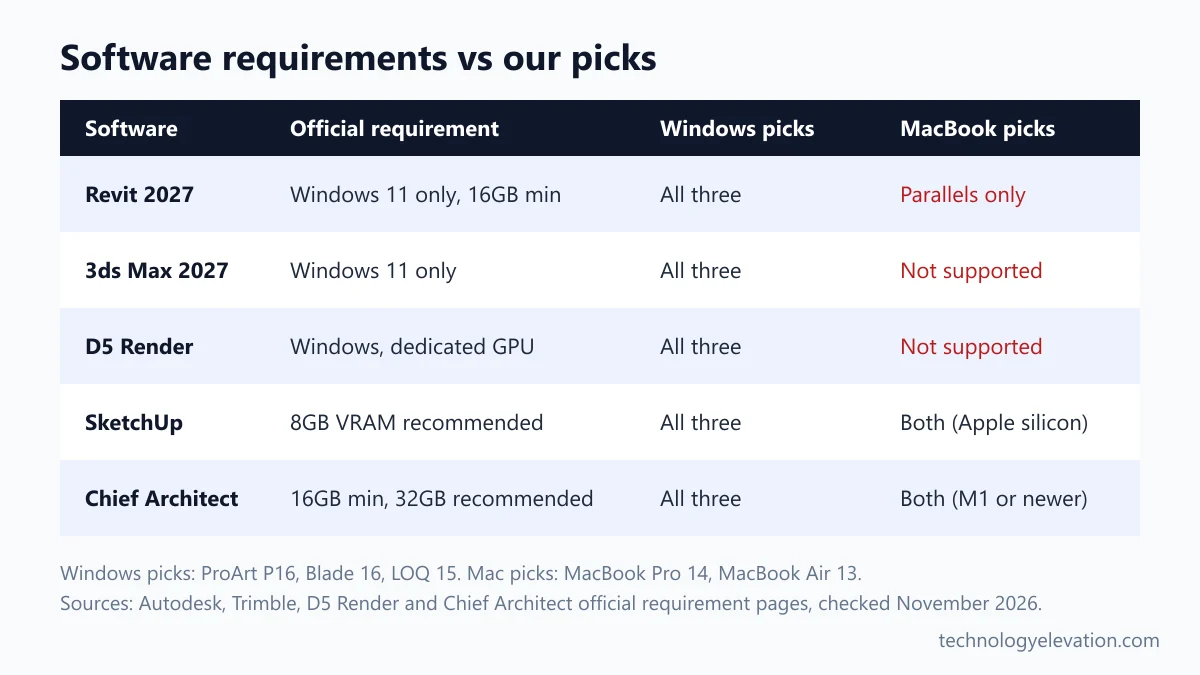
One fact settles the Mac question before anything else. Autodesk’s Revit 2027 system requirements list 64-bit Windows 11 as the only operating system, and 3ds Max 2027 is the same. If your course or studio runs on Revit or 3ds Max, you need a Windows laptop.
If you live in SketchUp, Chief Architect and Photoshop, a MacBook is a perfectly good choice.
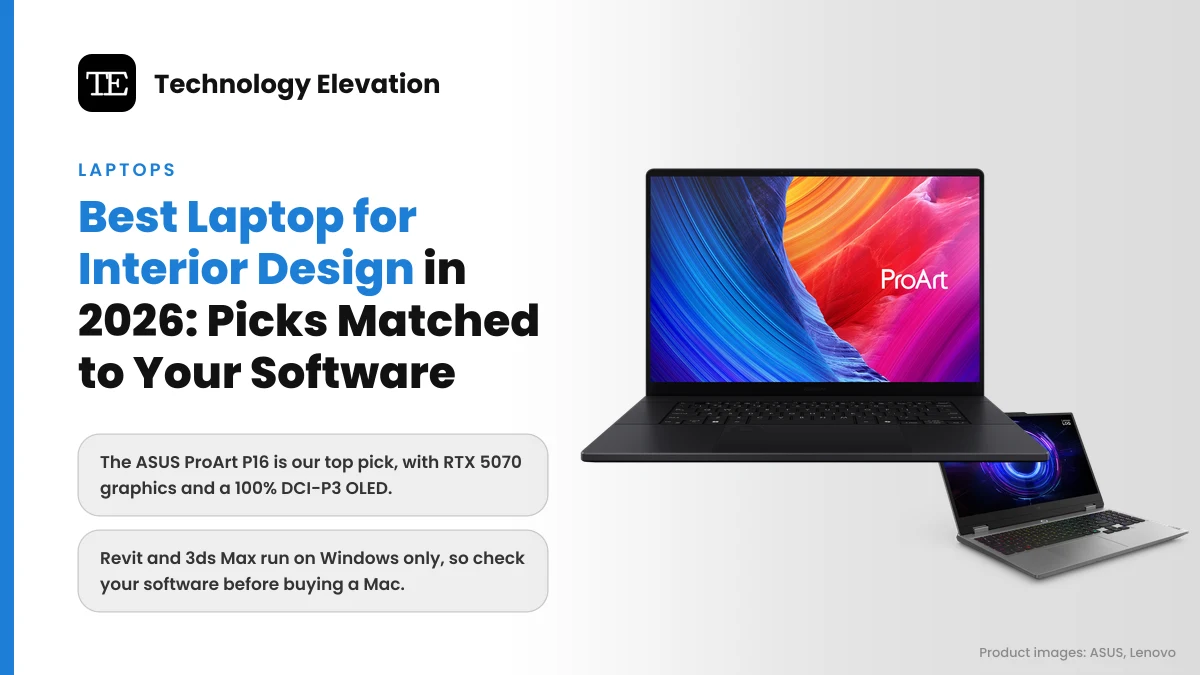
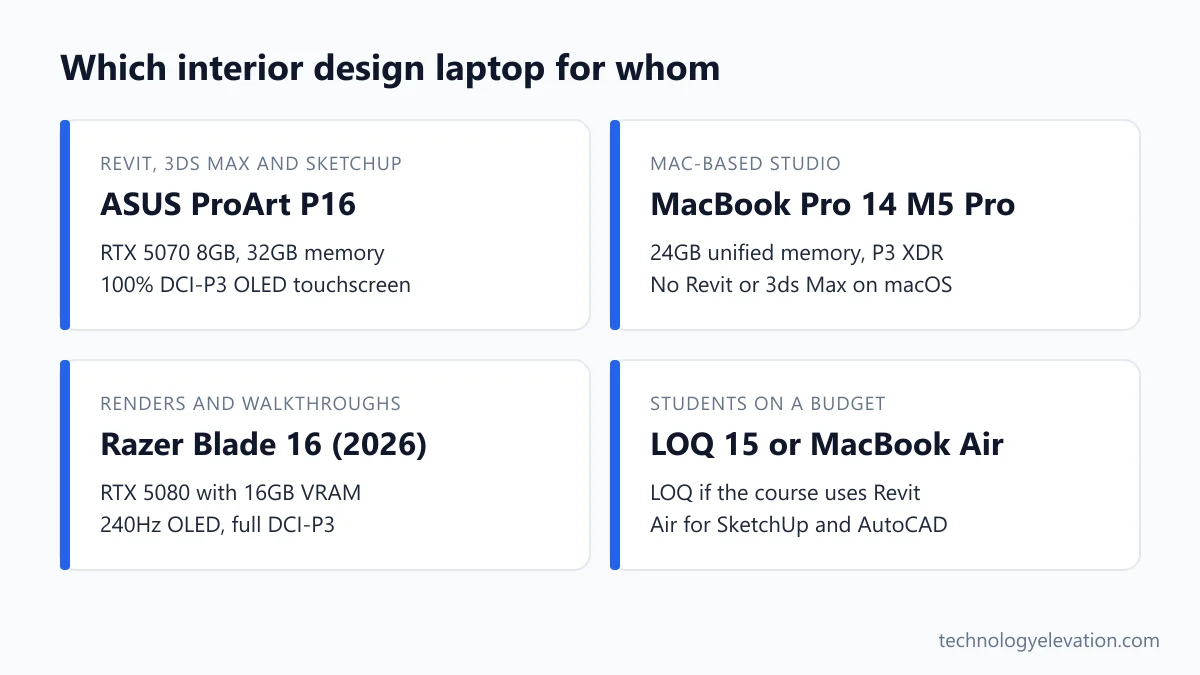
The best laptop for interior design is the ASUS ProArt P16
The ASUS ProArt P16 is the best laptop for interior design for most people. Its RTX 5070 graphics card meets the recommended specs for SketchUp, Enscape and Revit, its OLED screen covers 100% of DCI-P3, and it runs every Windows-only design app. It launched at $2,499.99.
Every pick, by the job it does best:
- Best overall: ASUS ProArt P16 (RTX 5070)
- Best MacBook for interior design: Apple MacBook Pro 14-inch (M5 Pro)
- Best for heavy rendering: Razer Blade 16 (2026, RTX 5080)
- Best budget Windows laptop for students: Lenovo LOQ 15 Gen 10 (RTX 5060)
- Best Mac for interior design students: Apple MacBook Air 13-inch (M5)
| Model | Chip / graphics | Memory / storage | Screen | Runs Revit and 3ds Max | Launch price |
|---|---|---|---|---|---|
| ASUS ProArt P16 (H7606WP) | Ryzen AI 9 HX 370, RTX 5070 8GB | 32GB / 2TB | 16 in OLED touch, 100% DCI-P3 | Yes | $2,499.99 |
| MacBook Pro 14 (M5 Pro) | 15-core CPU, 16-core GPU | 24GB / 1TB | 14.2 in XDR, P3 | No | $2,199 |
| Razer Blade 16 (2026) | Core Ultra 9 386H, RTX 5080 16GB | 32GB | 16 in QHD+ OLED, 240Hz | Yes | $3,499.99 |
| Lenovo LOQ 15 Gen 10 | Core i7-13650HX, RTX 5060 8GB | 16GB / 512GB | 15.6 in 1080p IPS, 144Hz | Yes | Varies by retailer |
| MacBook Air 13 (M5) | 10-core CPU, 8-core GPU | 16GB / 512GB | 13.6 in Liquid Retina, P3 | No | $1,099 |
Laptop prices moved a lot in 2026. Apple raised several Mac prices on June 25, 2026, blaming rising memory and storage chip costs, and the 13-inch MacBook Air went from $1,099 to $1,299. Treat every launch price above as a reference point, not a promise.
ASUS ProArt P16: the best laptop for interior design overall
The ASUS ProArt P16 is the best all-round interior design laptop because it clears the recommended bar for every common design app. It pairs an RTX 5070 with 32GB of memory and a colour-accurate OLED touchscreen that also takes a stylus for sketching.
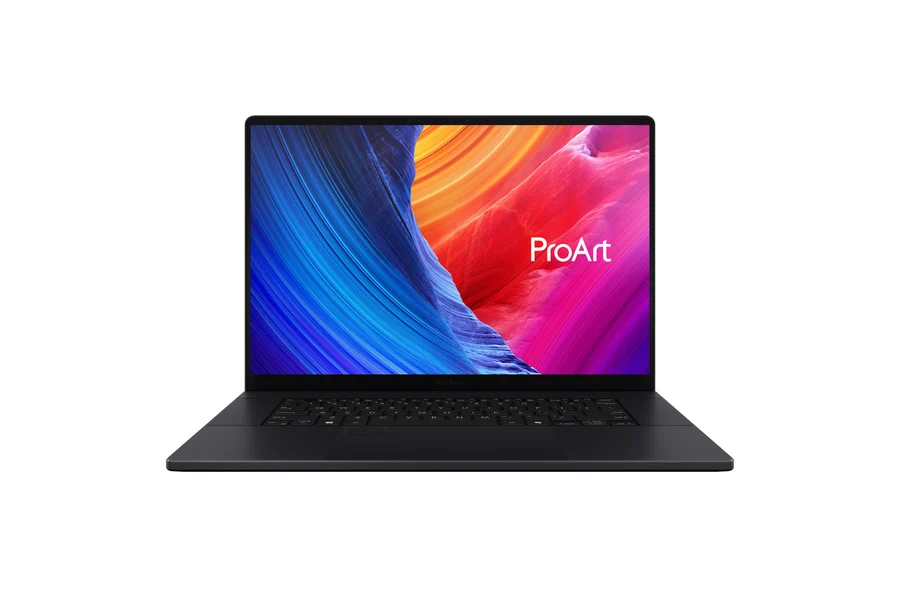
Key specs: AMD Ryzen AI 9 HX 370 (12 cores), NVIDIA GeForce RTX 5070 Laptop GPU with 8GB GDDR7, 32GB of memory, 2TB SSD, 16-inch OLED touchscreen with 100% DCI-P3 coverage and Pantone Validated colour, stylus support, 4.08 lb. ASUS announced the RTX 50 series version in June 2025 at $2,499.99.
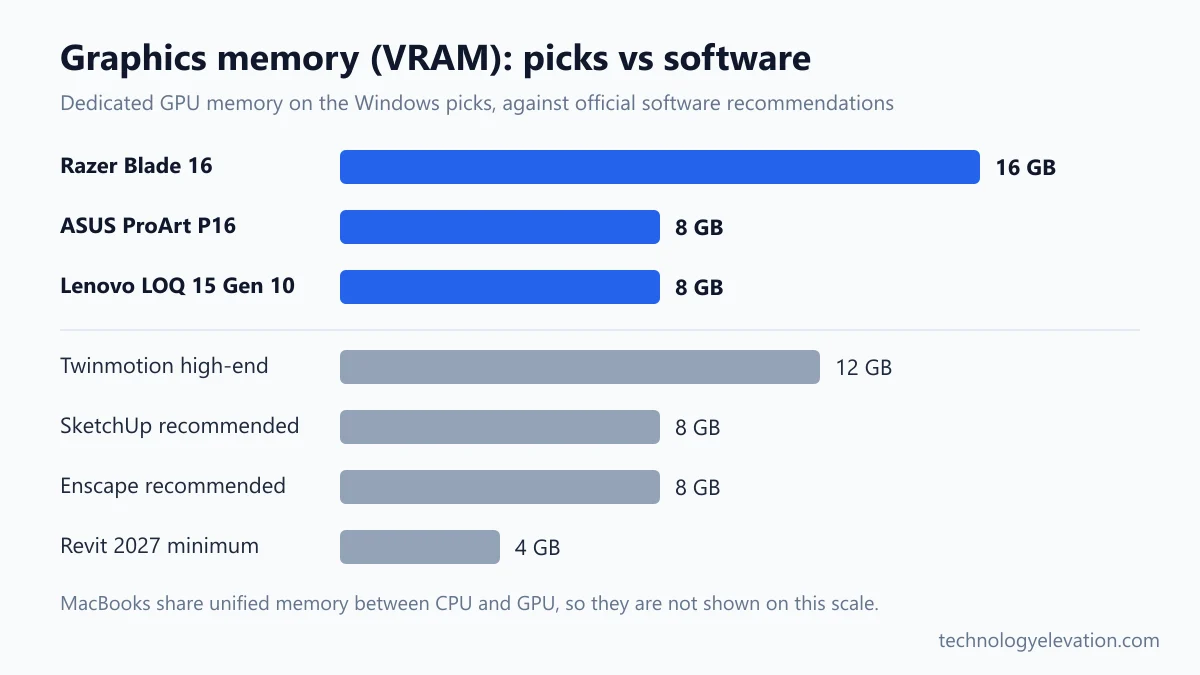
The 8GB of graphics memory is the number that matters here. Trimble recommends 8GB of VRAM for SketchUp’s newer graphics features, Enscape recommends 8GB, and Revit’s “value” tier asks for 6GB. The ProArt P16 meets all three without paying for a top-end gaming chip.
The screen is the other reason to buy it. A 100% DCI-P3 OLED shows the deep greens and warm wood tones in a render the way they were meant to look, and Pantone Validated means the panel passed Pantone’s own check for reproducing its reference colours.
The pen-friendly touchscreen helps too. Marking up a floor plan with a client beside you beats pointing with a mouse.
The catch? At 4.08 lb it is no featherweight, and 8GB of VRAM is the ceiling for big Twinmotion or D5 scenes. A 2026 version with the newer Ryzen AI 9 465 chip also appears at US retailers, so check the GPU line in the listing says RTX 5070.
Check the ASUS ProArt P16 price on Amazon
MacBook Pro 14-inch (M5 Pro): the best MacBook for interior design
The 14-inch MacBook Pro with M5 Pro is the best MacBook for interior design, as long as your work lives in SketchUp, Chief Architect, AutoCAD for Mac, Photoshop or Twinmotion. It starts with 24GB of memory and 1TB of storage, but it cannot run Revit or 3ds Max natively.
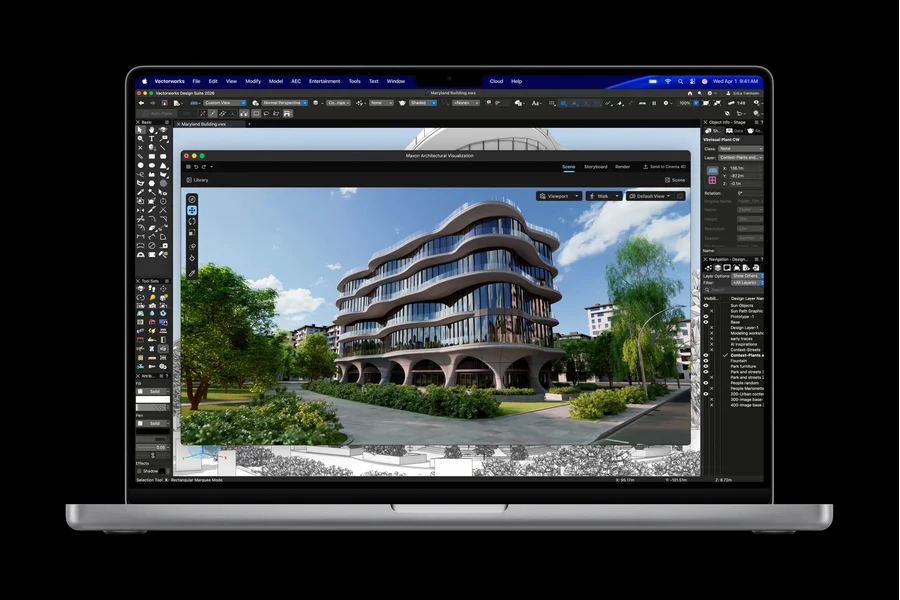
Key specs: Apple M5 Pro with a 15-core CPU and 16-core GPU, 24GB of unified memory (up to 64GB with the 20-core GPU chip), 1TB SSD, 14.2-inch 3024 x 1964 Liquid Retina XDR display with P3 wide colour and up to 1000 nits for normal content, up to 22 hours of video playback, 3.5 lb. Launch price: $2,199, or $2,049 with education pricing.
Apple’s laptops have a different kind of memory. Unified memory is shared between the processor and graphics, so the 24GB here works as both system RAM and graphics memory.
The limits are real, though. Twinmotion’s path tracer does not work on macOS, and Enscape runs on the Mac only on Apple silicon with macOS 14.8.1 or later. D5 Render is Windows only. Revit can run in Windows on a Mac through Parallels Desktop, but Autodesk says Revit’s Accelerated Graphics mode is not supported that way, and it asks for 32GB on the Mac host.
On a tighter Mac budget, the 14-inch MacBook Pro with the plain M6 chip launched on October 27, 2026, at $1,999 with 16GB and 1TB. We would still pay the extra for the M5 Pro’s 24GB.
Check the MacBook Pro 14-inch (M5 Pro) price on Amazon
Razer Blade 16 (2026): the best laptop for heavy rendering
The Razer Blade 16 (2026) is the best laptop for rendering and real-time walkthroughs. Its RTX 5080 carries 16GB of graphics memory, double the other Windows picks, which is what large Twinmotion, D5 Render and V-Ray scenes eat first. It launched at $3,499.99.
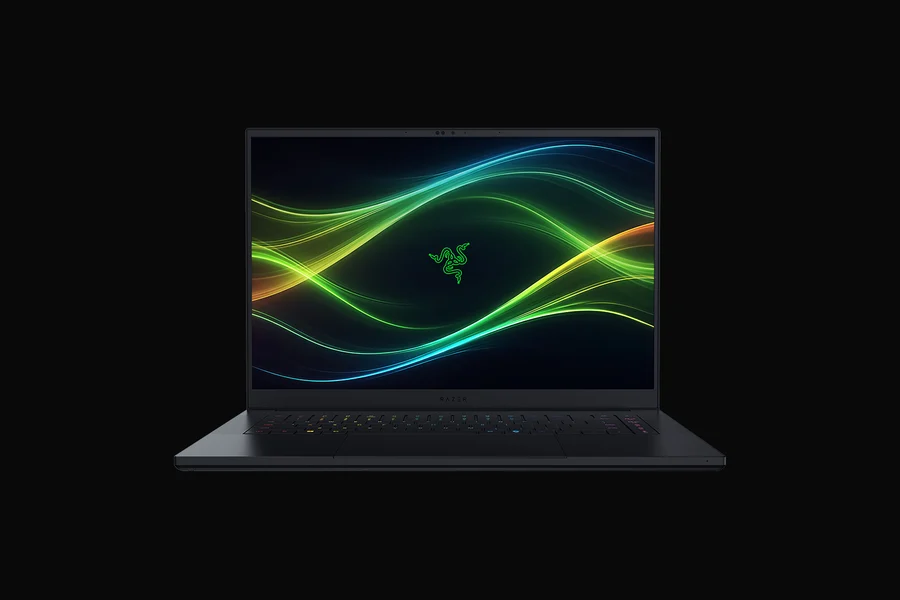
Key specs: Intel Core Ultra 9 386H (16 cores), NVIDIA GeForce RTX 5080 Laptop GPU with 16GB, 32GB of LPDDR5X-9600 memory, 16-inch QHD+ OLED at 240Hz with full DCI-P3 coverage and VESA DisplayHDR True Black 1000. Razer launched it in March 2026 at $3,499.99 for the RTX 5080 model.
Rendering is where VRAM runs out first. Epic Games lists 12GB of dedicated VRAM for Twinmotion’s high-end tier, and an RTX 5080 clears it with room to spare.
Most designers do not need this much. Buy the Blade if animated walkthroughs and photoreal stills are a big part of what you bill for.
Check the Razer Blade 16 (2026) price on Amazon
Lenovo LOQ 15 Gen 10: the best budget laptop for interior design students
The Lenovo LOQ 15 Gen 10 is the best budget Windows laptop for interior design students. It pairs an RTX 5060 with 8GB of graphics memory and a 14-core Intel chip, so Revit, 3ds Max, SketchUp and D5 Render all run, and it has a spare memory slot.
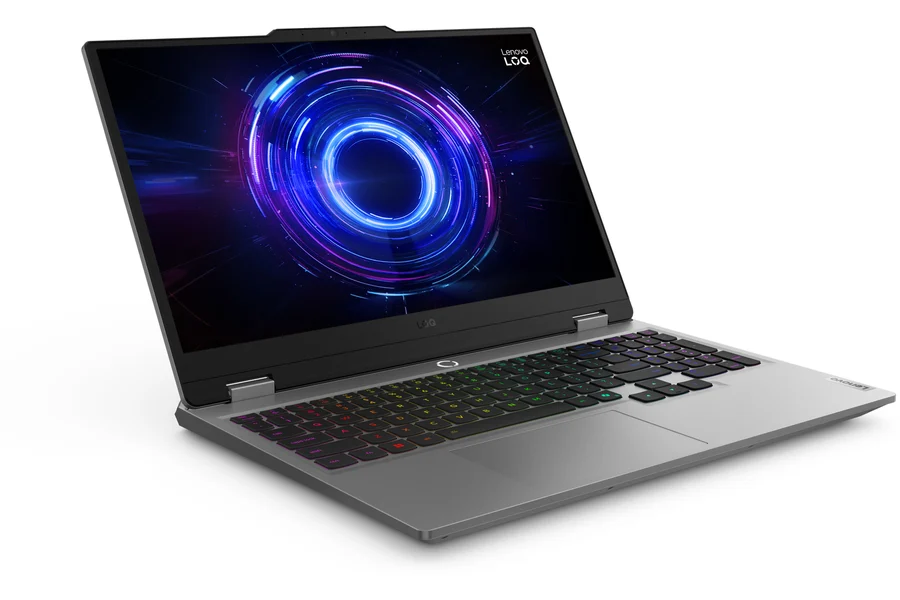
Key specs: Intel Core i7-13650HX (14 cores), NVIDIA GeForce RTX 5060 Laptop GPU with 8GB GDDR7 at 115W, 16GB of DDR5 with a free second slot, 512GB PCIe Gen 4 SSD, 15.6-inch 1920 x 1080 IPS screen at 144Hz. Model code 15IRX10.
Students should start with the syllabus. If your program teaches Revit or 3ds Max, a MacBook Air cannot open either one without workarounds. The LOQ still has a proper NVIDIA graphics card.
The spare slot is the hidden win. Autodesk recommends 32GB for AutoCAD 2027, and Revit’s mid tier asks for 32GB. Adding a second 16GB stick gets you there in a few minutes with a screwdriver, and it switches the memory to faster dual-channel mode.
The honest catch is the screen. A gaming 1080p IPS panel is fine for drafting, but it is not a colour-critical display like the OLEDs above.
Check the Lenovo LOQ 15 Gen 10 price on Amazon
MacBook Air 13-inch (M5): the best Mac for interior design students
The 13-inch MacBook Air with M5 is the best Mac for interior design students whose courses use SketchUp, Chief Architect, AutoCAD for Mac and Photoshop. It is silent, weighs 2.7 lb and has a P3 colour screen. It launched at $1,099, or $999 for students.
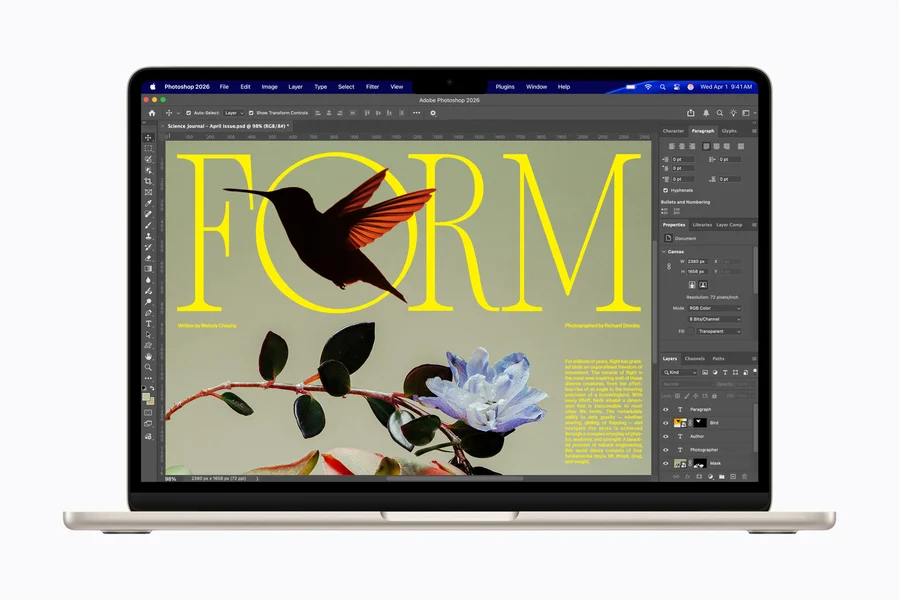
Key specs: Apple M5 with a 10-core CPU and 8-core GPU, 16GB of unified memory (up to 32GB on higher models), 512GB SSD, 13.6-inch 2560 x 1664 Liquid Retina display with P3 wide colour and 500 nits, support for two external displays, 2.7 lb. Launch price $1,099 ($999 education) in March 2026; the list price rose to $1,299 on June 25, 2026.
For a first-year student, 2.7 lb matters more than any benchmark. You will carry it to studio, the library and site visits, and with no fan it makes no noise in a lecture. Chief Architect lists 16GB as its Mac minimum, and this model meets it.
Know where it stops. No Revit, no 3ds Max and no D5 Render. And with 16GB shared between system and graphics, big rendered scenes will feel slow. If your budget stretches, the 24GB model is the better buy for a degree that lasts three or four years.
Check the MacBook Air 13-inch (M5) price on Amazon
Mac or Windows comes down to Revit and 3ds Max
Choose Windows if you use Revit, 3ds Max or D5 Render, because Autodesk lists only Windows 11 for Revit 2027 and 3ds Max 2027, and D5 is Windows only. Choose a Mac only if your full toolset has native Mac versions.
The 3ds Max 2027 system requirements name Microsoft Windows 11 as the only operating system. Revit is the same, apart from the Parallels workaround.
Here is how the rest of the common apps split:
- SketchUp: Windows and Mac. SketchUp 2027 needs Windows 11 on PC and Apple silicon on Mac.
- AutoCAD: Windows and a separate native Mac version.
- Chief Architect: Windows and Mac (Apple M1 or newer). Intel Macs and Snapdragon Windows laptops are not supported.
- Enscape: Windows, and Mac on Apple silicon only.
- Twinmotion: Windows and Mac, but the path tracer and VR mode are Windows only.
- D5 Render: Windows only.
- Photoshop: Windows and Mac.
Six rules for choosing a laptop for interior design
Choose a laptop for interior design by listing your software first, then matching the operating system, memory, graphics memory and screen to the strictest app on that list. Size and price come last, because the wrong chip costs far more than a heavier bag.
- List every app you will use. One Windows-only app, such as Revit or D5 Render, means a Windows laptop.
- Get 32GB of memory for professional work. Memory (RAM) holds your open models. Revit 2027 and AutoCAD 2027 run on 16GB, but Autodesk recommends 32GB, and Chief Architect does too.
- Get at least 8GB of graphics memory. VRAM is the graphics card’s own memory for textures and lighting. Trimble recommends 8GB for SketchUp, and Enscape’s recommended spec is 8GB too.
- Prefer an NVIDIA RTX card for rendering. Real-time renderers lean on ray tracing hardware, and V-Ray’s GPU engine runs in CUDA or RTX mode on NVIDIA cards.
- Look for a DCI-P3 screen. A screen covering close to 100% of DCI-P3 shows the full range of colours modern renders use.
- Get a 1TB SSD if you can. Texture libraries, furniture models and render outputs fill a 512GB drive quickly. A portable SSD is the cheap fix for older project files.
A three-button mouse is on that list too, believe it or not. Both SketchUp and 3ds Max ask for one in their official requirements, because orbiting a model with a trackpad gets old fast. Designers who model all day often swap to one of the mice built for architects, with extra buttons for orbit and pan.
Screen colour accuracy matters more for designers than for most buyers
Screen colour matters for interior designers because clients judge finishes, fabrics and paint from your renders. Look for 100% sRGB as a minimum and close to 100% DCI-P3 for presentation work, then still check physical samples before ordering anything expensive.
The terms sound technical, but the idea is simple. sRGB is the standard range of colours most websites and office screens are built around. DCI-P3 is a wider range, with richer reds and greens, used by film studios and by Apple’s P3 displays.
A screen covering 100% of DCI-P3, like the ProArt P16 and Razer Blade 16, shows that whole range. A cheaper screen shows only part of it, so a sage green sofa might look grey on your laptop and bright on the client’s phone.
At a desk, an external monitor helps more than any laptop screen. A properly calibrated monitor for photo editing gives you a bigger view for finish boards. Mount it on one of the monitor stands at eye level for long CAD sessions.
RAM and graphics memory decide how big your models can get
RAM decides how many models and apps you can keep open, and graphics memory decides how heavy your textures, lights and render scenes can be. For interior design, 16GB of RAM and 8GB of VRAM is the working minimum, and 32GB of RAM is the comfortable target.
Autodesk gives one of the clearest rules. Its Revit 2027 requirements say a 16GB machine usually handles a typical editing session on a single model up to roughly 300MB on disk. Bigger, linked projects belong on the 32GB or 64GB tiers.
Graphics memory follows the same logic. Twinmotion’s Windows minimum is 6GB of dedicated VRAM and its high-end tier is 12GB. Twinmotion also recommends at least 8GB for its path tracer, the mode that produces the most realistic stills.
Students can start at 16GB. Just pick a laptop with a spare memory slot, or buy more memory up front on a MacBook, since Apple’s memory cannot be added later.
Heavy rendering also heats a laptop fast. If your machine throttles during long renders, a laptop cooling pad is a cheap way to keep clock speeds up. And if your degree mixes interior work with building design, our picks for the best laptop for architecture students follow the same Windows-first logic.
Laptops to avoid for interior design work
Avoid any laptop with 8GB of memory, no dedicated graphics card, a Snapdragon chip or an Intel-based Mac. All four look fine in a store and then fail to run Revit, Chief Architect, SketchUp’s new graphics features or the latest software versions.
The MacBook Neo is the one to watch out for in sale ads. Apple’s cheapest laptop launched in March 2026 with an A18 Pro chip and 8GB of memory. Chief Architect’s Mac minimum is 16GB, so a Neo is a writing and browsing machine, not a design one.
Older Intel MacBooks are the second trap. SketchUp 2027 will not install on them, and Chief Architect and Enscape no longer support Intel Macs at all.
Snapdragon Windows laptops are the third. They are thin and efficient, but Chief Architect does not support them.
Frequently asked questions about laptops for interior design
What is the best laptop for interior design?
The ASUS ProArt P16 with an RTX 5070 is the best laptop for interior design for most people. It runs every Windows-only design app, has 8GB of graphics memory and 32GB of RAM, and its OLED screen covers 100% of DCI-P3.
Can a MacBook run Revit and 3ds Max?
No, not natively. Autodesk lists only Windows 11 for Revit 2027 and 3ds Max 2027. Revit can run in Windows through Parallels Desktop on a Mac, but Autodesk says its Accelerated Graphics mode is not supported that way.
Is 16GB of RAM enough for interior design?
Yes for students and smaller projects, but 32GB is better for professional work. Revit 2027 and AutoCAD 2027 list 16GB as the minimum, while Autodesk recommends 32GB for AutoCAD and for larger Revit models.
How much graphics memory do I need for SketchUp and Enscape?
Aim for 8GB of dedicated graphics memory. Trimble recommends 8GB of VRAM for SketchUp’s newer graphics features, and Enscape lists 4GB as its minimum and 8GB as its recommended amount.
What is the best laptop for interior design students?
The Lenovo LOQ 15 Gen 10 with an RTX 5060 is the best budget pick if your course uses Revit or 3ds Max. If your course uses only SketchUp, AutoCAD and Photoshop, the MacBook Air 13-inch with M5 is lighter and quieter.
Do I need an NVIDIA graphics card for rendering?
For most real-time rendering, an NVIDIA RTX card is the safest choice. V-Ray’s GPU engine runs in CUDA or RTX mode on NVIDIA cards, and D5 Render needs a Windows PC with a supported dedicated GPU.
Last checked and sources
Last checked on 15 November 2026 by Abdullah Kabeer. We compared the official system requirements for the main interior design apps against laptops on sale in the US, and checked every spec and launch price against manufacturer pages, launch announcements and independent reviews.
- Autodesk, system requirements for Revit 2027, 3ds Max 2027 and AutoCAD 2027, and Revit 2027 memory recommendations (help.autodesk.com)
- Trimble, SketchUp hardware and software requirements (help.sketchup.com)
- Chief Architect, Premier system requirements (chiefarchitect.com)
- Chaos (Enscape, V-Ray), D5 Render and Epic Games (Twinmotion) requirement pages
- Apple and ASUS tech specs and launch announcements
- Razer Blade 16 coverage by Gizmodo and THX, Lenovo LOQ 15 coverage by Notebookcheck and LaptopMedia, and Bloomberg on Apple’s June 2026 prices
We update this buying guide when software makers change their requirements or when laptops are launched or discontinued.
Technology Elevation is reader-supported. As an Amazon Associate, we earn from qualifying purchases. When you buy through links on this page, we may earn a small commission at no extra cost to you.



GIPHY App Key not set. Please check settings
2 Comments