

 Haris Khan
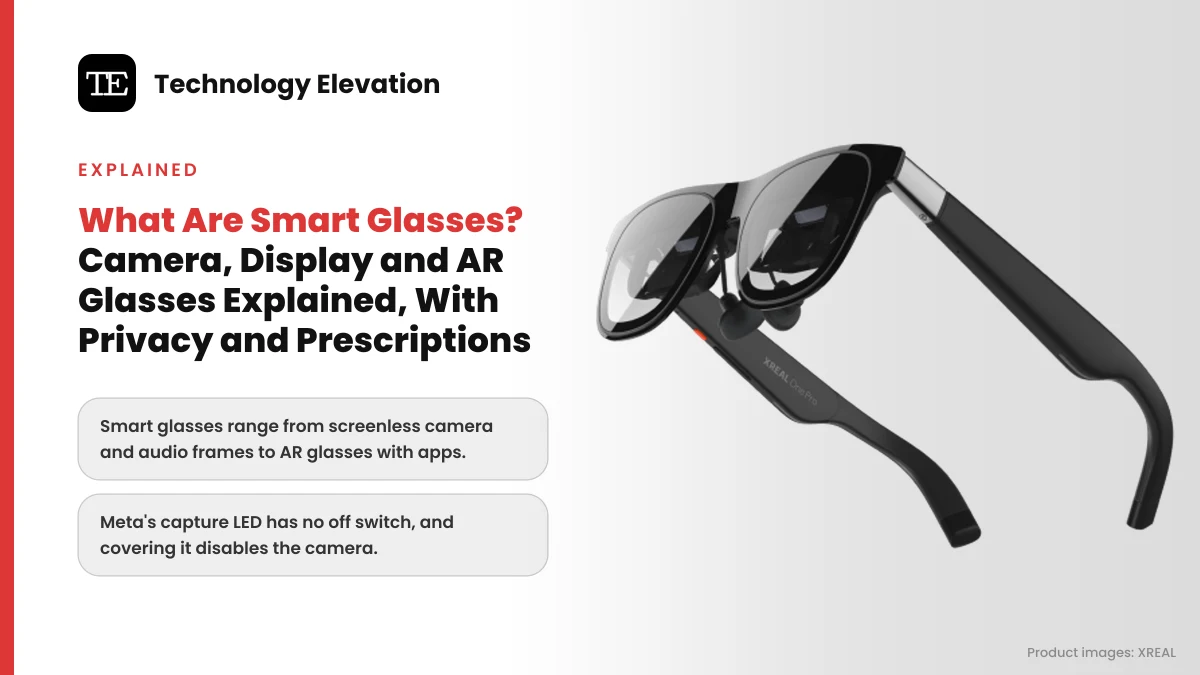
Watch a cyclist stop at a red light, tap the arm of her sunglasses and say “take a photo.” No phone comes out of a pocket. A second later the shot is saved inside the frame, and a song she was playing carries on through speakers sitting just above her ears.
So what are smart glasses? They are glasses with electronics built into the frame: some mix of a camera, microphones, small speakers, a battery and, on some models, a tiny screen. Most pair with your phone, and many now talk to an AI assistant that can see what you see.
The name covers very different products, though. A $349 pair of audio glasses and a $1,279 pair of Android XR glasses share almost nothing apart from the hinges. Google’s own Android XR page already splits the category into intelligent eyewear, display glasses and XR glasses.
Below, we explain each type, how the cameras, speakers and screens work, what the recording lights do for privacy, and how prescriptions fit in. Every spec comes from the makers’ own pages, checked on 19 November 2026.
Smart glasses are regular-looking frames with a computer, sensors and audio inside
Smart glasses are eyeglasses or sunglasses with a battery, a chip, microphones and open-ear speakers in the frame. Many add a camera, and some add a display in the lens. Paired with your phone, they take photos, play calls and answer questions hands-free.
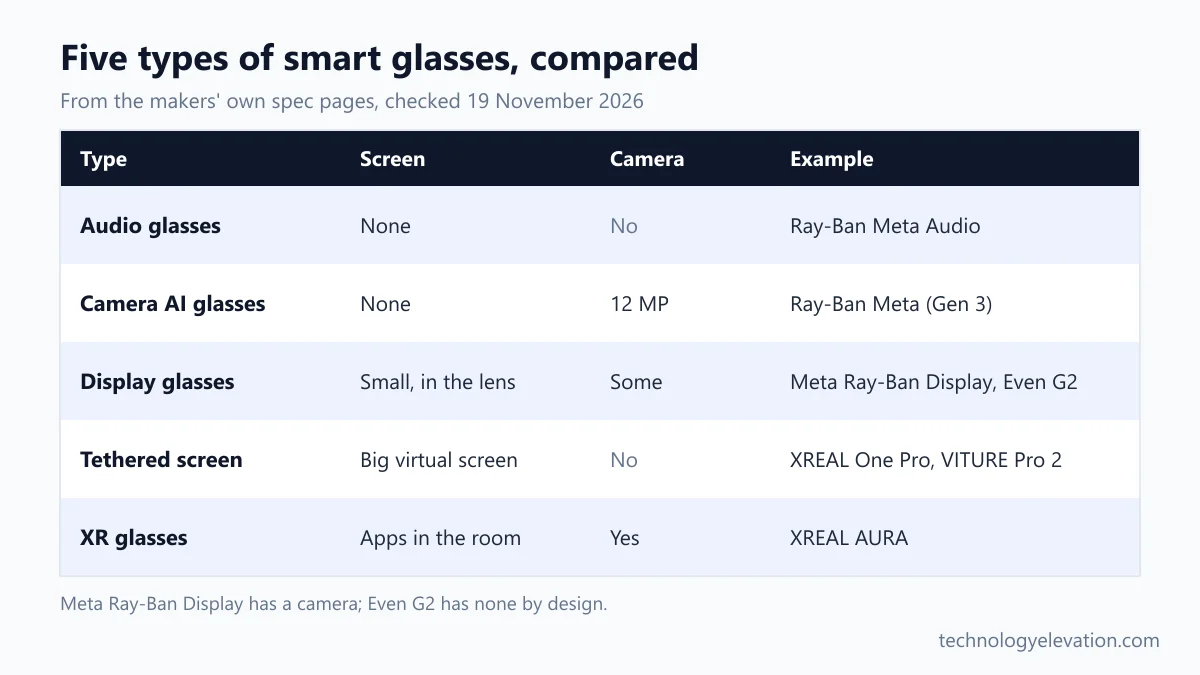
In November 2026, the products on sale fall into five groups:
- Audio glasses: speakers and microphones for music, podcasts, calls and voice questions, with no camera. Example: Ray-Ban Meta Audio.
- Camera AI glasses: audio plus a camera for hands-free photos, video and “what am I looking at?” questions. Example: Ray-Ban Meta (Gen 3).
- Display glasses: a small heads-up image in the lens for messages, directions, captions or notes. Examples: Meta Ray-Ban Display and Even G2.
- Tethered screen glasses: a cable to a phone, laptop or console, and a large virtual screen for films and games. Examples: XREAL One Pro and VITURE Pro 2.
- XR glasses: see-through lenses that pin apps into the room around you, run by a separate pocket computer. Example: XREAL AURA.
The first two groups look and feel like ordinary glasses. The last two are closer to wearable monitors, and you would not wear them to dinner.
If you already know which type suits you, the best smart glasses for each job are compared model by model, with launch prices.
| Type | Screen | Camera | Main job |
|---|---|---|---|
| Audio glasses | No | No | Music, calls, voice assistant |
| Camera AI glasses | No | Yes | Hands-free photos and AI questions |
| Display glasses | Small image in the lens | Some models | Messages, directions, captions |
| Tethered screen glasses | Large virtual screen | No | Films and gaming |
| XR glasses | Apps placed in the room | Yes | Spatial computing |
Camera and audio smart glasses work without any screen at all
Camera and audio smart glasses have no display. You control them by voice, a touch strip or a button, and answers come back as speech through small speakers near your ears. Camera models add photos, video and an assistant that can describe what you see.
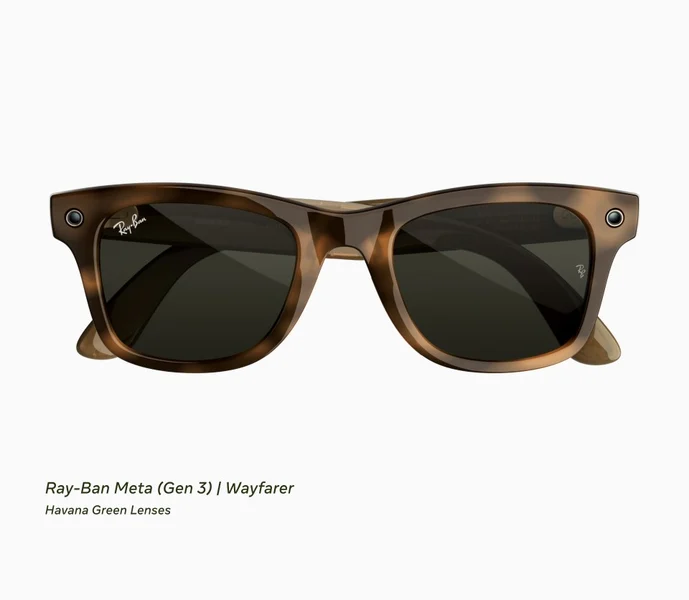
The Ray-Ban Meta (Gen 3) shows the recipe. Meta lists a 12 MP camera, 3K Ultra HD video, a 6-microphone array that it says cuts more than 90% of background noise, and up to nine hours of battery. Prices start at $449.
Audio glasses drop the camera. Meta’s Ray-Ban Meta Audio weigh 43 grams, last up to 12 hours on a charge, and get up to 48 more hours from the included case. Meta says calls capture your voice more clearly than earbuds.
The speakers are “open-ear”: they sit near your ear rather than inside it, so you still hear traffic and people talking to you. The same idea drives clip-on earbuds, and the trade-offs of leaving your ears open are explained in open-ear vs bone conduction headphones.
Google is entering this group too. Its intelligent eyewear, designed with Warby Parker and Gentle Monster, has an ultra-wide 12 MP camera, up to 3K video and up to 9 hours of battery, according to Google’s eyewear page. The page lists pre-orders through both brands and no display.
One honest limit: without a screen, everything is spoken. Asking for a recipe step works well. Reading a long message out loud on a crowded train does not.
Display smart glasses put a small, private screen in the lens
Display smart glasses project a small image into one or both lenses, so text and simple graphics appear to float in your view. Only the wearer sees it. The screens suit quick glances, such as a message, the next turn on a walk, live captions or speaker notes, not films.
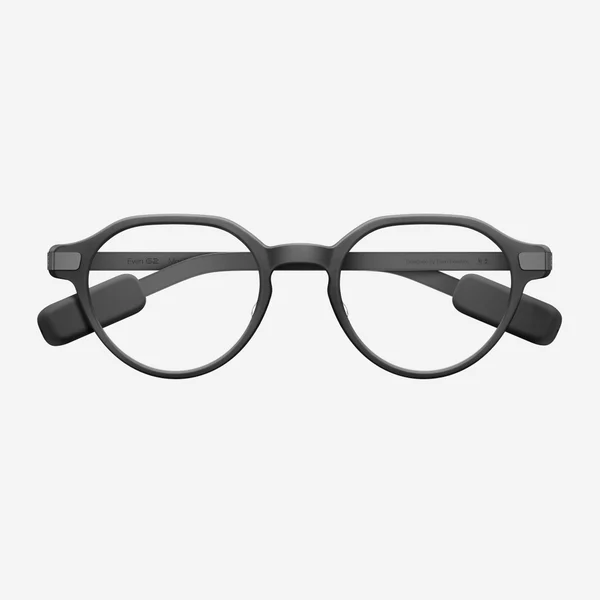
Meta Ray-Ban Display is the best-known example. Meta describes a full-color display placed off to the side so it does not block your view, and it is not on all the time. The glasses come with the Meta Neural Band, a wristband that reads muscle signals so a pinch or thumb swipe controls the screen. The set launched on 30 September 2025 at $799, with up to six hours of mixed use.
Even Realities took the opposite approach with privacy. Its Even G2 have no camera at all (“Camera-free. By design,” says the maker) and a green-only display in both lenses at 640 x 350 pixels, a 27.5-degree field of view and up to 1,200 nits. The frame weighs 36 grams.
Green-only sounds basic, and it is. But green text is enough for notes, prompts and translations, and Even rates the G2 at up to two days per charge, with a case that holds seven full charges.
AR and XR glasses add a big virtual screen or apps placed in the room
AR and XR glasses show a large, sharp image over the real world. Tethered screen glasses act as a wearable monitor for a phone, laptop or console. XR glasses go further, pinning apps in place around you, tracking your hands and running on their own pocket computer.
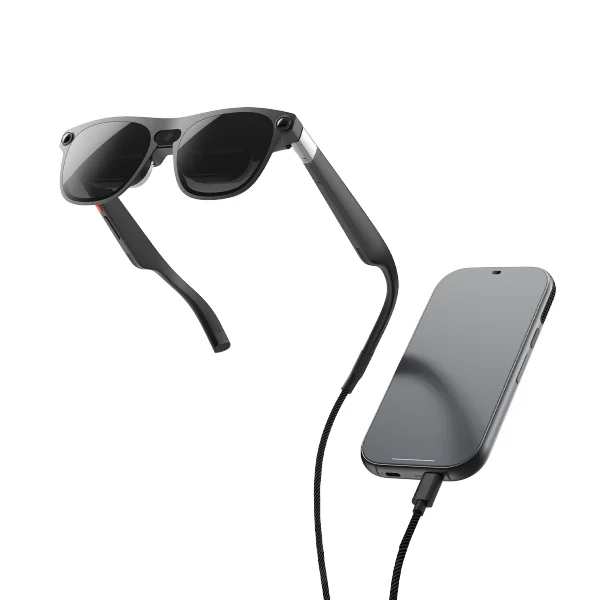
XR stands for extended reality, which Google defines as “an umbrella term that encompasses all technologies that blend the real and virtual worlds.” AR, or augmented reality, is the part where digital images sit on top of the room you can still see.
Screen glasses are the simple version. The XREAL One Pro uses 0.55-inch Sony micro-OLED displays and a 57-degree field of view to show a screen equal to 171 inches seen from 4 meters away. Your device needs a USB-C port with DisplayPort output, and a Nintendo Switch needs XREAL’s separate hub. The VITURE Pro 2 weighs 63 grams, shows a 146-inch virtual screen and costs $299.
XR glasses add sensors and a computer. The XREAL AURA runs Google’s Android XR with Gemini, offers a 70-degree field of view, tracks your hands and anchors apps in 6DoF (it knows where you move, not only where you look). A 265-gram puck in your pocket holds the Snapdragon chip and a 4,455 mAh battery. List prices are $1,279 and $1,499.
Gamers already use screen glasses with handhelds, since the handheld gaming PCs people buy now output video over USB-C. Anyone wanting full immersion, where the room disappears, still needs a headset: the trade-offs are covered in the best VR headset comparison.
Smart glasses display images with waveguides, prisms or birdbath optics
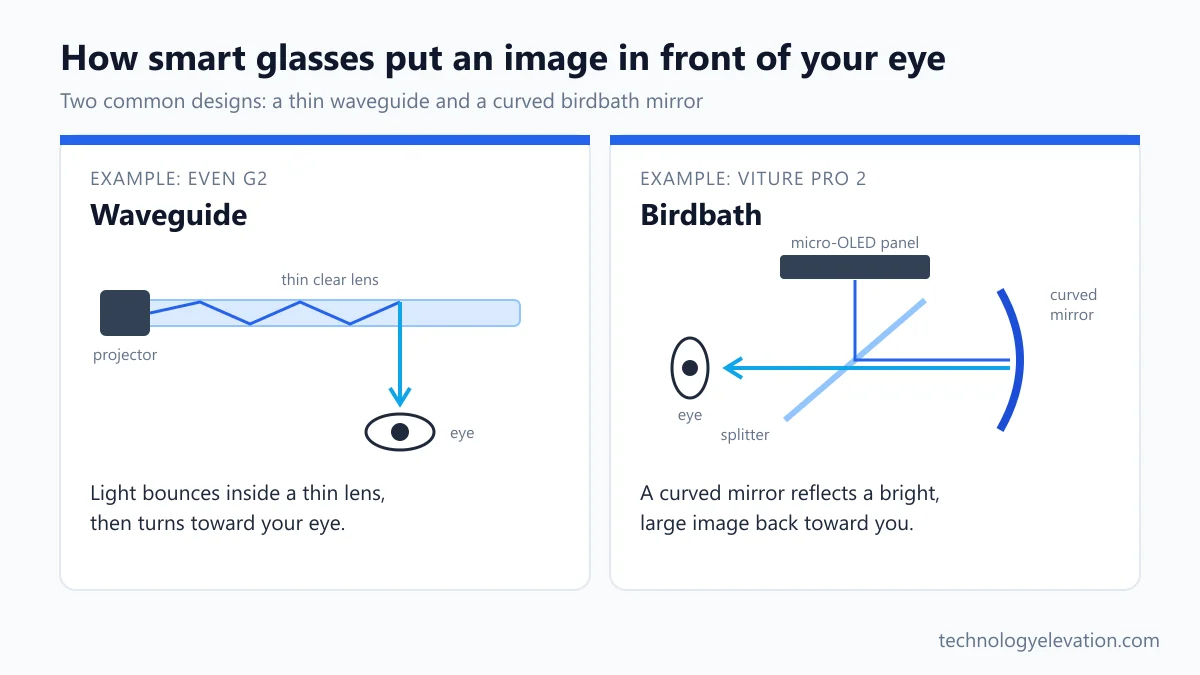
Smart glasses cannot put a normal screen in front of your eye, so they use optics. A tiny display hides in the frame, and a waveguide, prism or curved mirror steers its light into your eye. The choice decides how thin, bright and wide the picture can be.
A waveguide is a thin, clear layer inside the lens. Light from a small projector enters at the edge, bounces along inside the glass, and is turned toward your eye in front of the pupil. Lenses stay thin and look almost normal. Even Realities lists waveguides for the G2.
Birdbath optics use a curved mirror and a partly see-through reflector in front of each eye. A micro-OLED panel above the lens shines down, and the mirror bounces a bright, large image back toward you. VITURE says the Pro 2 uses its UltraClarity 3.0 birdbath optics. The result is a wider, punchier picture in a thicker frame with tinted lenses.
XREAL uses its own prism design on the One Pro, which it calls X Prism, paired with the 0.55-inch Sony micro-OLED panels.
Field of view is the number that tells you how big the picture feels. The G2’s 27.5 degrees suits a few lines of text. The One Pro’s 57 degrees and AURA’s 70 degrees are what make a virtual cinema screen possible.
Smart glasses privacy rests on recording lights, local storage and manners
Smart glasses with cameras show a light when they record. Meta’s white capture LED has no off switch, and its newer glasses disable the camera if the LED is covered. Google’s eyewear stops recording if its outer light is blocked. Photos stay on the glasses until you import them.
Meta’s answers on AI glasses privacy give the detail. The LED blinks briefly for a photo and keeps blinking for as long as a video runs. Since the second generation, the camera turns off if the glasses detect the LED is blocked, and Meta now disables it if the LED is physically tampered with.
| Maker | Recording signal | If the light is covered | Where media is saved |
|---|---|---|---|
| Meta (Ray-Ban, Oakley, Meta Glasses) | White LED blinks for photos, keeps blinking for video | Camera disabled | On the glasses until you import |
| Google intelligent eyewear | Inner and outer lights flash for photos, pulse for video | Recording stops | Not stated by Google |
| XREAL AURA | Privacy LED by the camera | Not stated by XREAL | Not stated by XREAL |
| Even G2 | No camera | Not applicable | Not applicable |
A light only works if people notice it. Meta itself says the shutter sound is heard by the wearer and is not practical to hear at a distance. In a busy street, plenty of people will never spot a small blink.
So the manners matter more than the hardware. Ask before filming anyone up close. Take camera glasses off in changing rooms, at the doctor’s and in meetings where phones are not allowed. Expect some gyms, schools and venues to ban them outright.
Your own data is the other half. Meta says your photos are for you only unless you share them, including with Meta AI. Asking the assistant about what you see means sending that image to it, the same trade-off that comes with any connected camera, from a doorbell to the indoor security cameras with privacy shutters.
Smart glasses batteries are tiny, and one model has been recalled for heat
Smart glasses run on small batteries hidden in the arms, so they last hours, not days. Rated figures run from about six hours for a full-color display pair to 12 hours for audio glasses. Charging cases refill them. One model, the INMO Air3, was recalled in September 2026 for overheating.
The US Consumer Product Safety Commission announced the INMO Air3 recall on 24 September 2026. The CPSC says the left temple can overheat during extended use, posing a burn hazard, and INMO received 10 reports of overheating, including a burning feeling on the face and ear. About 1,643 units were sold in the US, plus about 120 in Canada.
Owners of the AIR3 model (black, with “AIR3” and “INMO” on a label on the right temple) should stop using them now and contact INMO for a free repair, which updates the system to version V3.16 online.
No recalls are listed on the CPSC database for Meta, Ray-Ban, Oakley, XREAL, VITURE or Even Realities glasses as of 19 November 2026.
Travel is where battery planning matters. Display glasses and screen glasses lean on your phone or a power bank, and the power bank airline rules decide what you can carry on a flight.
Prescription smart glasses are easy for most eyes, harder for strong ones
Most smart glasses take prescription lenses, but the range and the process differ. Even G2 lenses run from -12.00 to +12.00. Meta sells frames built for prescriptions. Screen glasses work differently: VITURE builds in nearsighted dials, and XREAL uses partner lens inserts.
On camera and audio glasses, the prescription goes into the lens like any frame, because there is no screen to look through. Meta’s Blayzer Optics and Scriber Optics (Gen 2), announced in March 2026 from $499, are designed to “support nearly all prescriptions,” with overextension hinges and interchangeable nose pads. Meta says the Ray-Ban Meta Audio work with “a wide range of optical prescriptions.”
Display glasses are trickier, because the lens has to correct your eyes and line up with the display layer. Even Realities says each G2 lens is digitally etched to your exact prescription and aligned with the display.
Screen glasses use a separate route. The VITURE Pro 2 has a dial for each eye from 0 to -5.00D, so many nearsighted people skip lenses entirely. VITURE notes that these adjustments can interfere with head tracking on some of its models. XREAL sells prescription lenses through optical partners in the US, EU and UK, and makes the One Pro in two IPD sizes (the distance between your pupils): 57 to 66 mm and 66 to 75 mm.
Strong astigmatism and progressive lenses are the hard cases. Get a fitting at an optical store and keep the receipt, because a pair that sits wrong gives a blurry picture.
Pick smart glasses by the one job you want done first
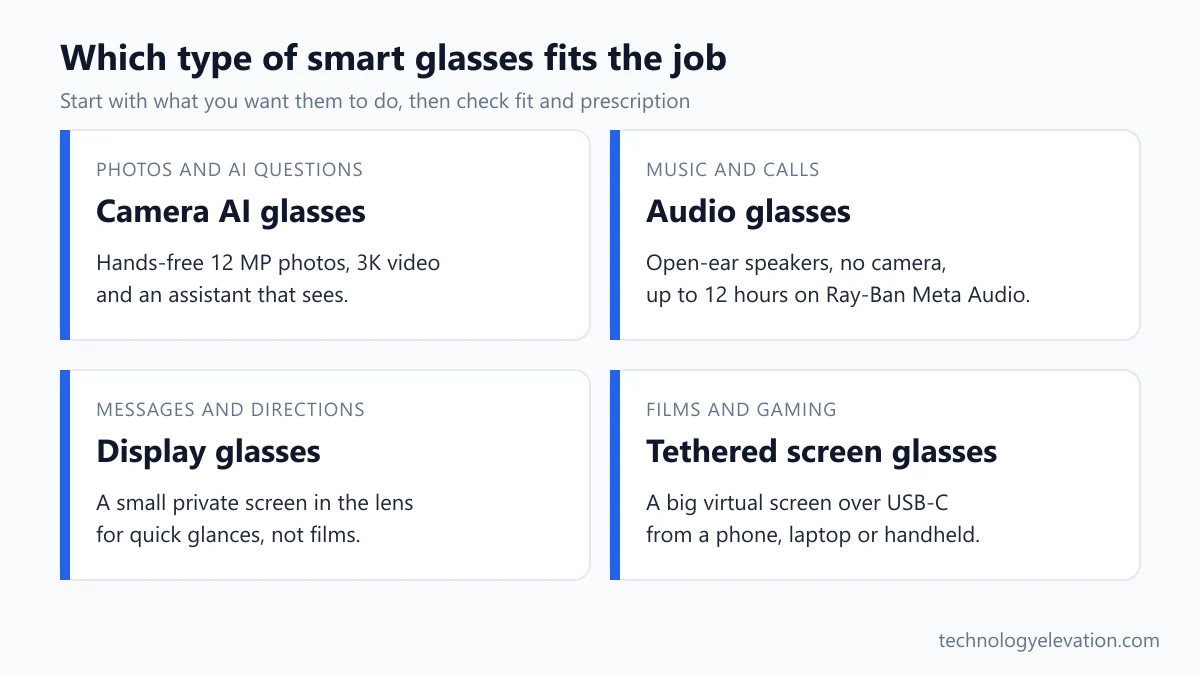
Choose smart glasses by the job, then check your phone, your prescription and the battery. Photos and AI questions point to camera glasses, music and calls to audio glasses, glanceable text to display glasses, and films or games on the go to tethered screen glasses.
- Name the job: capture, listening, reading messages, watching films or working with apps in space.
- Decide whether you want a camera on your face, for your sake and for the people around you.
- Check your phone. Google lists Pixel 7 and later, iPhone 13 and later on iOS 26.6, and Samsung Galaxy S and Z phones on One UI 9.0. Screen glasses need USB-C video output.
- Check the prescription range against your own numbers before you pay.
- Compare rated battery life with how long you would wear them in a day.
- Try the fit, or buy from a store with easy returns.
Many people asking about smart glasses mainly want health tracking. Glasses are not built for that job, and smart ring vs smartwatch covers the devices that are.
For everyone else, the next step is model by model. Ready to compare prices, cameras and lens options? The best smart glasses of 2026 picks one pair for each of these jobs.
Frequently asked questions about smart glasses
What do smart glasses actually do?
Smart glasses let you take photos, listen to music, make calls and ask an AI assistant questions without holding your phone. Display models also show messages, directions and captions in the lens, and screen glasses show films and games on a large virtual screen.
Do smart glasses have a screen?
Not all of them. Camera and audio glasses such as the Ray-Ban Meta (Gen 3) have no screen and answer by voice. Display glasses such as the Meta Ray-Ban Display and Even G2 show a small image in the lens.
Can smart glasses record without people knowing?
Meta and Google glasses show a light while recording, and both stop the camera if that light is covered. A small blink is still easy to miss in a busy place, so ask before you film anyone up close.
Can you get smart glasses with a prescription?
Yes, most smart glasses take prescription lenses. Even G2 lenses run from -12.00 to +12.00, Meta’s Blayzer and Scriber Optics frames support nearly all prescriptions, and the VITURE Pro 2 has built-in dials from 0 to -5.00D.
Do smart glasses work with iPhone?
Most do, but check the model. Google lists iPhone 13 and later on iOS 26.6 or newer for its intelligent eyewear. Screen glasses such as the XREAL One Pro need an iPhone with a USB-C port that outputs video.
What is the difference between AI glasses and AR glasses?
AI glasses use a camera, microphones and speakers to talk to an assistant, usually with no screen. AR glasses show digital images over the real world, from a small heads-up display to a large virtual screen or apps fixed in the room.
Are smart glasses safe to wear?
Glasses from the major brands have no recalls listed by the CPSC as of 19 November 2026. The INMO Air3 was recalled in September 2026 because its left temple can overheat, so owners should stop using it and contact INMO for a free repair.
Last checked and sources
Last checked on 19 November 2026 by Haris Khan. We read each maker’s product pages, newsroom posts and privacy answers, checked the CPSC recall database, and kept only what those sources state.
- Meta Newsroom: Ray-Ban Meta (Gen 3) and Ray-Ban Meta Audio announcement, September 2026; Meta Ray-Ban Display and Meta Neural Band announcement, September 2025; prescription frames, March 2026; AI glasses privacy questions, July 2026
- Google: intelligent eyewear page and Android XR page
- Even Realities: Even G2 product page and tech specs
- XREAL: One Pro and AURA product pages
- VITURE: XR glasses lineup guide
- US Consumer Product Safety Commission: INMO Air3 smart glasses recall, 24 September 2026
We update this explainer when new types of smart glasses launch or makers change their privacy and prescription rules.



GIPHY App Key not set. Please check settings