

 Haris Khan
A text lands while you are queuing for coffee: your parcel is “on hold” and needs a $1.99 redelivery fee. You did order a gift last week, so the timing feels right. One tap later, a polished page asks for your card number. Nobody was holding a parcel.
Knowing how to avoid online shopping scams comes down to a handful of habits that hold up against fake stores, delivery texts, gift card demands and payment tricks. The stakes are real. People filed 56,478 non-payment and non-delivery complaints with the FBI in 2025 and reported $503,373,587 in losses, according to the FBI’s 2025 Internet Crime Report.
Holiday shopping gives scammers cover. You expect tracking texts, you see more ads, and you are buying for other people from shops you have never used.
Every step below comes from current guidance by the FTC, the FBI’s Internet Crime Complaint Center (IC3), CISA and the US Postal Inspection Service, checked on 19 November 2026.
How to avoid online shopping scams: nine habits that stop most of them
To avoid online shopping scams, type store addresses yourself, research any seller you find through an ad, never tap links in delivery texts, never pay by gift card, wire or crypto, use a credit card, and turn on two-step login. Report anything suspicious fast.
- Type the store’s web address yourself or use a bookmark. Do not click search ads or links in messages.
- Before buying from an unfamiliar shop, search its name with the words “scam” and “complaint”.
- Treat every delivery text with a link as fake. Check tracking on the carrier’s own site instead.
- Refuse any seller or caller who wants payment by gift card, wire transfer, payment app or cryptocurrency.
- Pay with a credit card, ideally one with a low limit that you keep for online shopping.
- Turn on two-step login (multi-factor authentication) for your email, bank and shopping accounts.
- Never read a one-time passcode to anyone who calls or texts you, even if they say they are your bank.
- Keep order confirmations and compare them with your card statement every week in December.
- If something goes wrong, call your card issuer first, then report it at ReportFraud.ftc.gov and ic3.gov.
Steps 4 and 5 do the heavy lifting. A credit card gives you a legal route to get money back. A gift card or a crypto transfer almost never does.
Fake stores and social media ads are the biggest holiday shopping trap
Fake stores reach most victims through ads. The FTC says people reported losing more than $95 million in 2025 to scams that started when they ordered something seen in a social media ad, and that platforms do not always thoroughly vet those ads or advertisers.
Shopping scams were the most reported scam on social media in 2025, according to an FTC data spotlight from April 2026. More than 40% of people who lost money to a social media scam said it began with an order from an ad. Facebook had the most reported losses, with WhatsApp and Instagram a distant second and third.
Search ads carry the same risk. The FBI warned in 2025 that criminals buy search ads that imitate real businesses to push fake sites to the top of results, a trick it calls “SEO poisoning”. A June 2026 FBI alert adds that malicious links can closely resemble real ones.
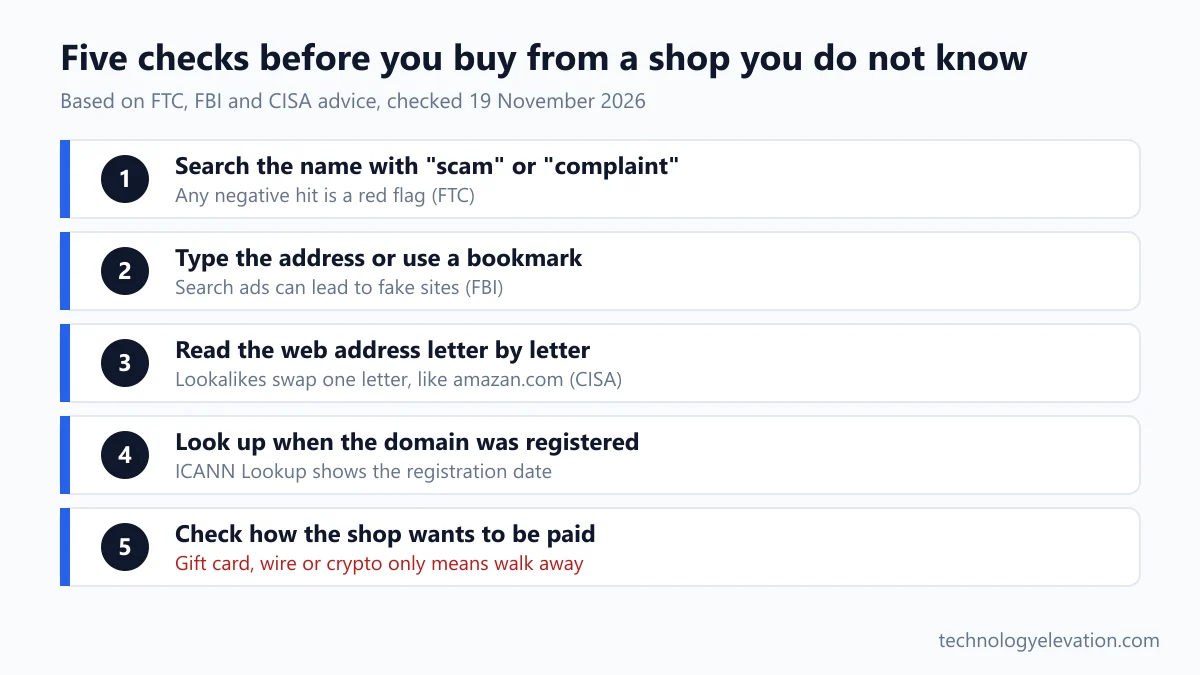
Before you pay a shop you have never used, run these checks:
- Search the store name plus “scam” or “complaint”. In its warning about spoofed websites, the FTC calls any negative hit a red flag.
- Read the address bar letter by letter. CISA’s phishing advice uses amazan.com as its example of a lookalike.
- Look up the domain in ICANN Lookup, the official registration database, to see when it was registered. A “since 1998” shop on a domain registered in October is lying about something.
- Paste the address into Google’s Safe Browsing site status tool, which flags sites Google knows to be unsafe.
- Save the seller’s phone number and physical address, as CISA suggests, so you have a way to chase a billing problem.
Good reviews prove little. The FTC notes that scammers copying a real business can copy its glowing reviews too, and fake reviews have been a problem on big marketplaces for years, as the long fight over fake reviews on Amazon shows.
Polished writing no longer helps either. CISA points out that AI tools now let scammers write messages with perfect grammar and spelling.
Delivery texts with a link are almost always fake
A delivery text with a link is almost always a scam. USPS says its tracking texts arrive only after you request tracking for a specific number, and that those messages will not contain a link. USPS tracking is free, so any “redelivery fee” is fake.
Fake package delivery problems were the most reported text scam of 2024, the FTC says, usually posing as the Postal Service. People reported losing $470 million to text scams that year, more than five times the 2020 total.
The US Postal Inspection Service gives clear steps in its smishing warning:
- Do not tap the link, even if you are expecting a parcel.
- Type usps.com into your browser and enter your tracking number there.
- Do not reply to the text. Forward it to 7726 so your carrier can block the number, then delete it.
- For a USPS lookalike, email [email protected] with the text copied into the message, a screenshot showing the sender’s number and date, and whether you clicked or lost money.
- If you already opened the link, even without typing anything, contact your bank or card issuer.
The same rule covers UPS, FedEx, Amazon and toll road texts. Bogus unpaid toll notices made the FTC’s top five text scams too. Go to the company’s site or app yourself, never through the message.
Your phone can help. Turn on the built-in filter for unknown senders, and use the “report junk” option in Messages or Google Messages, which the FTC lists as a reporting route.
Anyone who asks for payment by gift card is a scammer
Any request to pay with a gift card is a scam. The FTC says no real business or government agency will ever tell you to pay that way. Scammers want the card number and PIN, which lets them drain the card while you still hold it.
The stories vary: a fake tech support call, a “grandchild” in trouble, a prize with a fee, a seller who says the card payment failed. The FTC says scammers often keep you on the phone while you buy the card, or tell you to split purchases across stores so cashiers do not notice.
Gift cards are still a great present. Buying them safely takes three habits from the FTC:
- Buy cards only from stores you know, never from online auction sites, where cards may be fake or stolen.
- Check that the protective sticker is intact and the PIN is hidden before you pay.
- Take a photo of the card and the receipt before you leave the store.
That photo matters if a scammer gets the number. Report it to the card’s issuer straight away, ask for a refund, and report it to the FTC. Some issuers, Apple and Google Play among them, can freeze a card if money is still on it.
Game store cards are a favourite of both gift buyers and scammers. If a gamer is on your list, the gifts for gamers we picked include safer options than a code sent to a stranger.
Pay with a credit card, because federal law protects it best
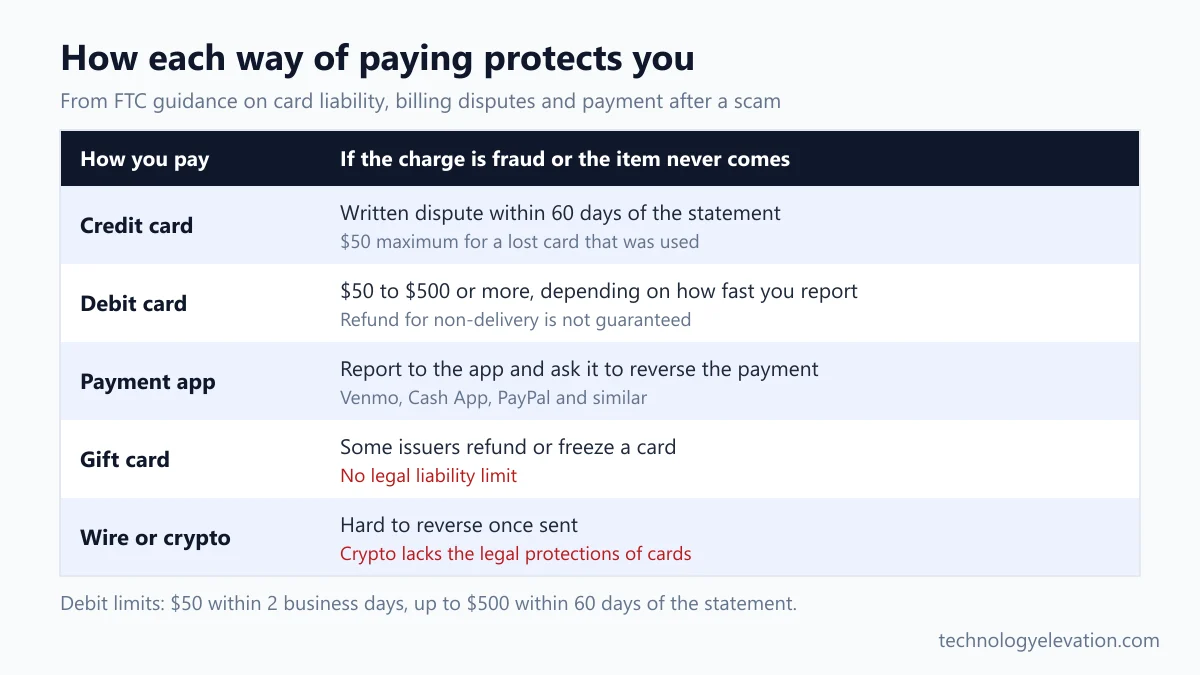
A credit card is the safest way to pay online. If someone uses your card number without permission, federal law generally leaves you owing nothing, and the Fair Credit Billing Act lets you dispute items that never arrived. Debit cards, payment apps, wires and crypto offer much less.
| How you pay | Protection if the item never comes or the charge is fraud |
|---|---|
| Credit card | Dispute in writing within 60 days of the statement; $50 maximum for a lost card that was used |
| Debit card | $50 to $500 or more for a lost card, depending on how fast you report; refunds for non-delivery not guaranteed |
| Payment app | Report to the app and ask it to reverse the payment |
| Gift card | Some issuers refund or freeze a card; no legal liability limit |
| Wire or crypto | Hard to reverse; crypto lacks the legal protections of cards |
The details matter. Under the Fair Credit Billing Act, you must send the dispute in writing within 60 days of the first statement that shows the charge, to the billing-errors address rather than the payment address. The issuer must resolve it within two billing cycles and no more than 90 days.
Debit is weaker because the money leaves your account at once. Report a lost debit card within 2 business days and your loss is capped at $50. Wait longer and the cap rises to $500, or more after 60 days.
CISA suggests keeping one low-limit credit card just for online shopping. Money stored in shopping apps or on gift cards, it notes, has no legal liability limit at all.
Fake deals hide in the comparison price, not the sale price
Most fake deals are not fake stores at all. Real shops inflate the “was” price so an ordinary price looks like a bargain. A seller that only accepts gift cards, wires or crypto for a deal is the outright scam version.
Our Black Friday 2026 tech buying advice explains how the FTC defines a genuine former price and how to check price history in two minutes.
The outright fakes share a pattern: a hot product at half price, a countdown timer, and a checkout that suddenly “fails” and asks you to pay another way. Walk away the moment a deal needs an unusual payment method.
Lock down your accounts before the holiday rush
Locking down accounts stops the scams that skip the fake store and go straight for your bank or shopping login. Turn on multi-factor authentication, use a unique password for each account, and never share a one-time code. The FBI says companies generally do not ask for one.
Account takeover is a big business. The FBI said in November 2025 that it had received more than 5,100 complaints since January about criminals posing as bank or support staff, with losses above $262 million. They trick victims into giving up login details or one-time passcodes, then reset the password.
CISA’s point about two-step login is simple: even if a criminal steals your password, they cannot complete the second step. The FBI adds a habit worth keeping: open your bank and shopping sites from a bookmark, not a search result.
Children’s devices need a check too. A kid tapping “buy” on a convincing pop-up is a shopping problem of its own, and the parental controls on a kids’ tablet can require your approval for every purchase.
Unexpected packages and QR codes are a different trap
An unexpected package is not a bill, and its QR code is not a gift. The FTC says you never have to pay for or return products you did not order. The FBI warns that some unsolicited packages carry QR codes that lead to data-stealing sites or malware.
The FBI describes these as a variation of brushing, where sellers ship unordered goods to real addresses so they can post fake positive reviews. The QR code version adds fraud on top. FBI advice: do not scan QR codes from unknown sources, be wary of packages with no sender details, and check your free credit reports if you suspect someone is using your details.
Order mix-ups have their own rules. If a shop gives no shipping time, the FTC’s mail order rule says it must ship within 30 days, tell you about a delay, and offer a full refund (not just store credit) if it cannot ship.
What to do in the first hour after a shopping scam
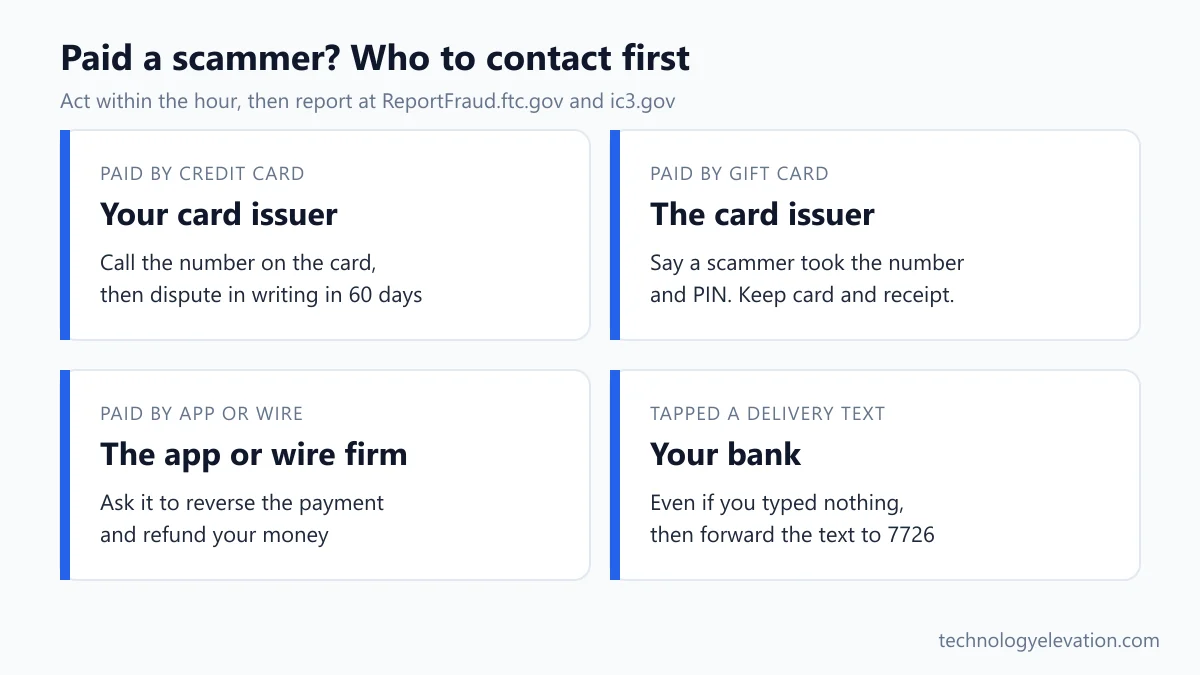
Act within the hour if you paid a scammer. Call the company you paid through and ask for a reversal, change any password you shared, and report the scam to the FTC and IC3. Speed matters, because the FBI can sometimes freeze money that moves fast.
- Call the company you paid through, using the number on the back of your card or in its app. Say the payment was fraud and ask for a refund or reversal.
- For a gift card, say a scammer tricked you into giving them the card number and PIN. Keep the card and receipt.
- Change the password on any account you logged into from the scam link, and turn on two-step login.
- Report the scam at ReportFraud.ftc.gov and file a complaint at ic3.gov.
- Follow up a credit card call with a written dispute within 60 days of the statement.
- Ignore anyone who contacts you offering to recover the money for a fee.
Step 6 catches people twice. The FBI warned in July 2026 that scammers pose as IC3 staff to “update” a victim’s report. IC3 will never contact you by phone, email or social media, never charges to recover funds, and has no social media accounts.
The FBI’s Recovery Asset Team works with banks to freeze fraudulent transfers, and the bureau says that process works best when complaints are filed as quickly as possible. A complaint filed tonight beats a perfect one filed next week.
Safe holiday gift shopping starts with known shops and early dates
The safest holiday gift shopping happens at stores you already know, on sites you reach by typing the address, paid by credit card, with time to spare. Last-minute panic is when a too-cheap listing or an “urgent” delivery text looks believable.
Make a short list of gifts early. Our best tech gifts for 2026 are sorted by budget, so you can buy from big retailers instead of chasing an unknown shop’s discount.
Then line up the sale dates. Black Friday falls on 27 November this year and Cyber Monday on 30 November, and the Black Friday 2026 deals worth waiting for are mostly last year’s models from major brands.
Shipping gifts straight to someone else? Tell them to expect a parcel and to check tracking only on the carrier’s own site. A warned recipient ignores the fake “missed delivery” text that follows every December order.
Frequently asked questions about online shopping scams
How can you tell if an online store is fake?
Search the store’s name with “scam” or “complaint”, check the web address letter by letter, and look up when the domain was registered. Be wary of brand-new domains, prices far below every other shop, and sellers that push gift cards, wires or crypto.
Does USPS send texts with links?
No. USPS sends tracking texts only after you request them for a tracking number, and the Postal Inspection Service says those messages will not contain a link. Forward fake ones to 7726 and report USPS lookalikes to [email protected].
Is it safer to pay with a credit card or a debit card online?
A credit card is safer. Federal law caps your liability for unauthorized charges and lets you dispute items that never arrived. With a debit card, the money leaves your account at once and your protection depends on how fast you report.
Can you get your money back after a shopping scam?
Often, if you paid by credit card and act fast. Call the issuer, ask for a refund, and follow up in writing within 60 days. Gift card, wire and crypto payments are much harder to recover, so report them to the company immediately.
Why do scammers ask for gift cards?
Scammers ask for gift cards because the money is hard to trace and easy to spend once they have the card number and PIN. The FTC says no real business or government agency will ever ask you to pay with a gift card.
Where do you report an online shopping scam?
Report it at ReportFraud.ftc.gov and file a complaint with the FBI at ic3.gov. Also tell your card issuer or bank, the platform where you saw the ad, and the company being impersonated.
Last checked and sources
Last checked on 19 November 2026 by Haris Khan. We read each agency’s current guidance and the FBI’s 2025 crime data and kept only what those sources state.
- FBI Internet Crime Complaint Center: 2025 Internet Crime Report; public service announcements on account takeover fraud (November 2025), unsolicited packages with QR codes (July 2025), malicious traffic distribution systems (June 2026) and IC3 impersonation (July 2026)
- Federal Trade Commission: gift card scams, billed for things you never got, lost or stolen credit and debit cards, what to do if you were scammed, spam text messages; consumer alerts on social media ads and spoofed dealer websites; data spotlights on social media scams (April 2026) and top text scams of 2024
- CISA: Secure Our World pages on phishing and multi-factor authentication; Shopping Safely Online tip
- US Postal Inspection Service: smishing guidance
We update this guide when the FTC, FBI or CISA change their advice or publish new scam data.

GIPHY App Key not set. Please check settings