

 Haris Khan
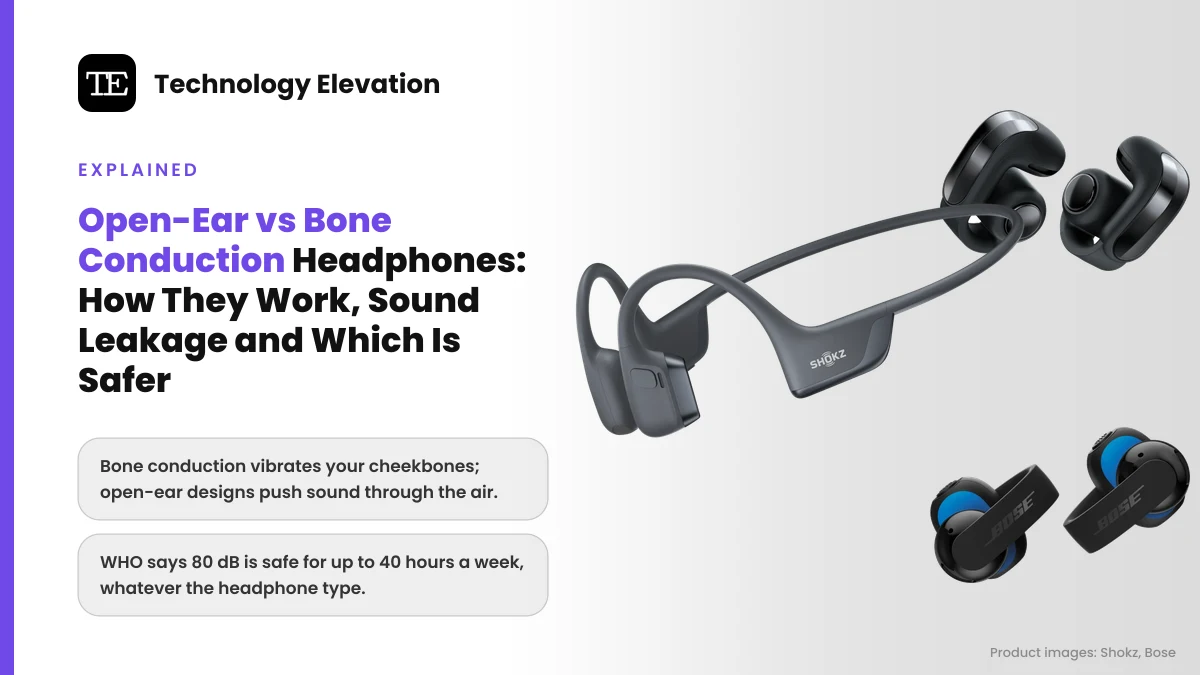
Stand at a busy crosswalk with a pair of sealed earbuds in and you will notice the bus about one second later than everyone else. That gap is why so many runners, cyclists and dog walkers now wear headphones that leave the ear canal open. The question is which kind: open ear vs bone conduction is the choice most people face first, and the two work in completely different ways.
Bone conduction headphones rest on your cheekbones and send vibrations through bone. Open-ear headphones, the air-conduction kind, hang a tiny speaker next to your ear and send sound through the air. A third style, the clip-on or cuff earbud, is really a variation of the open-ear idea that grips the edge of your ear instead of hooking over it.
Hearing safety is the part most comparisons skip. The World Health Organization says over 1 billion young adults are at risk of permanent, avoidable hearing loss due to unsafe listening practices, and neither open design changes the maths on volume.
Open-ear and bone conduction headphones differ in how sound reaches your inner ear
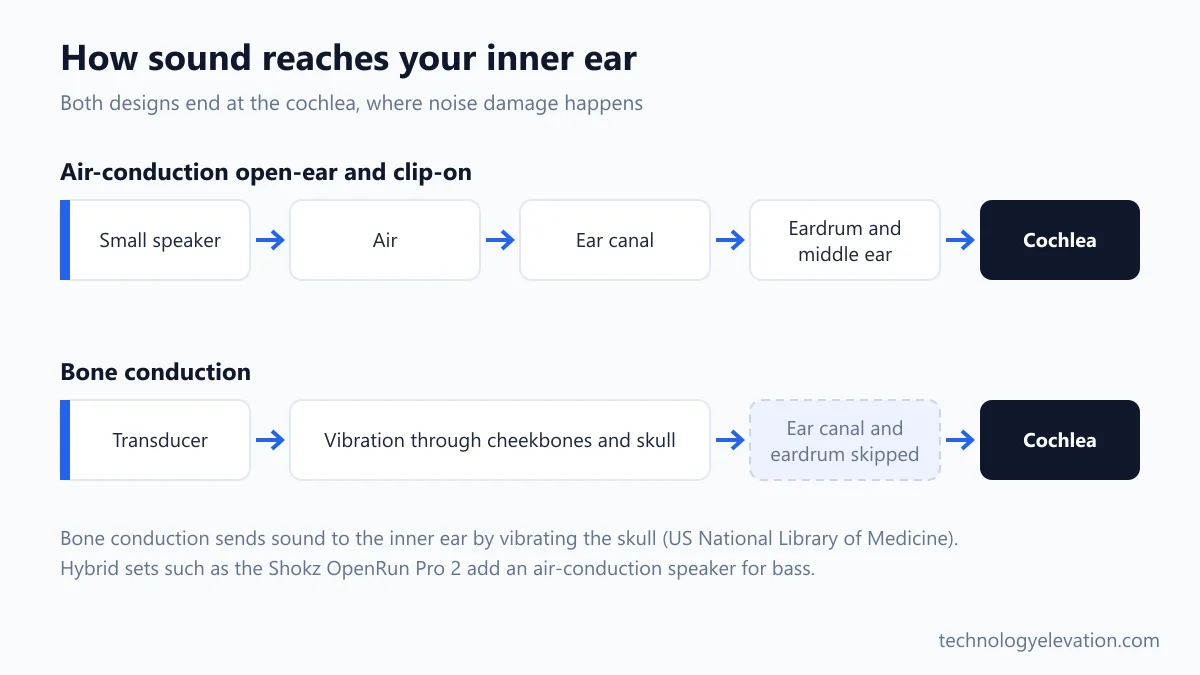
Open-ear headphones push sound through the air into your open ear canal. Bone conduction headphones skip the air and vibrate your skull, which carries sound straight to the inner ear. Both keep your ears uncovered, so both let traffic and voices in, but they sound and fit differently.
The three open designs you will find in shops in November 2026:
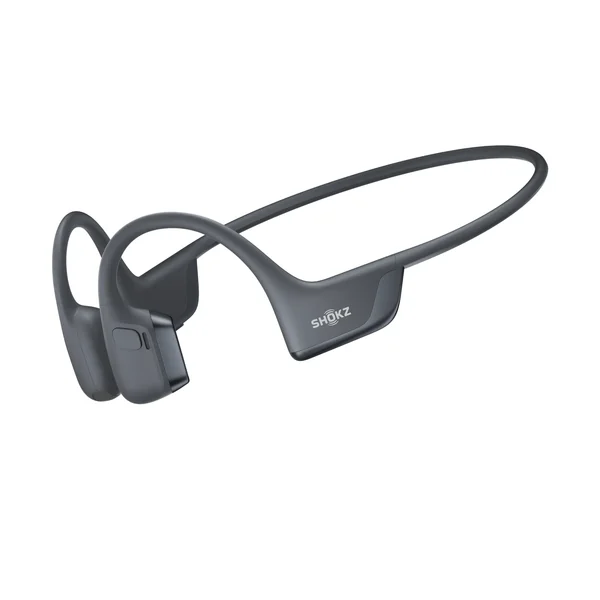
- Bone conduction: transducers press lightly on the cheekbones in front of the ears, joined by a band behind the head. Example: Shokz OpenRun Pro 2.
- Air-conduction open-ear (ear hook): a small speaker sits just outside the ear canal, held by a hook over the top of the ear.
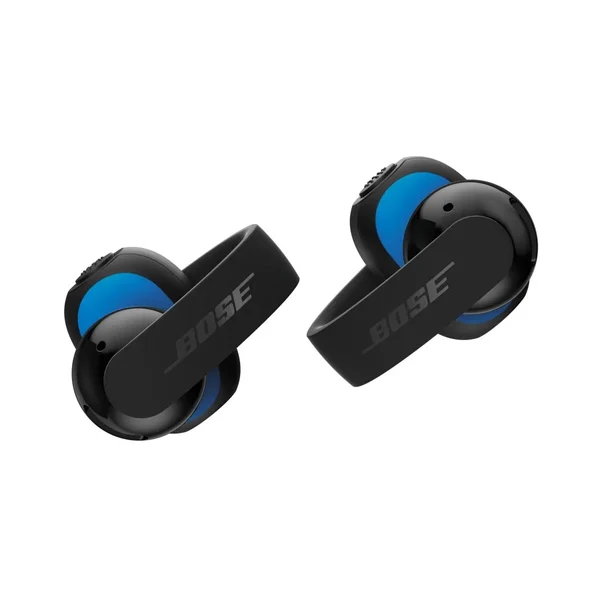
- Clip-on or cuff open-ear: the same air-conduction idea, but each earbud clamps gently around the edge of the ear. Examples: Bose Ultra Open Earbuds (2nd Gen) and Bose Sport Open Earbuds.
| Point | Bone conduction | Air-conduction open-ear | Clip-on cuff |
|---|---|---|---|
| How sound travels | Vibration through cheekbones and skull | Through the air into the ear canal | Through the air into the ear canal |
| Ear canal | Fully open | Fully open | Fully open |
| Contact with your head | Firm pressure on the cheekbones | Hook resting on top of the ear | Light grip on the ear’s edge |
| Bass | Weakest of the three | Better, still lighter than sealed earbuds | Better, still lighter than sealed earbuds |
| Typical buyer | Road runners, cyclists | All-day office and home wear | All-day wear with glasses or a hat |
Sealed in-ear earbuds and over-ear headphones are the opposite approach: they block outside sound on purpose. Keep that in mind, because it matters for the safety section further down.
Bone conduction headphones send vibrations through your cheekbones
Bone conduction headphones turn audio into small vibrations that travel through your cheekbones and skull to the cochlea, the snail-shaped hearing organ in your inner ear. The eardrum and ear canal are bypassed, which is why your ears stay completely free.
Medicine has used the same principle for years. A 2019 review in the Journal of Neurological Surgery, published through the US National Library of Medicine, notes that bone conduction implants “transfer sound to the inner ear through direct vibration of the skull” and can bypass a damaged ear canal or middle ear. Headphones do a gentler version from outside the skin.
The trade-off is bass. Low notes need a lot of movement, and vibrating bone is not great at that. Turn the volume up and you can also feel a faint tickle on your cheeks. Some people stop noticing it; others never get used to it.
Shokz, the brand most people picture when they hear “bone conduction”, now hedges its bets. Its OpenRun Pro 2 uses what Shokz calls DualPitch: bone conduction for “precise mids and highs” plus “a dedicated air conduction speaker for powerful bass”. Shokz lists it at $179.95, with up to 12 hours of music and an IP55 water-resistant design. So the line between the two categories is already blurring.
If bone conduction suits you, the full shortlist of current models lives with the best bone conduction headphones we have compared by spec.
Air-conduction open-ear headphones aim a small speaker at your ear canal
Air-conduction open-ear headphones place a small speaker just outside your ear canal and point the sound in. Nothing touches the cheekbones and nothing goes inside the ear. You get fuller sound than bone conduction, with a little more sound escaping to people nearby.
Because the sound arrives the normal way, through the air and the eardrum, music sounds more natural. Bose makes the point directly in its September 17, 2026 announcement: unlike bone conduction designs, its open earbuds “do not require a tight contact point against the head”, delivering sound “through the air near the ear rather than bone vibrations”.
Ear-hook models are the most common shape. A soft hook loops over the top of the ear and holds the speaker in place, with the battery often sitting behind the ear. People who wear glasses sometimes find the hook and the glasses arm fight for the same spot, so try both together if you can.
Bass is still lighter than with sealed earbuds. A sealed tip traps low notes inside the ear canal. An open speaker lets them spill out, and no amount of clever tuning fully makes up for that.
Clip-on cuff earbuds are open-ear headphones with a different grip
Clip-on, or cuff, earbuds use the same air-conduction method as ear-hook models. The difference is the fit: each bud clamps softly around the edge of your ear like an ear cuff, so there is no band behind your head and no hook over the top.
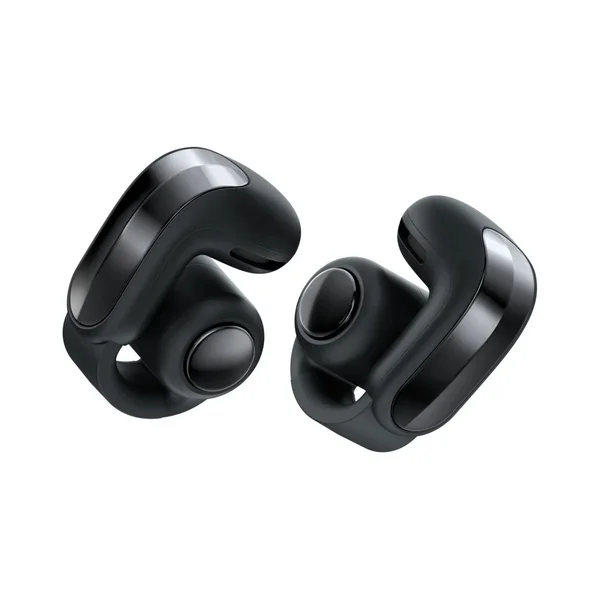
Bose says it pioneered the cuff shape, and it refreshed the line this autumn. According to Bose’s announcement, the Ultra Open Earbuds (2nd Gen) cost $299 and run up to 9 hours, with up to 19.5 more hours in the case. The new Bose Sport Open Earbuds cost $199, use “a C-arm cuff” for a steadier fit, run up to 7 hours and carry an IP54 rating for sweat, splash and dust. Both went on sale on October 1, 2026.
Cuffs are the easiest open design to forget you are wearing. That cuts both ways: on a long run, a cuff can shift slightly as you sweat, while a bone conduction band or a hook stays more locked in place.
Sound leakage affects both designs, so volume matters more than type
Both open designs leak some sound, because nothing seals the audio inside your ear. Makers fight this with acoustic tricks, but their own claims say “minimal” or “controlled”, never zero. The louder you play, the more the person next to you hears.
Bose says its OpenAudio technology delivers sound “with minimal sound leakage”. Shokz says the OpenRun Pro 2 has “advanced sound leakage control” and that its decoupled drivers help audio stay private “even in shared spaces”. Both statements describe an effort to reduce leakage, not to stop it.
In practice, a quiet office is the toughest test. A podcast at moderate volume will usually stay private. A playlist turned up to beat an air conditioner probably will not, and the colleague at the next desk may know your music taste better than you would like.
For calls on a train or in an open office, a sealed design is the more polite choice. Our picks of earbuds for making phone calls cover that job.
Neither design is automatically safer for your hearing
Neither bone conduction nor open-ear headphones protect your hearing by design. Bone conduction still delivers sound to the cochlea, where noise damage happens. What keeps your hearing safe is how loud you listen and for how long, measured against official limits.
The US National Institute on Deafness and Other Communication Disorders (NIDCD) explains that most noise-induced hearing loss comes from damage to the hair cells in the inner ear, and that human hair cells don’t grow back. Sounds at or below 70 dBA are unlikely to cause hearing loss, while long or repeated exposure at or above 85 dBA can. NIDCD lists music through headphones at maximum volume at 94 to 110 dBA.
WHO gives weekly limits. Its safe listening guidance says you can listen at 80 dB for up to 40 hours a week. The allowance shrinks fast as volume rises: 12 hours 30 minutes at 85 dB, 4 hours at 90 dB, 1 hour 15 minutes at 95 dB and just 20 minutes at 100 dB. The joint WHO and ITU safe listening standard uses the same 80 dB for 40 hours a week for adults, and 75 dB for 40 hours a week for children.
NIOSH, the US workplace safety institute, uses a similar logic for jobs: a recommended limit of 85 dBA averaged over an 8-hour shift, and for each 3 dBA increase in noise level it recommends halving the exposure time.
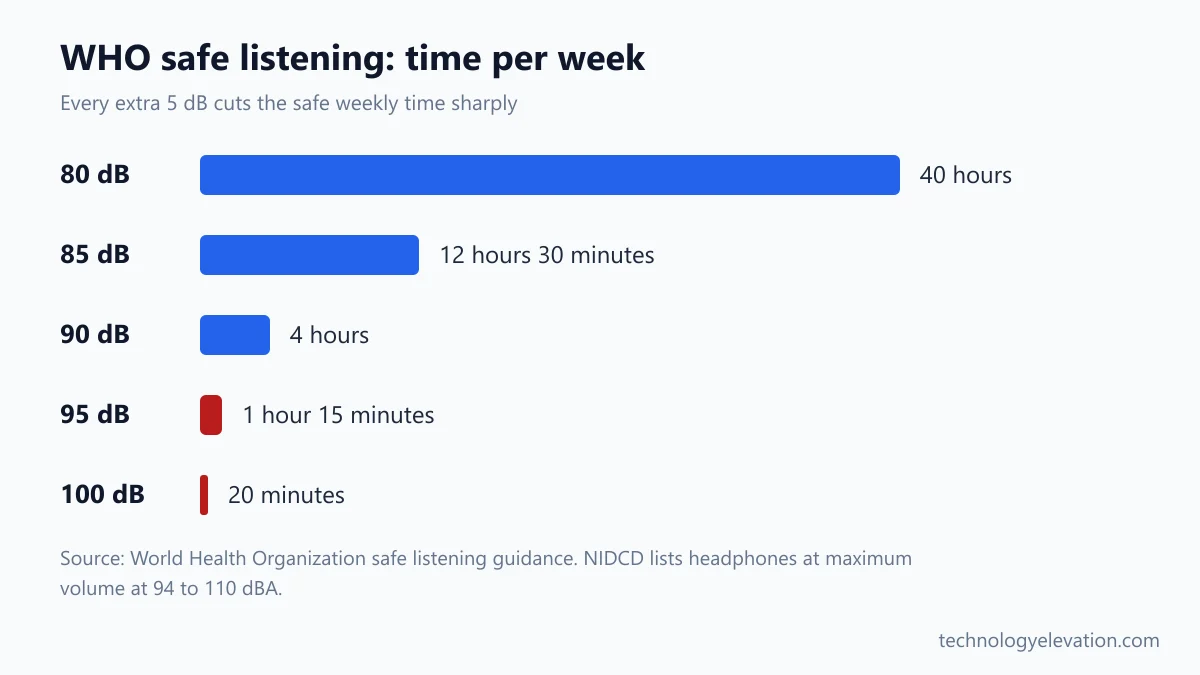
Here is where open designs carry a hidden risk. WHO’s own advice is to “use well-fitted, and noise cancelling headphones to reduce the need to raise volume in noisy situations.” Open headphones do the opposite: they let the noise in. On a loud street or a train, you will be tempted to turn them up to compete, and that is exactly how the weekly allowance disappears.
So the honest answer: open designs are better for hearing traffic, sealed noise-cancelling designs are better for keeping volume down in noisy places. Many people end up owning one of each.
Keep any open headphone below the official weekly limit
The simplest rule comes from WHO: keep your device volume at no more than 60% of maximum, take regular breaks and use the safe listening features built into your phone. Those three habits matter more than whether your headphones vibrate bone or push air.
- Set a volume habit of 60% or less of maximum, as WHO recommends, and drop lower in quiet rooms.
- Turn on your phone’s listening monitor. On an iPhone, Apple’s headphone notifications warn you after over 80 dB for 40 hours total within the last 7 days, then set your volume lower the next time headphones connect.
- Use Apple’s Reduce Loud Audio setting, or your phone’s equivalent, to lower headphone volume automatically above a level you choose.
- Give your ears a break from loud sound often, as WHO advises, especially after a concert or a noisy commute.
- Switch to sealed, noise-cancelling headphones on planes, trains and loud streets where you do not need to hear traffic.
Hearing traffic is where open designs earn their place
Open-ear and bone conduction headphones exist mainly so you can hear what is around you while listening. For running, cycling and walking on roads, that awareness is the whole point, and both designs keep your ear canal clear to do it.
Bone conduction gets the edge for pure awareness, because nothing sits in front of the ear opening at all. Air-conduction and cuff designs put a small speaker near the canal, which still lets outside sound in but covers a little more of the ear.
Wind is the catch on a bike. At speed, wind roar across an open ear can drown out both your music and the car behind you, whatever the headphone type. Keeping the volume low, or sticking to podcasts on fast descents, is the sensible habit.
Runners carrying a phone for music will want a stable mount too. A good phone holder for running stops the bounce, and a cheap running watch with music storage can replace the phone entirely.
Race rules on headphones depend on the event
Headphone rules are set by each sport’s governing body and each race, not by the headphone type. USA Triathlon is the clearest example: its rules let you carry a phone, but playing music during competition counts as distractive use and may mean disqualification.
The USA Triathlon rules page says participants “may carry a phone (such as, mounted on bike handlebars or in an arm band) but may not use communication devices of any type” in “any distractive manner during the competition”. Its list of distractive uses includes making or receiving calls, texting, playing music and using social media. The linked competition rules PDF is marked as updated on January 1, 2026.
Notice what that wording does not do: it does not make an exception for open-ear or bone conduction headphones. Marketing that calls a pair “race-ready” says nothing about the rules at your event.
Road running races vary. Each race publishes its own rules in its participant guide or race instructions, and rules can differ between the elite field and everyone else. Read that document before race day, not at the start line.
Pick bone conduction for roads and open-ear for all-day comfort
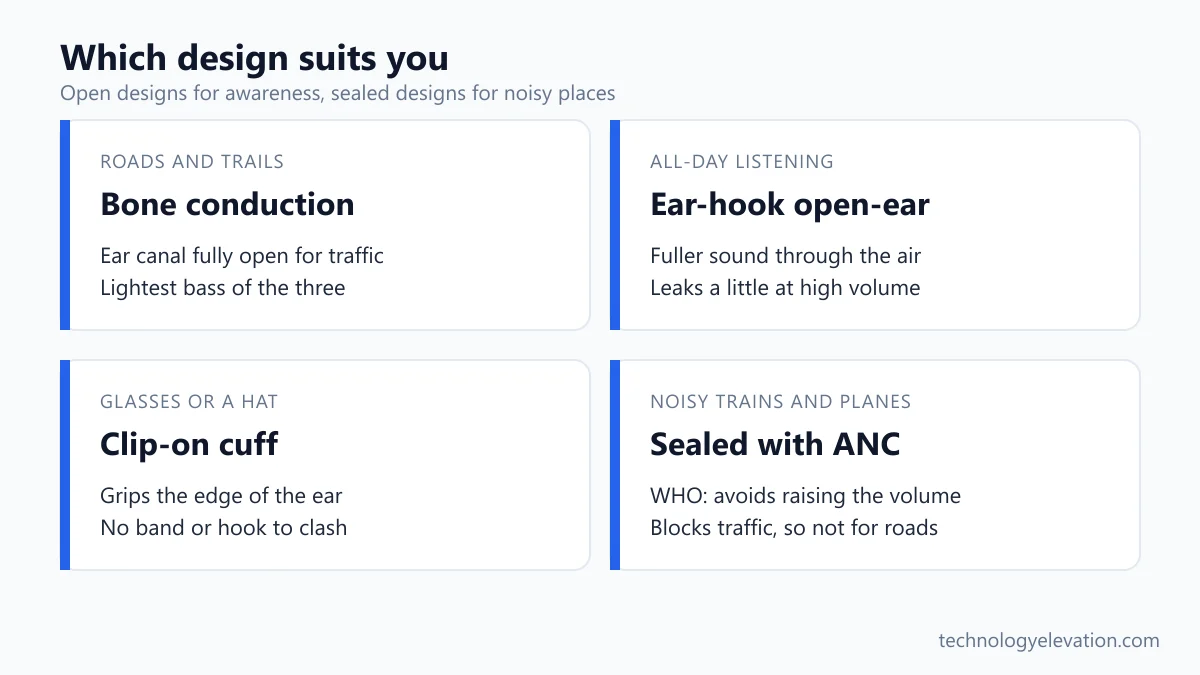
Choose bone conduction if you mostly run or ride on roads and want the most awareness. Choose air-conduction open-ear or clip-on buds if you want better sound for long days at a desk or around the house. Choose sealed noise-cancelling headphones for loud places.
A few practical tie-breakers decide most cases:
- You wear glasses or a helmet: cuff buds avoid the band and hook entirely. With a cycling helmet, try any band or hook under the straps before you buy.
- You sweat heavily or train in rain: check the IP rating. The Shokz OpenRun Pro 2 is rated IP55 and the Bose Sport Open Earbuds IP54. Swimmers need a model built for it, and our pick of waterproof headphones covers those.
- You care about music more than podcasts: air-conduction or hybrid designs such as DualPitch, because pure bone conduction is weakest on bass.
- You share an office: keep volume low or switch to sealed earbuds, since both open styles leak.
Price is no longer a reliable tie-breaker. The three models named here range from $179.95 to $299 at list price. Cheaper bone conduction and open-ear sets exist, and the bone conduction headphones shortlist includes budget options. For other kit worth pairing with them, the running gadgets roundup is a good next stop.
Frequently asked questions about open-ear vs bone conduction headphones
Is bone conduction better than open-ear?
Bone conduction is better for maximum awareness on roads, while air-conduction open-ear headphones usually sound fuller, especially in the bass. Neither is better for every use. Pick by where you listen most.
Are bone conduction headphones safer for your ears?
No, not automatically. Bone conduction still sends sound to the cochlea, where noise damage happens, so loud volume for long periods carries the same risk. WHO’s weekly guide is 80 dB for up to 40 hours.
Can other people hear my open-ear or bone conduction headphones?
Yes, at higher volumes. Both designs leave the ear unsealed, so some sound escapes, and makers such as Bose and Shokz describe their leakage as minimal or controlled rather than zero. Quiet rooms make leakage most noticeable.
Can I wear open-ear headphones in a triathlon?
Not for music in a USA Triathlon event. Its rules let you carry a phone, but playing music counts as distractive use of a communication device and may result in disqualification. Check your race’s own rules too.
What is a clip-on or cuff earbud?
A clip-on or cuff earbud is an open-ear, air-conduction earbud that grips the edge of your ear instead of hooking over it. Examples include the Bose Ultra Open Earbuds (2nd Gen) and Bose Sport Open Earbuds.
Why do bone conduction headphones tickle?
Bone conduction works by vibrating the cheekbones, and at higher volumes you can feel those vibrations on your skin. Hybrid designs such as the Shokz OpenRun Pro 2 move bass to an air-conduction speaker to reduce vibration.
How loud is too loud for headphones?
NIDCD says long or repeated exposure at or above 85 dBA can cause hearing loss. WHO suggests keeping your device at no more than 60% of maximum volume and limiting 80 dB listening to 40 hours a week.
Last checked and sources
Last checked on 15 November 2026 by Haris Khan.
We compared the leading explainers for this topic, then checked every health figure, rule and product spec against the official body’s or maker’s own page.
- World Health Organization: Deafness and hearing loss fact sheet, and the safe listening questions and answers
- WHO and ITU: Safe listening devices and systems standard
- National Institute on Deafness and Other Communication Disorders (NIDCD): Noise-induced hearing loss
- CDC National Institute for Occupational Safety and Health (NIOSH): noise exposure pages
- US National Library of Medicine: Bone Conduction Implants for Hearing Rehabilitation in Skull Base Tumor Patients (2019)
- USA Triathlon: Multisport rules page and competition rules
- Apple Support: Headphone notifications on your iPhone, iPad, or Apple Watch
- Bose: Sport Open Earbuds and Ultra Open Earbuds (2nd Gen) announcement, September 17, 2026
- Shokz: OpenRun Pro 2 product page
We update this guide when official guidance changes or new open-ear designs launch.

GIPHY App Key not set. Please check settings