

 Abdullah Kabeer
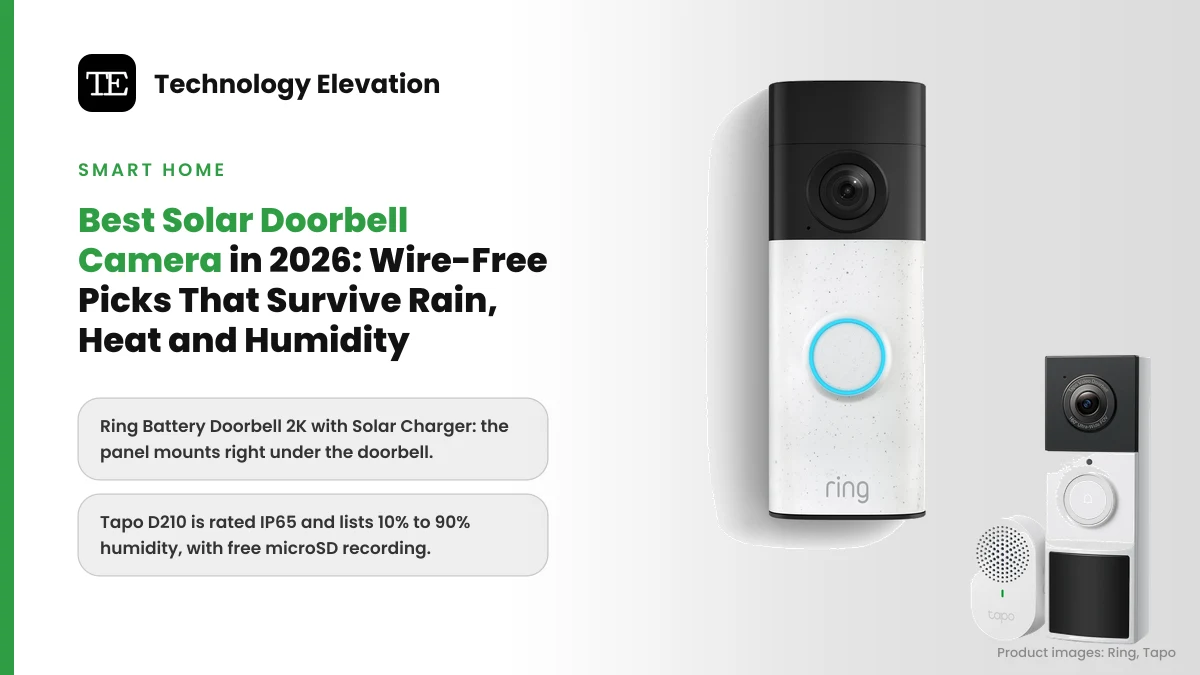
Look at the front doors on any street in August and you can spot the solar doorbells. A small black panel sits under the button or a few feet up the wall, angled at the sky. Finding the best solar doorbell camera is less about the panel than about two questions most buyers skip: does your door actually get direct sun, and will the doorbell itself cope with the rain, heat and sticky air it sits in all year?
The sun question has a real answer. Ring’s own support page says its doorbell solar accessories need three to four hours of direct sunlight a day, and that filtered light through clouds will not charge the doorbell at all. A porch under a deep roof overhang may never see that much.
The weather question is harder, because makers describe it in codes. IP65, IP55 and a bare “IPX” all appear on the doorbells in this guide, and they do not mean the same thing. Humidity ratings are rarer still.
So we compared every solar-ready doorbell we could find from the big brands, checked each maker’s own spec sheet for its weather rating, temperature range and solar accessory, and left out anything that only works with an unofficial panel.
The best solar doorbell camera is the Ring Battery Doorbell 2K with Solar Charger
The Ring Battery Doorbell 2K (2nd Gen) with Ring’s Solar Charger is the best solar doorbell camera for most homes. The panel mounts directly under the doorbell, it records 2K head-to-toe video, works from -5°F to 120°F, and the doorbell launched at $99.99.
Every pick, by the job it does best:
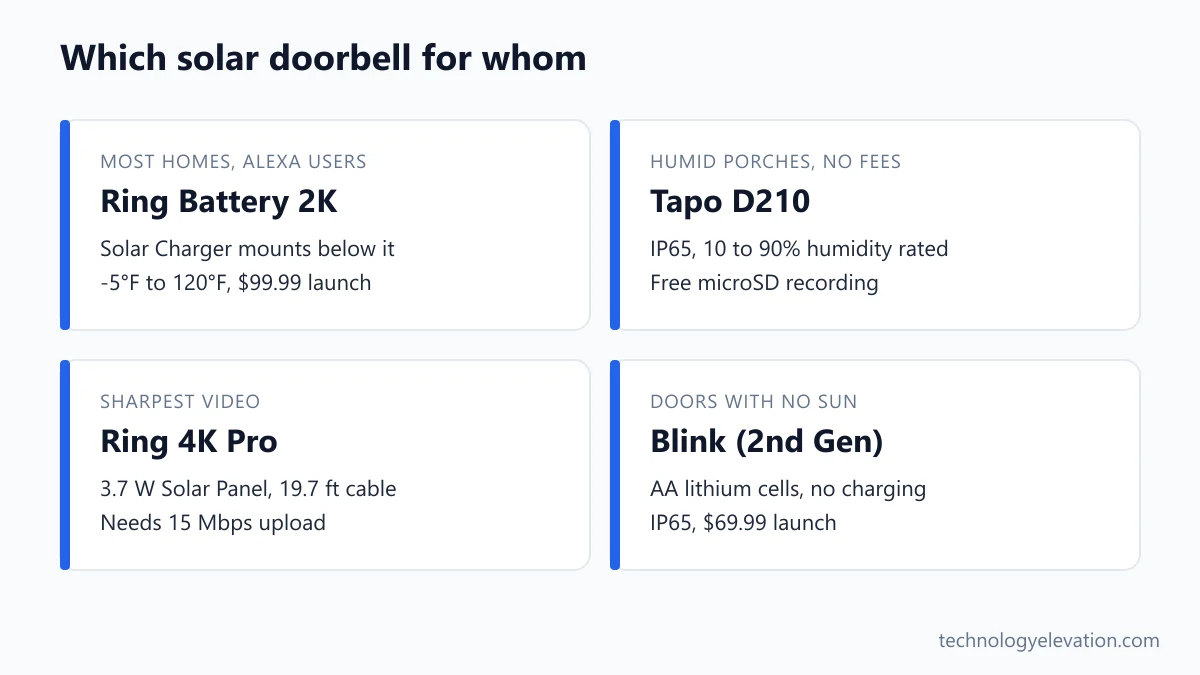
- Best overall: Ring Battery Doorbell 2K (2nd Gen) + Solar Charger
- Best for humid porches and no subscription: Tapo D210 with the Tapo A201 solar panel
- Best for rainy climates in a Ring home: Ring Battery Doorbell 2K Plus (2nd Gen)
- Best video quality: Ring Battery Doorbell 4K Pro (2nd Gen) + Solar Panel
- Best for shady doors where solar will not work: Blink Video Doorbell (2nd Gen)
| Model | Solar option | Weather rating | Operating range | Video | Launch price |
|---|---|---|---|---|---|
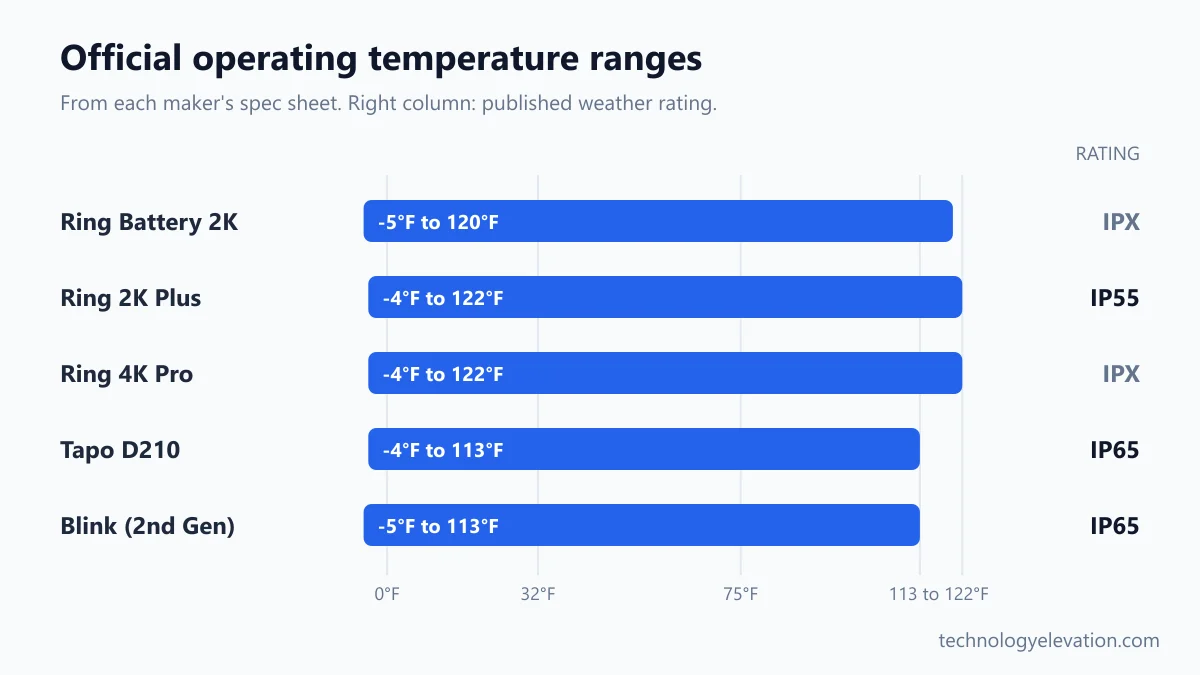
| Ring Battery Doorbell 2K (2nd Gen) | Solar Charger ($49.99) or Solar Panel ($59.99) | Weather resistant (IPX) | -5°F to 120°F | 2K, 140° x 140° | $99.99 |
| Tapo D210 | Tapo A201 panel, sold separately | IP65 | -4°F to 113°F | 2K, 160° diagonal | $74.99 list |
| Ring Battery Doorbell 2K Plus (2nd Gen) | Solar Charger or Solar Panel | IP55 | -4°F to 122°F | 2K, 140° x 140° | $179.99 |
| Ring Battery Doorbell 4K Pro (2nd Gen) | Solar Panel ($59.99) | Weather resistant (IPX) | -4°F to 122°F | 4K, 140° x 140° | $249.99 |
| Blink Video Doorbell (2nd Gen) | None from Blink | IP65 | -5°F to 113°F | 1440p, 150° x 150° | $69.99 with Sync Module Core |
Ring’s bundle of the Battery Doorbell 2K and Solar Charger carries a list price of $129.99. Prices on all of these drop often around Prime Day and Black Friday, so treat the figures above as a ceiling.
Ring Battery Doorbell 2K (2nd Gen) + Solar Charger: the best solar doorbell overall
The Ring Battery Doorbell 2K (2nd Gen) is the best solar doorbell overall because Ring designed the panel and doorbell to work as one unit. The Solar Charger sits directly beneath the doorbell, so there is no loose cable to route, and the pair covers -5°F to 120°F.
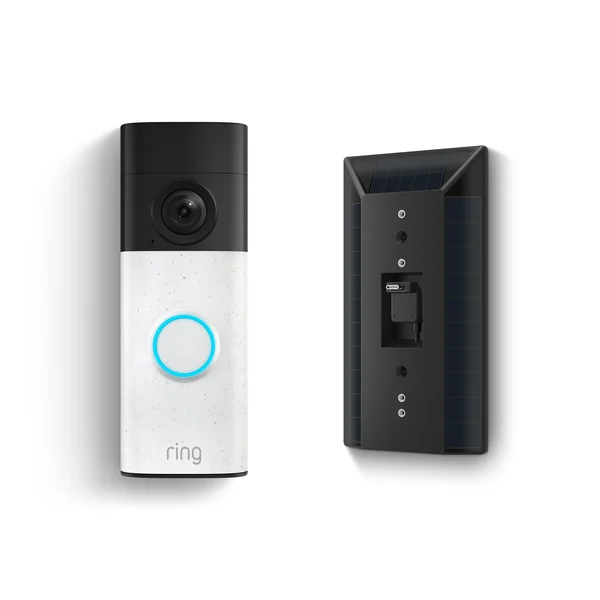
Key specs: Retinal 2K video at 1920 x 1920, 140° horizontal and 140° vertical field of view, up to 6x Enhanced Zoom, built-in rechargeable battery, 2.4 GHz Wi-Fi, operating range -5°F to 120°F, optional hardwiring to an 8 to 24 VAC transformer. Announced March 25, 2026, at $99.99. The Solar Charger launched at $49.99.
Ring announced its second-generation battery doorbells and two new solar accessories together in March 2026, in an Amazon announcement that put the Battery Doorbell (2nd Gen) at $99.99 and the Solar Charger at $49.99. Ring has since renamed the doorbell the Battery Doorbell 2K. Same product, new label.
The Solar Charger works like a backplate. You screw it to the wall, then mount the doorbell on top of it. Ring says to face it south if you live in the Northern Hemisphere, and to fully charge the doorbell before you put it up.
The honest catch is the battery. It is built in, not removable. On a week of grey skies, when the panel cannot keep up, you take the whole doorbell down to charge it indoors. Owners of the Plus and Pro models just swap a battery pack instead.
Ring also lists the weather rating only as “IPX,” with no numbers. That is weaker paperwork than the IP65 on the Tapo D210 below, and it matters if your front door faces driving rain off the coast.
Buy it if you want the simplest wire-free doorbell with solar built into the mount, and you already use Alexa or an Echo Show smart display to see who is at the door.
Buy the Ring Battery Doorbell 2K + Solar Charger now on Amazon
Tapo D210: the best solar doorbell for humid porches and no subscription
The Tapo D210 is the best solar doorbell for humid, rainy porches and for anyone who hates monthly fees. It carries a full IP65 rating, publishes a humidity range, records to a microSD card for free and takes TP-Link’s optional Tapo A201 solar panel.
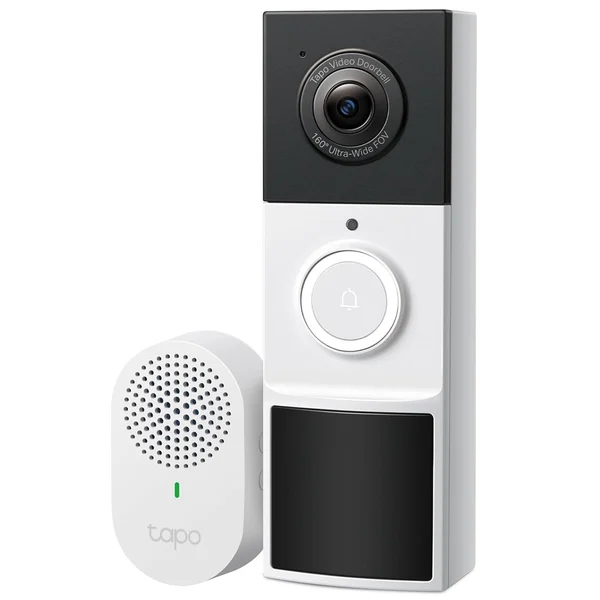
Key specs: 2K video at 2304 x 1296, 160° diagonal field of view, 5,200 mAh built-in battery rated for up to 180 days, IP65, operating range -4°F to 113°F, operating humidity 10% to 90% RH non-condensing, microSD slot up to 512 GB, plug-in chime included, works with Alexa and Google Assistant. List price $74.99 on TP-Link’s US store.
Humidity is the number almost nobody prints. TP-Link does: 10% to 90% relative humidity, non-condensing. Non-condensing means the air can be damp, but water should not form droplets inside the case. For a Gulf Coast porch that feels like a sauna by 9 a.m., that is the most useful line on any spec sheet in this guide.
The IP65 rating means the case is dust-tight and protected against jets of water from any direction. A summer downpour blowing sideways is well inside that.
You also skip the subscription if you want to. Video saves to a microSD card (sold separately), and Tapo’s own page says local storage carries no subscription fee. Tapo Care, the paid cloud plan, adds cloud storage and snapshot alerts.
The catch is heat. At 113°F, the D210’s upper limit is the lowest here alongside Blink. A west-facing door in Arizona can beat that in July. And the Tapo A201 panel is sold separately, so budget for it.
Buy the Tapo D210 now on Amazon
Ring Battery Doorbell 2K Plus (2nd Gen): the best Ring solar doorbell for rainy climates
The Ring Battery Doorbell 2K Plus (2nd Gen) is the best Ring choice for wet climates. It is the only Ring battery doorbell here with a numbered weather rating, IP55, and its Quick Release Battery Pack swaps out in seconds when a cloudy week drains it.
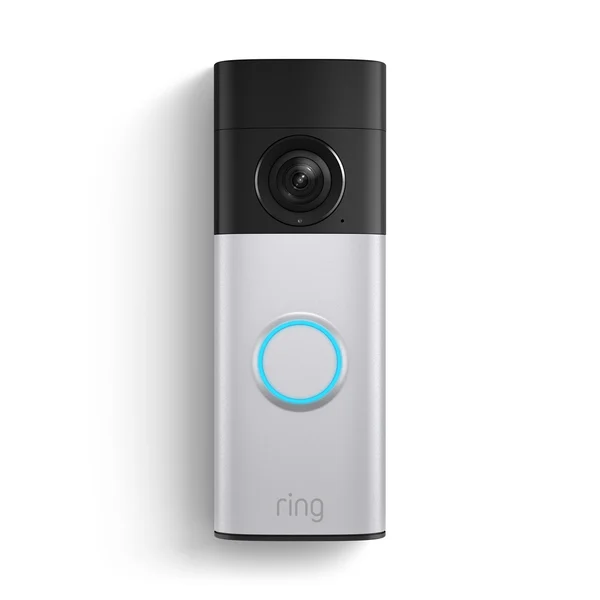
Key specs: Retinal 2K video at 1920 x 1920, 140° x 140° head-to-toe view, up to 6x Enhanced Zoom, removable Quick Release Battery Pack, dual-band Wi-Fi 6 on 2.4 and 5 GHz, IP55, operating range -4°F to 122°F, optional hardwiring to an 8 to 24 VAC transformer. Launched at $179.99.
IP55 is a step below IP65, but a real one. The first 5 means dust protected rather than dust-tight. The second 5 means protected against water jets. For a rainy Pacific Northwest porch, that covers what the sky throws at it.
The removable battery changes how solar feels day to day. When the panel falls behind in November, you pull the pack, drop in a charged spare and keep recording. Ring sells extra packs, and two of them make cloudy months painless.
Dual-band Wi-Fi 6 is the other upgrade over the cheaper 2K. If your router sits at the back of the house, the doorbell can fall back to 2.4 GHz for range. A weak signal also drains batteries faster, because the doorbell works harder to stay connected. A good mesh Wi-Fi system near the front door fixes both problems.
The Plus works with Ring’s Solar Charger or its larger Solar Panel. Ring recommends a 10 Mbps upload speed for it.
Buy the Ring Battery Doorbell 2K Plus now on Amazon
Ring Battery Doorbell 4K Pro (2nd Gen) + Solar Panel: the best video on solar power
The Ring Battery Doorbell 4K Pro (2nd Gen) is the best solar doorbell for video quality. It records Retinal 4K with up to 10x Enhanced Zoom, uses radar-based 3D Motion Detection, and pairs with Ring’s 3.7-watt Solar Panel. It launched at $249.99.
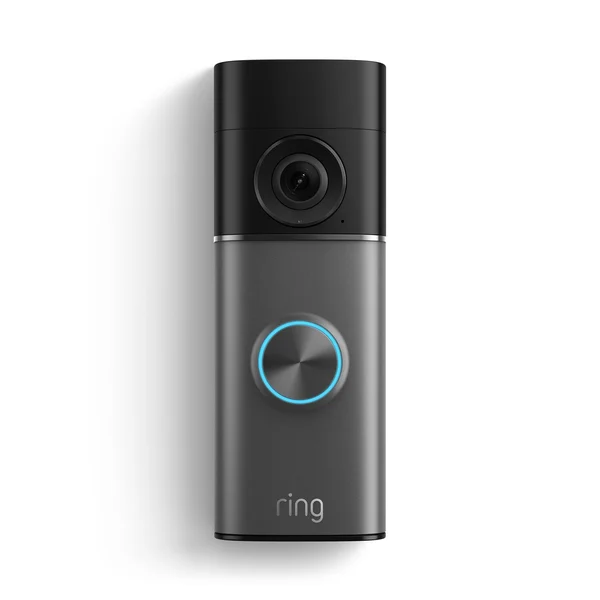
Key specs: Retinal 4K video, 140° horizontal and 140° vertical field of view, up to 10x Enhanced Zoom, 3D Motion Detection, removable Quick Release Ultra Battery Pack charged over USB-C, dual-band Wi-Fi 6, operating range -4°F to 122°F, optional hardwiring to an 8 to 24 VAC transformer. Solar Panel: 3.7 W with a 19.7-foot cable, launched at $59.99.
4K is the reason to pay more. Zoom in on a license plate at the curb or a face at the edge of the frame, and the extra pixels hold up where 2K turns to mush.
4K also uses more power and more bandwidth. Ring recommends at least 15 Mbps of upload speed for its 4K devices. That is why the Pro pairs best with the Solar Panel rather than the smaller charger. The panel mounts on a wall or roof on its own adjustable base, so you can aim it at open sky even if the door itself sits in shade.
That separate panel is the big practical win. A 19.7-foot cable lets you put the panel above the porch roof while the doorbell stays under cover, out of the worst rain and the hottest afternoon sun.
The catch matches the cheaper Ring: the weather rating is listed only as “IPX.” Ring’s video and motion features also lean on a Ring plan, more on that below.
Buy the Ring Battery Doorbell 4K Pro now on Amazon
Blink Video Doorbell (2nd Gen): the best pick for doors with no sun
The Blink Video Doorbell (2nd Gen) is the best choice when your door never gets three hours of direct sun. It runs up to two years on three AA lithium batteries, carries an IP65 rating, and launched at $69.99 with the Sync Module Core it needs.
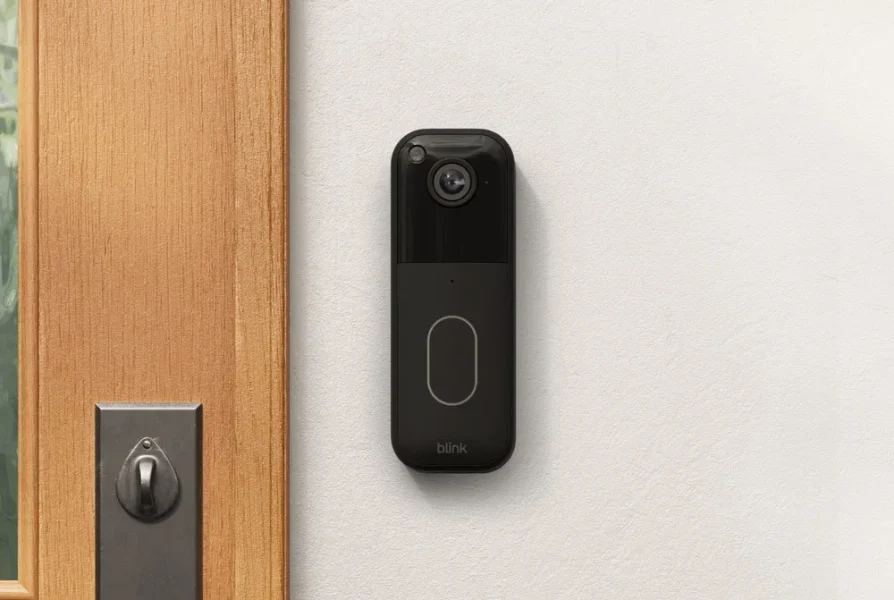
Key specs: 1440p HD video at up to 30 fps, 150° x 150° head-to-toe view, three AA 1.5-volt lithium non-rechargeable batteries rated for up to two years at default settings, IP65, operating range -5°F to 113°F, optional connection to 16 to 24 VAC chime wiring, Sync Module required.
Solar only helps if sunlight reaches the panel. North-facing doors, deep porches and apartment hallways do not get enough, and a solar doorbell there just becomes a battery doorbell with an extra bracket.
Blink sidesteps the issue. Its batteries are not rechargeable, so there is no charging step to pause in cold or heat. You swap three AA cells when the app says so.
Blink does not make a solar panel for this doorbell. Third-party panels exist, but compatibility varies by backplate and model, and none comes from Blink.
The weak points are video and features. 1440p is behind the 2K and 4K Ring models, and person detection needs a paid Blink plan.
Buy the Blink Video Doorbell (2nd Gen) now on Amazon
Most doorbell brands do not sell their own solar panel
Only Ring and TP-Link’s Tapo sell their own solar accessories for their current battery doorbells among the big US brands. eufy says its solar panels are not compatible with its video doorbells, and Blink, Arlo and Wyze doorbell panels come from third-party makers.
That surprised us. eufy sells solar cameras everywhere, yet its own blog post on solar doorbells, updated in October 2026, states plainly that “eufy solar panels are not compatible with our video doorbells yet.” The popular eufy Video Doorbell E340 is a battery doorbell, not a solar one, whatever a listing title says.
Third-party panels from brands like Wasserstein are sold for Blink, Arlo, Wyze and eufy doorbells. Some work well. But each listing comes with its own compatibility fine print (one Blink panel fits only the “two-hole” backplate, for example), and the doorbell maker will not support it if charging goes wrong.
Our rule for this guide was simple: the doorbell maker has to sell or list the panel itself.
Sun, weather rating and running costs decide the right solar doorbell
Choose a solar doorbell by checking your sunlight first, then the weather rating, then the temperature range, then the running costs. A panel that gets less than three hours of direct sun will not keep up, and a weak rating will not survive a soaked, humid porch for long.
- Watch your door for a day. Note when direct sun actually hits it, the same test you would use for an outdoor solar motion sensor light. Ring says its solar accessories need three to four hours of direct sunlight daily. Less than that, look at a separate panel on a longer cable, or the Blink.
- Read the weather rating. IP65 beats IP55, and both beat a bare “IPX.” Coastal and very humid homes should lean toward IP65.
- Check both ends of the temperature range. Every pick here bottoms out at -4°F or -5°F. The top end varies from 113°F to 122°F, which matters in the desert Southwest.
- Decide on removable or built-in battery. A removable pack (Ring 2K Plus and 4K Pro) lets you swap and keep recording. A built-in battery means taking the doorbell down to charge.
- Plan for chimes. Ring battery doorbells ring a mechanical or digital chime only when wired to doorbell wiring. The Tapo D210 includes a plug-in chime.
- Price the subscription. Ring and Blink keep recorded video behind a paid plan. The Tapo records to microSD for free.
A quick reality check on solar: in every case here, the panel tops up a battery. It does not replace it. Ring’s own wording is that its panels “extend the life” of the doorbell battery. If none of your doors gets enough sun, a wired video doorbell avoids the battery question completely.
IP ratings in plain words, and what humidity really does
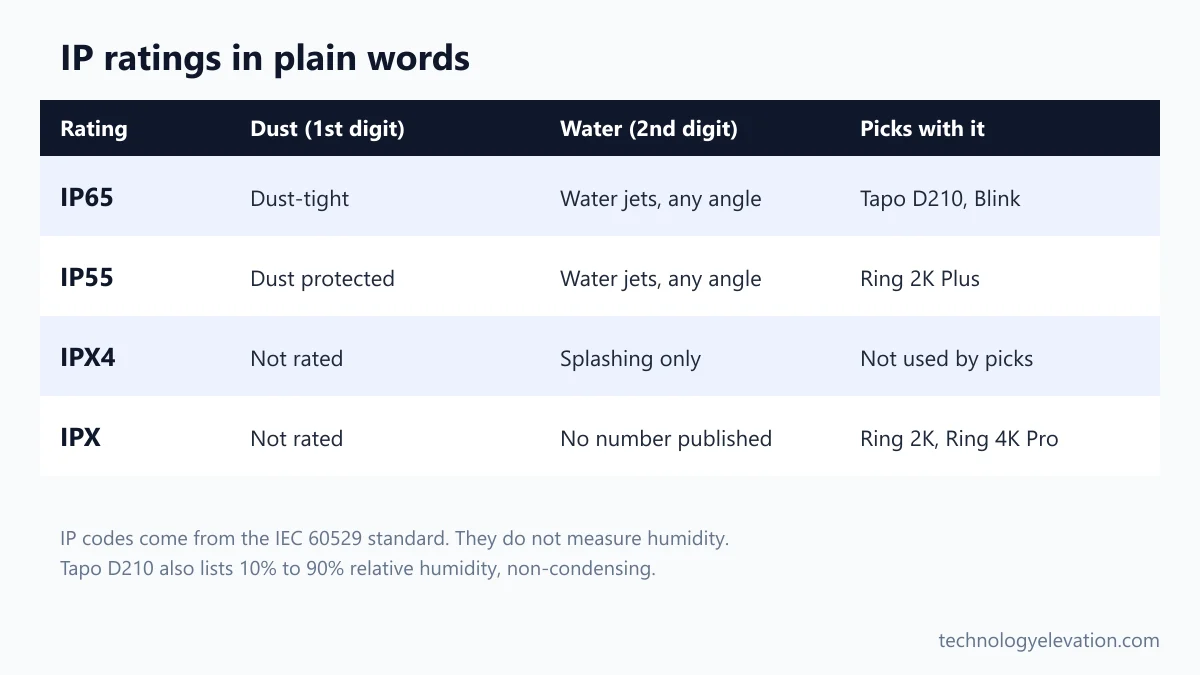
An IP rating is two digits: the first for dust, the second for water. IP65 means dust-tight and protected from water jets. IP55 means dust protected and protected from water jets. An “X” means that part was not rated, so “IPX” alone tells you very little.
Those codes come from the international IEC 60529 standard. The second digit is the one most people care about on a front door. A 5 covers water jets from any angle, which is what wind-driven rain looks like to a doorbell. A 4 would only cover splashing.
Humidity is a separate problem, and IP ratings do not measure it. A sealed case keeps rain out, but warm, damp air still gets in through tiny gaps and condenses when the night cools. That is what fogs a lens from the inside or corrodes a charging contact over a few summers.
Rust resistance is not something any of these makers publishes a test for. The closest official numbers are the IP rating and, where it exists, an operating humidity range like the Tapo D210’s 10% to 90% non-condensing.
Three habits help in muggy climates:
- Mount the doorbell under a roof edge or overhang if you can, and put a separate panel in the sun.
- Charge removable batteries indoors on a dry day, so you are not opening the case in the rain.
- Use a wedge mount if your doorbell comes with one, so the camera tilts toward the path instead of up into the rain.
Heat and cold both pause solar charging
Solar doorbells stop charging in extreme heat and in freezing weather, even in bright sun. Ring says its battery devices are designed to stop charging below freezing and will not charge, or can shut down, if they get too hot. Plan for slower charging in both summer and winter.
Cold first. Ring’s cold weather support page says the device is “designed to stop charging if the temperature is below freezing,” and suggests charging indoors over USB rather than waiting for the sun. A sunny January morning at 25°F charges nothing. If your winters stay below freezing for weeks, a wired model from the cold weather doorbell list is the safer bet.
Heat is the summer version of the same problem. Ring says the ideal temperature is around 75°F, that a device which gets too hot will not charge, and that some models enter a cooldown mode with lower video quality. A black doorbell on a south-facing door in Phoenix can run far hotter than the air.
That is the strongest argument for a separate panel. Put the panel in full sun and the doorbell in shade, and you get the charge without cooking the battery.
Renters can use solar doorbells, with a few limits
Renters can use most solar doorbells, because none of the picks here needs house wiring. The Tapo D210 comes with 3M adhesive for a no-drill install. Ring’s Solar Charger and Solar Panel use screws, so ask your landlord first.
Check your lease for drilling and exterior changes. Four small screw holes beside a door frame are easy to fill when you move out, but some buildings ban anything on the facade.
Apartment doors usually face a hallway, which means no sun at all. Skip solar there. A battery doorbell or a peephole camera makes more sense, and a smart lock from the keyless entry door locks range pairs well with either.
Chimes are the other renter issue. If you do not connect to the existing doorbell wiring, the old chime will not ring. Use the Tapo’s plug-in chime, a Ring Chime, or an Echo device instead.
Subscription costs add up faster than the panel
Ring’s main plans run from $4.99 a month for one device to $19.99 a month for a whole home, and Ring says a plan is required for video recording and person alerts. Tapo records to microSD for free. Blink needs a paid plan for person detection.
Ring’s current plans are named Solo ($4.99 a month or $49.99 a year, one device), Multi ($9.99 a month or $99.99 a year, every device at one address) and Pro ($19.99 a month or $199.99 a year, which adds 24/7 professional monitoring). All three keep up to 180 days of video history. A free 30-day trial starts at setup.
Over three years, Ring Solo adds about $150 to the price of the doorbell.
If you plan to add outdoor security lights with cameras later, a whole-home plan starts to make more sense than paying per device.
Frequently asked questions about solar doorbell cameras
Do solar doorbell cameras work at night?
Yes, solar doorbells work at night because the panel charges a battery during the day and the doorbell runs from that battery after dark. Every pick in this guide has night vision, and none of them needs sunlight to record.
How much sun does a solar doorbell need?
Ring says its doorbell solar accessories need three to four hours of direct sunlight a day. Filtered light through clouds will not charge the doorbell, so a shaded or north-facing door may never keep up.
Will a solar doorbell camera rust in humidity?
A well-sealed solar doorbell should not rust quickly, but no maker in this guide publishes a corrosion test. Pick an IP65 model, mount it under an overhang, and choose one with a published humidity range like the Tapo D210.
Does a solar doorbell need a subscription?
Not always. Ring requires a plan, starting at $4.99 a month, for video recording and person alerts. The Tapo D210 records to a microSD card with no subscription fee.
Can a solar doorbell ring my existing chime?
Only if you also connect it to your doorbell wiring. Ring battery doorbells work with mechanical and digital chimes when hardwired, while the Tapo D210 includes its own plug-in chime.
Do solar doorbells charge in winter?
Many stop charging below freezing, even in full sun. Ring says its battery devices are designed to stop charging below freezing, so in a cold winter you may need to charge the battery indoors.
Was there a Ring doorbell recall?
Yes, Ring recalled about 350,000 Video Doorbell (2nd Generation) units, model 5UM5E5, in November 2020 because the wrong screws could damage the battery. The 2026 Battery Doorbell 2K (2nd Gen) is a different product and is not part of that recall.
Last checked and sources
Last checked on 15 November 2026 by Abdullah Kabeer.
We compared each doorbell’s official spec sheet, solar accessory page and launch announcement, and checked every pick against the US Consumer Product Safety Commission recall database.
- Ring product and tech spec pages for the Battery Doorbell 2K, Battery Doorbell 2K Plus and Battery Doorbell 4K Pro (2nd Gen), the Solar Charger and the Solar Panel
- Ring support articles on solar panels for battery doorbells and on batteries in cold weather
- Ring plans page (Ring Solo, Multi and Pro)
- Amazon announcement of the Ring battery doorbell lineup, March 25, 2026
- TP-Link Tapo D210 specifications and US store listing; TP-Link Tapo A201 specifications
- Blink Video Doorbell (2nd Gen) tech specs; Bloomberg and TechRadar launch coverage
- eufy blog post on solar doorbell cameras (updated October 29, 2026)
- US Consumer Product Safety Commission recall notice for the Ring Video Doorbell (2nd Generation), November 2020
We update this guide when new solar doorbells launch or current models are discontinued.
Technology Elevation is reader-supported. As an Amazon Associate, we earn from qualifying purchases. When you buy through links on this page, we may earn a small commission at no extra cost to you.


GIPHY App Key not set. Please check settings