

 Abdullah Kabeer
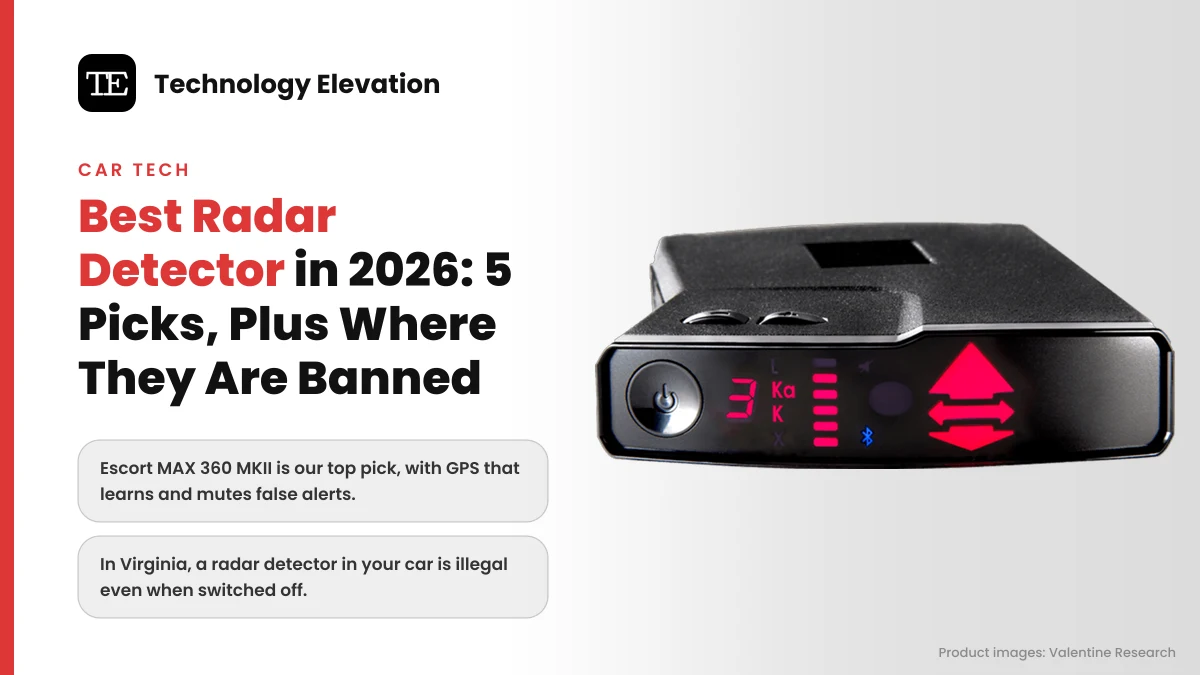
Pull into a pharmacy parking lot with a cheap radar detector on the dash and you will hear it shriek at the automatic doors. Merge next to a new SUV on the highway and it will go off again, this time at the other car’s blind spot sensors. Choosing the best radar detector in 2026 is mostly about one thing: how well it ignores the noise so you notice the alerts that matter.
Think of a detector as a situational awareness tool. It tells you that radar is in use somewhere ahead or behind, so you check your speed, look for a stopped car on the shoulder and pay closer attention. A detector does not make speeding safe, and it does not make speeding legal.
Legality matters too. In Virginia, a detector sitting in your car is enough on its own. Virginia Code section 46.2-1079 treats the presence of one in a vehicle on the highway as prima facie evidence of a violation, whether it was switched on or not.
We ranked these five on filtering first, range second and price third, and checked every legal claim against official text.
The best radar detector for most drivers is the Escort MAX 360 MKII
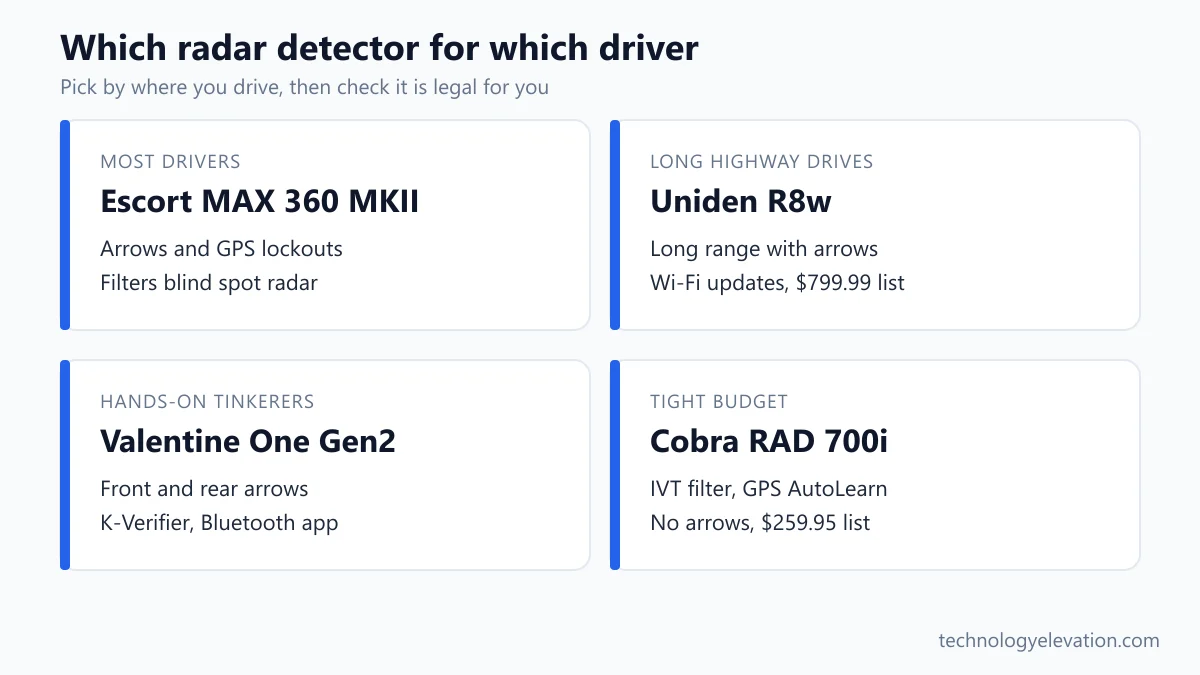
The Escort MAX 360 MKII is the best radar detector for most drivers. It has front and rear antennas with directional arrows, GPS that learns and mutes repeat false alerts, and filtering aimed at blind spot systems. It launched in March 2023 at an MSRP of $599.95.
Every pick, by the job it does best:
- Best overall: Escort MAX 360 MKII
- Best long range radar detector: Uniden R8w
- Best connected premium detector: Escort Redline 360c
- Best for drivers who want full control: Valentine One Gen2
- Best on a budget: Cobra RAD 700i
| Model | Directional arrows | Connectivity | False alert tools | Launch or list price |
|---|---|---|---|---|
| Escort MAX 360 MKII | Yes, 360 degrees | Bluetooth, GPS | AutoLearn GPS lockouts, CAS and BSM filtering | $599.95 MSRP (2023) |
| Uniden R8w | Yes, front and rear | Wi-Fi, Bluetooth, GPS | GPS lockouts, DSP filtering | $799.99 list |
| Escort Redline 360c | Yes, triple antenna | Wi-Fi, phone app | IVT filter, AutoLearn | $749.95 at launch (2020) |
| Valentine One Gen2 | Yes, front and rear | Bluetooth | K-Verifier | $499 at launch, $599 list now |
| Cobra RAD 700i | No | Bluetooth, GPS | IVT filter, AutoLearn | $259.95 list |
Prices swing a lot around Black Friday, so treat these figures as a ceiling.
Escort MAX 360 MKII: the best radar detector overall
The Escort MAX 360 MKII wins because it balances range, quiet and price better than anything else here. Dual antennas and arrows show where a signal comes from, and its software is tuned to reject collision avoidance and blind spot radar from nearby cars.
Key specs: M13 platform with dual antennas (front and rear), directional arrows, Blackfin DSP chip, GPS-based AutoLearn, Bluetooth link to the Drive Smarter app, X, K, Ka and laser detection. MSRP at launch: $599.95.
Escort claims 50% improved detection range for the MKII platform. What you notice day to day, though, is how often it stays silent. Escort’s sell sheet calls out filtering for CAS (collision avoidance systems) and BSM (blind spot monitors), the two biggest sources of false alarms on a modern commute.
AutoLearn uses GPS to remember the spots where you keep getting the same false alert, like the grocery store doors on your route home. After a few passes, it mutes that location on its own.
The catch is updates. The MAX 360 MKII lacks Wi-Fi, so firmware goes on over a USB cable and Escort’s desktop software. The MAX 360c MKII adds dual-band Wi-Fi for over-the-air updates, at an MSRP of $699.95.
Check the Escort MAX 360 MKII price on Amazon
Uniden R8w: the best long range radar detector
The Uniden R8w is the best long range radar detector for drivers who spend hours on open highways. It pairs dual antennas and arrows with GPS lockouts and Wi-Fi updates, and Uniden lists it at $799.99. It replaces the original R8, which Uniden is phasing out.
Key specs: Dual antennas with front, side and rear coverage, directional arrows, X (10.525 GHz), K (24.150 GHz) and Ka band, laser detection from 800 to 1,100 nm, GPS lockouts, Wi-Fi for firmware and camera database updates, R/Tach app over Bluetooth. Uniden unveiled it in November 2024.
The R8 was Uniden’s flagship for years. The R8w keeps the same detection hardware and adds 2.4 GHz Wi-Fi, so updates no longer mean plugging into a laptop.
Long range is most useful on rural interstates, where an early signal gives you time to check your speed calmly. In cities, extra range mostly means extra alerts.
The honest catch is availability. The R8w was launched as a Uniden.com exclusive, and Uniden’s own store showed it sold out in mid-November 2026. If you find an original R8 at a discount, know that newer firmware tends to arrive for the Wi-Fi model first.
Check the Uniden R8w price on Amazon
Escort Redline 360c: the best connected premium detector
The Escort Redline 360c is the best premium pick for drivers who want Escort’s strongest range with connected alerts. It uses a triple-antenna design, directional arrows and an updatable IVT filter, and it launched in 2020 at an MSRP of $749.95.
Key specs: Triple-antenna design, directional alert arrows, IVT filter for collision avoidance systems, AutoLearn, Wi-Fi for live software updates, Escort Live app for shared alerts, Defender database of red-light and speed camera locations. Unit weight: 1 lb.
IVT stands for in-vehicle technology. The filter targets radar from other cars’ adaptive cruise and emergency braking systems, and Escort can update it as car makers add new sensors.
Age is the downside. The Redline 360c is six years old, early firmware had bugs, and independent testers still logged some blind spot false alerts. Escort fixed the worst problems through updates and still supports it for repair.
Check the Escort Redline 360c price on Amazon
Valentine One Gen2: the best for drivers who want full control
The Valentine One Gen2 is the best radar detector for drivers who like to read the signals themselves. Its front and rear arrows, Bluetooth app and K-Verifier filter give you detailed control. Valentine lists it at $599 on its own store.
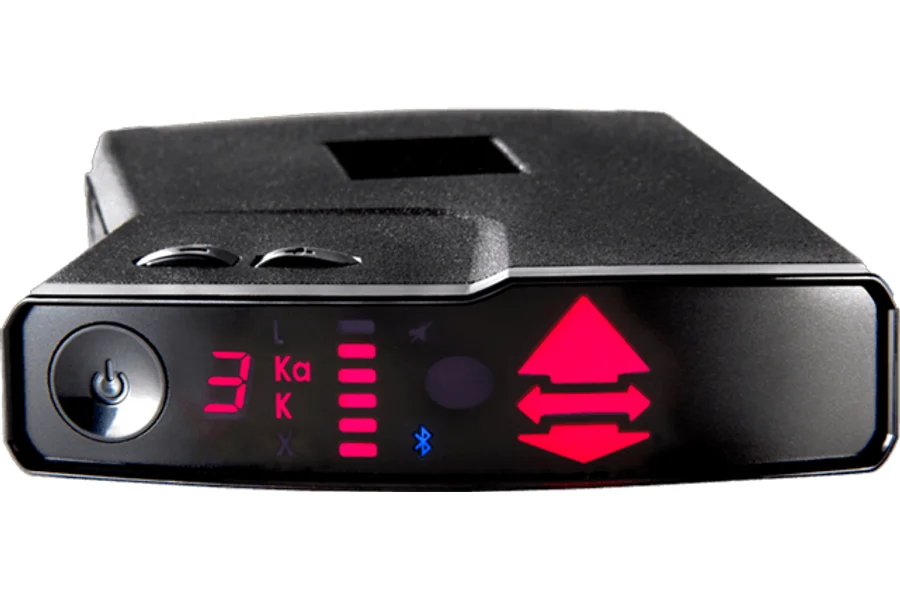
Key specs: Front and rear antennas with directional arrows, K-Verifier to cut blind spot and door opener alerts, Bluetooth 5.0 link to the free V1Connection app, detection of 3D, 3DHD and 4D K band photo radar. It launched in 2020 at $499.
The original Valentine One was the enthusiast favorite for decades, and Valentine says the Gen2 improves both Ka and K band range.
K-Verifier is the feature to know. Valentine says it improves resistance to blind spot detection systems in new cars and reduces false alarms from store-door openers. You can tweak it, along with band settings, through the app.
The V1 is not a set-and-forget device, though. It has no GPS of its own, so automatic location lockouts depend on a phone app, and the default display shows more raw detail than casual drivers want.
Resellers often ask well above Valentine’s $599 list price, so compare before you buy.
Check the Valentine One Gen2 price on Amazon
Cobra RAD 700i: the best budget radar detector
The Cobra RAD 700i is the best radar detector on a budget. Cobra launched it in September 2023 as the flagship of its RAD line, with GPS AutoLearn, an IVT filter and Bluetooth alerts, and lists it at $259.95.
Key specs: X, K, Ka and laser detection, LaserEye front and rear laser detection, IVT filter, GPS-based AutoLearn, MultaRadar (MRCD and MRCT) photo radar alerts, Bluetooth link to the Drive Smarter app, 5-color OLED display, EZ Mag Mount.
Cobra and Escort share a parent company, Cedar Electronics, so the RAD 700i runs the same Drive Smarter app and shared alert network as Escort’s detectors.
MultaRadar detection is a nice extra at this price. MRCD and MRCT are low-power photo radar units used by some speed cameras.
The main thing you give up is direction. The RAD 700i has no directional arrows, so it tells you that radar is out there but not where. For a commuter who mostly wants a quieter heads-up, that is a fair trade for less than half the price of the picks above.
Check the Cobra RAD 700i price on Amazon
Radar bands explained in plain words
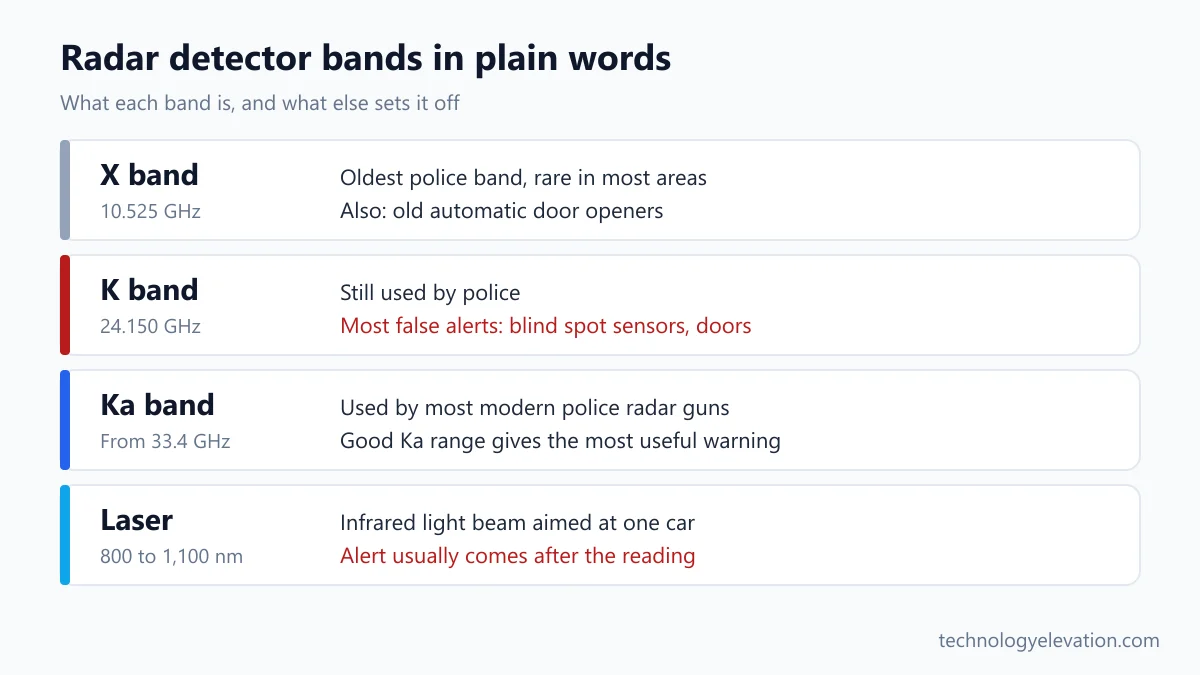
Police radar in the US runs on three bands: X, K and Ka. Each band is a slice of radio frequencies. Laser, or lidar, is not radio at all but invisible infrared light, so detectors use a separate sensor for it.
- X band (10.525 GHz): the oldest police band. Rare in most areas now, and a common source of junk alerts from old door openers.
- K band (24.150 GHz): still used by police, and shared with blind spot sensors, adaptive cruise control and many automatic doors. Most false alerts happen here.
- Ka band (from 33.4 GHz): the band most modern police radar guns use. Detectors with good Ka range give you the most useful warning.
- Laser (800 to 1,100 nm): a narrow beam of light aimed at one car. Covered further down.
You will also see “instant-on” radar: the gun stays silent until a car approaches. A detector only catches it if a car ahead gets targeted first.
Blind spot sensors cause most false alerts today
Most false alerts in 2026 come from other cars. Blind spot monitors and collision avoidance radar often transmit near police K band, so a detector without good filtering will chirp every time you pass a new SUV. Filtering software is now the most important feature.
Every maker has its own name for this. Escort and Cobra call theirs an IVT filter. Valentine calls it K-Verifier. Uniden relies on digital signal processing and GPS lockouts.
GPS lockouts handle fixed sources, like a gas station door that sets it off every morning. Moving sources, like the car beside you, need the filter.
A detector that cries wolf all day trains you to ignore it. That is the real reason a radar detector for false alerts matters: it keeps you paying attention when a real signal shows up.
Mounting matters too. A detector mounted high and centered sees farthest. One stuck low behind a car phone mount for thick cases will lose range, and some will lose their rear arrow entirely.
A laser detector usually warns you too late
A laser detector rarely gives useful warning. Police lidar fires a narrow beam of light at one specific car and gets a speed reading almost instantly. By the time your detector sees that beam, the officer usually already has your speed.
Laser alerts still have some value. If the car ahead is targeted, scatter from the beam can reach you first. Treat it as a sign that enforcement is nearby, not a chance to react.
Radar detector legality: Virginia, Washington DC, trucks and military bases
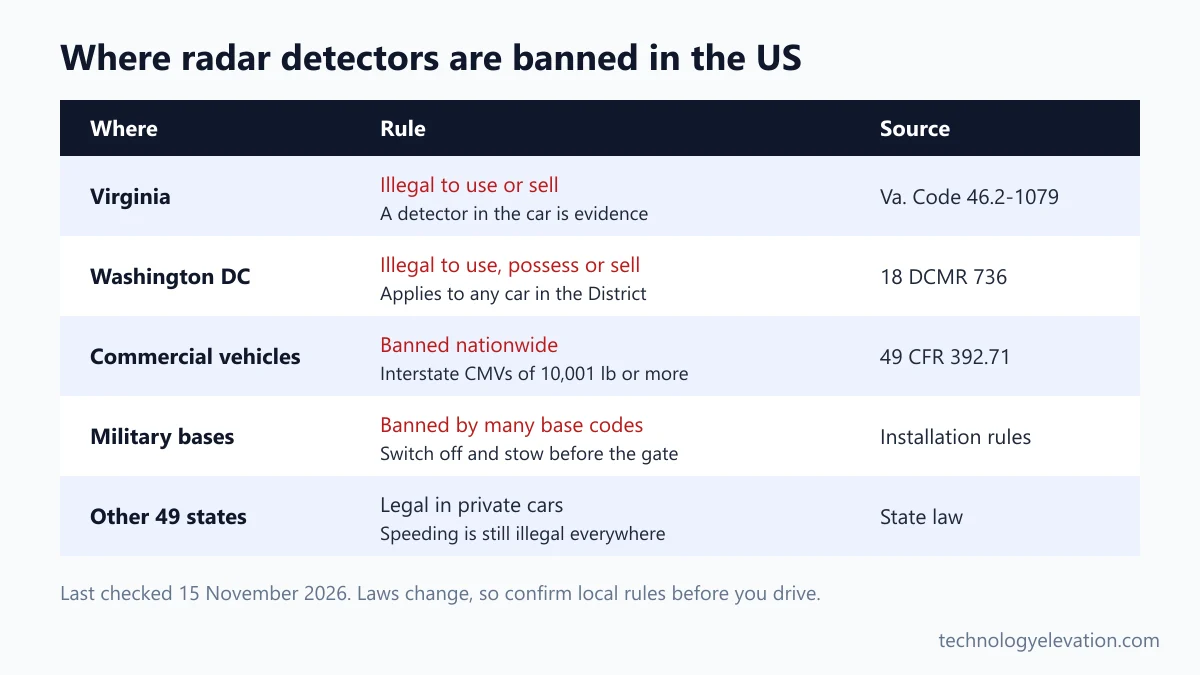
Radar detectors are legal in private cars in 49 states. They are illegal in Virginia and Washington DC, banned in commercial motor vehicles by federal rule, and banned on many military bases. Here is what each rule actually says.
Virginia. Section 46.2-1079 of the Virginia Code makes it unlawful to operate a motor vehicle on the state’s highways with a radar detector, and unlawful to sell one in Virginia. Having the device in the car is prima facie evidence of a violation, and the state does not need to prove it was switched on. You are not guilty if the device had no power source and was not readily within reach of the driver or passengers, so a detector packed in the trunk is treated differently from one on the dash.
Washington DC. District regulations (18 DCMR section 736) ban selling a device designed to detect or counteract police radar, and ban using or possessing one in a car in the District. Driving through from Maryland does not change that.
Commercial vehicles. Federal rule 49 CFR 392.71 says no driver shall use a radar detector in a commercial motor vehicle, or operate one that is equipped with or contains a detector. Motor carriers may not permit it either. FMCSA’s definition of a commercial motor vehicle covers interstate vehicles with a gross weight rating of 10,001 pounds or more, plus certain passenger vans and hazmat vehicles. A pickup towing a large trailer for a business can cross that line.
Military bases. Bases set their own traffic codes, and many prohibit radar detection devices on the installation, including Army posts such as Fort Leonard Wood and Fort Huachuca. Turn yours off and put it away before you reach the gate.
Leaving the US? Escort notes that detectors are illegal in most Canadian provinces.
A radar detector does not make speeding safe or legal
A radar detector does not make speeding safe or legal. Speed limits apply whether or not police are measuring, and a detector cannot see instant-on radar, laser aimed at you or an officer pacing your car. Use it as awareness, not permission.
Used well, an alert simply means look around. It might be a patrol car on the shoulder with people on foot nearby, so slow down and move over, as state move-over laws require.
Navigation apps add another layer. Waze flags reported speed traps, and Google Maps shows speed limits and reported speed cameras on many roads. None of those tools replaces watching your speedometer.
Six checks for choosing a radar detector
Choose a radar detector by where you drive first, then filtering, then features. City commuters need strong false alert filtering and GPS lockouts. Highway drivers benefit most from range and arrows. Check your state and vehicle rules before anything else.
- Confirm it is legal for you. Not in Virginia, DC, a commercial vehicle of 10,001 pounds or more, or on a military base.
- Prioritize filtering. Look for a named blind spot filter (IVT, K-Verifier or similar) and GPS lockouts.
- Decide if you need arrows. Arrows need front and rear antennas and add cost. They matter most on multi-lane highways.
- Match range to your roads. A long range radar detector shines on open rural highways. In cities, quiet beats range.
- Plan for updates. Wi-Fi models update themselves. Others need a USB cable and a computer, which most people skip.
- Sort out power. Most detectors run off a 12V plug. If you also charge a phone, a dual-port USB-C car charger keeps the cables tidy.
Two others are worth knowing. The Radenso DS1, launched in 2021, is a single-antenna detector with GPS lockouts and no arrows. Uniden’s R9w is a custom-installed system priced far above any windshield unit.
Take the detector off its magnetic mount when you park, since one on the glass tells thieves there is gear inside. For broader car security, a GPS tracker for cars is a better buy than any detector.
Frequently asked questions about radar detectors
What is the best radar detector in 2026?
The Escort MAX 360 MKII is the best radar detector for most drivers. It has directional arrows, GPS lockouts and filtering for blind spot and collision avoidance radar, at a launch MSRP of $599.95. The Uniden R8w is better for long highway drives.
Are radar detectors legal in the US?
Radar detectors are legal in private cars in 49 states. They are illegal in Virginia and Washington DC, banned in commercial motor vehicles by federal rule 49 CFR 392.71, and prohibited on many military bases.
Can truck drivers use a radar detector?
No, not in a commercial motor vehicle. Federal rule 49 CFR 392.71 bans using or having a radar detector in a commercial motor vehicle, which covers interstate vehicles rated at 10,001 pounds or more and certain passenger and hazmat vehicles.
Why does my radar detector keep going off for no reason?
Most false alerts come from other cars’ blind spot monitors and collision avoidance radar, plus automatic doors. Detectors with an IVT filter, K-Verifier or GPS lockouts mute many of these. Older or budget models without filtering alert far more often.
Do laser detectors actually work?
Laser detectors detect lidar, but they rarely give useful warning. Police lidar targets one car with a narrow beam and reads its speed almost instantly, so the alert usually arrives after the reading is taken.
Is a radar detector worth it?
A radar detector is worth it if you use it as an awareness tool on long drives. It does not make speeding safe or legal, and it cannot warn you about instant-on radar or laser aimed directly at your car.
What is the difference between K band and Ka band?
K band (24.150 GHz) is an older police band that blind spot sensors and automatic doors also use, so it causes most false alerts. Ka band, starting at 33.4 GHz, is the band most modern police radar guns use.
Last checked and sources
Last checked on 15 November 2026 by Abdullah Kabeer. We compared the radar detectors currently sold in the US using manufacturer spec sheets, launch announcements and store listings, and checked every legal statement against the official statute or regulation text.
- Virginia Code section 46.2-1079 (law.lis.virginia.gov)
- District of Columbia Municipal Regulations, Title 18, section 736
- 49 CFR 392.71 and the commercial motor vehicle definition in 49 CFR 390.5 (ecfr.gov)
- Escort, MAX 360 MKII and MAX 360c MKII sell sheets, Redline 360c spec sheet and support article on detector laws
- Uniden, R8w and R4 product pages and November 2024 Wi-Fi model announcement
- Valentine Research, V1 Gen2 store page
- Cobra, RAD 700i spec sheet and September 2023 launch announcement
- Installation traffic regulations from Fort Leonard Wood and Fort Huachuca
- Independent reviews by Motor Authority, Vortex Radar and Automoblog
We update this buying guide when detectors launch or are discontinued, and when state or federal rules change.
Technology Elevation is reader-supported. As an Amazon Associate, we earn from qualifying purchases. When you buy through links on this page, we may earn a small commission at no extra cost to you.


GIPHY App Key not set. Please check settings
One Comment