

 Haris Khan
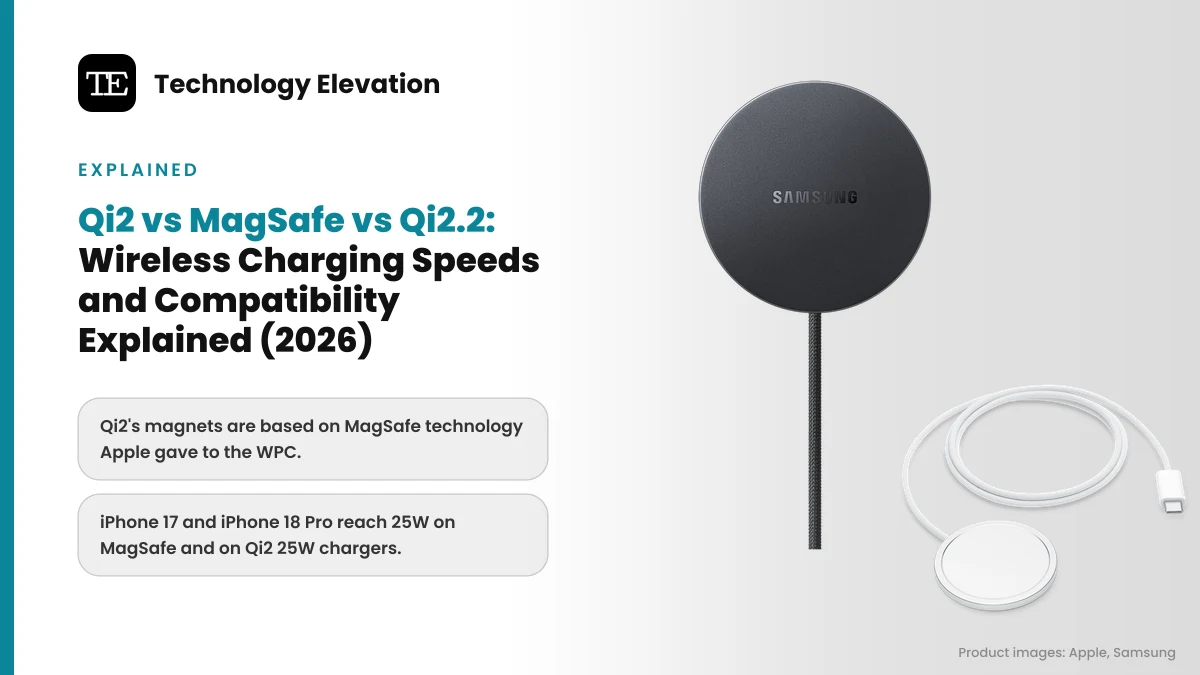
Pick up any wireless charger in a store this year and the box will shout at you. “MagSafe compatible.” “Qi2 Certified.” “Qi2 25W.” “Qi2 Ready.” Four labels, one small puck, and no explanation of whether it will charge your phone any faster than the one already on your nightstand.
The short answer to Qi2 vs MagSafe is that they are closer than the packaging suggests. When the Wireless Power Consortium (WPC) wrote Qi2, it built the magnetic part on MagSafe technology that Apple contributed to the group. The WPC’s own Qi standard page now lists two Qi2 tiers: the original 15W version from 2023 and Qi2 25W, launched in July 2025.
So the real differences are about speed tiers, which phone you own, and the power adapter behind the charger. Those three things decide whether you get 7.5W, 15W or 25W, and most charger boxes skip all of them.
We checked every figure below against Apple, Google, Samsung and WPC pages that were live on 15 November 2026.
Qi2 and MagSafe are the same magnetic charging under different names
Qi2 and MagSafe use the same magnet ring and the same coil alignment, so a Qi2 charger snaps onto a MagSafe iPhone and an Apple MagSafe Charger works with Qi2 phones. MagSafe is Apple’s brand. Qi2 is the open standard anyone can certify against.
The WPC calls the magnetic part of Qi2 the Magnetic Power Profile, or MPP. Its November 2023 launch release says plainly that MPP “is based on MagSafe technology contributed by Apple.” Apple also certifies its own chargers to the open standard now. The current MagSafe Charger product page states that it “is certified for Qi2 25W and Qi charging.”
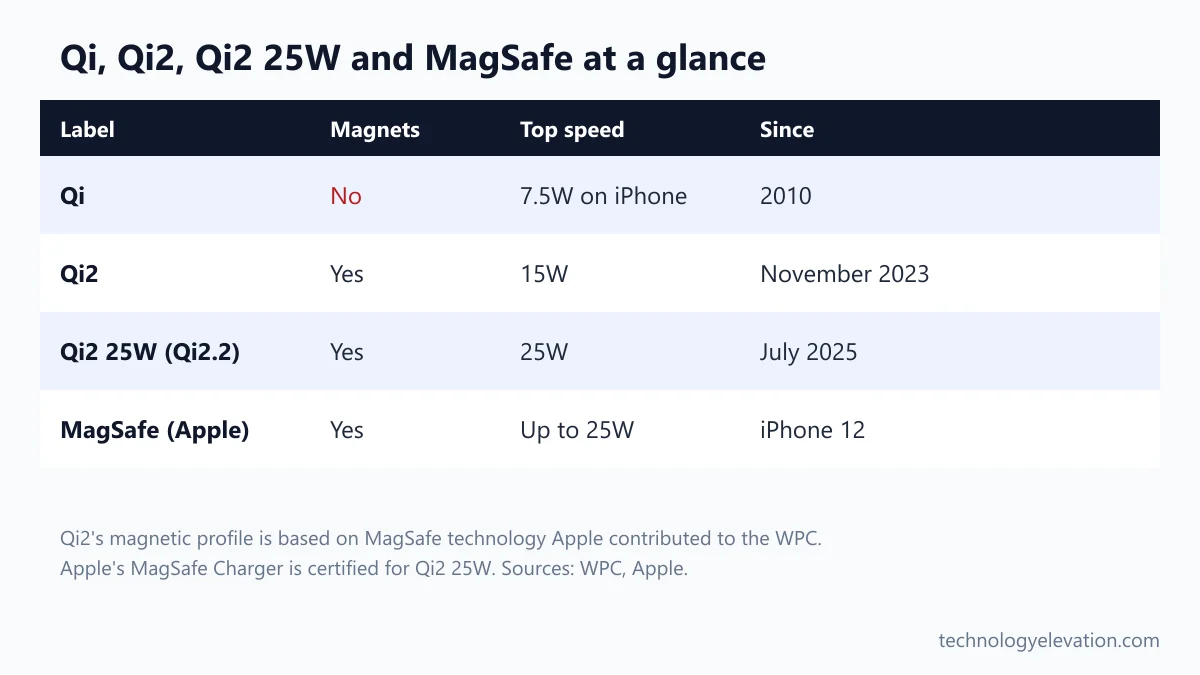
That leaves four labels you will actually see:
- Qi: the original flat-pad standard, launched in 2010. No magnets. iPhones top out at 7.5W on it.
- Qi2: Qi v2.0 with the magnet ring, up to 15W. Launched in November 2023, starting with the iPhone 15.
- Qi2 25W: Qi v2.2.1, launched July 23, 2025. The same magnets with up to 25W. Many shops call it Qi2.2.
- MagSafe: Apple’s name for the same magnetic system on iPhone 12 and later, now up to 25W on recent models.
| Label | Magnets | Top speed | Who certifies it |
|---|---|---|---|
| Qi | No | 7.5W on iPhone | WPC |
| Qi2 | Yes | 15W | WPC |
| Qi2 25W (Qi2.2) | Yes | 25W | WPC |
| MagSafe | Yes | Up to 25W, by iPhone model | Apple, and its charger is also Qi2 25W certified |
One practical takeaway: a “MagSafe compatible” sticker on a cheap charger only tells you it has magnets. It says nothing about speed or safety testing. The Qi2 logo does, because the WPC only lets certified products print it.
Qi2 25W is the official name for what shops call Qi2.2
Qi2.2 and Qi2 25W are the same thing. The WPC’s specification number is Qi v2.2.1, and its branding is Qi2 25W. It keeps the Qi2 magnets and raises the power ceiling from 15W to 25W, which the WPC describes as nearly 70% more power.
The WPC’s consumer site says Qi2 25W “has been tested to charge a smartphone battery from 0% to 50% charge in about 30 minutes,” with the honest caveat that not everyone will see the same result. Treat that as a best case on a cool phone with a strong adapter.
The rollout was fast. Fourteen devices finished Qi2 25W certification in the week before the July 2025 launch, and the WPC says it certified over 1,200 new Qi2 and Qi2 25W devices during 2025. At CES 2026 its booth showed Qi2 25W chargers from Anker, Aukey, Belkin, Nimble, Nomad, Satechi, Scosche and UGREEN.
Qi v2.1 sat in between. Announced in January 2025, it added two extensions: Qi2 Ready phones and cases, and a moving-coil car charger that hunts for the phone’s position. You will mostly notice the first one, and it gets its own section below.
The WPC’s consumer site also gives the rule that matters most. To get full Qi2 speeds, pair similar generations: a Qi2 phone with a Qi2 charger, or a Qi2 25W phone with a Qi2 25W charger. A 25W charger will not push an older 15W phone any faster.
MagSafe speed depends on your iPhone model and adapter
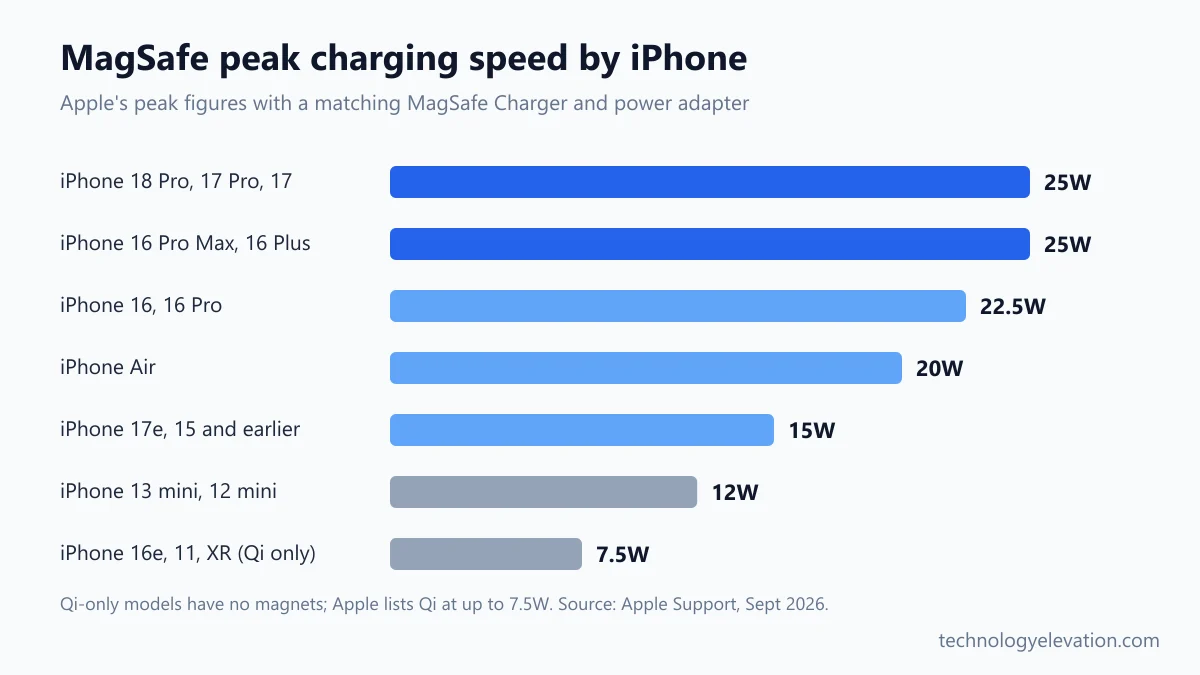
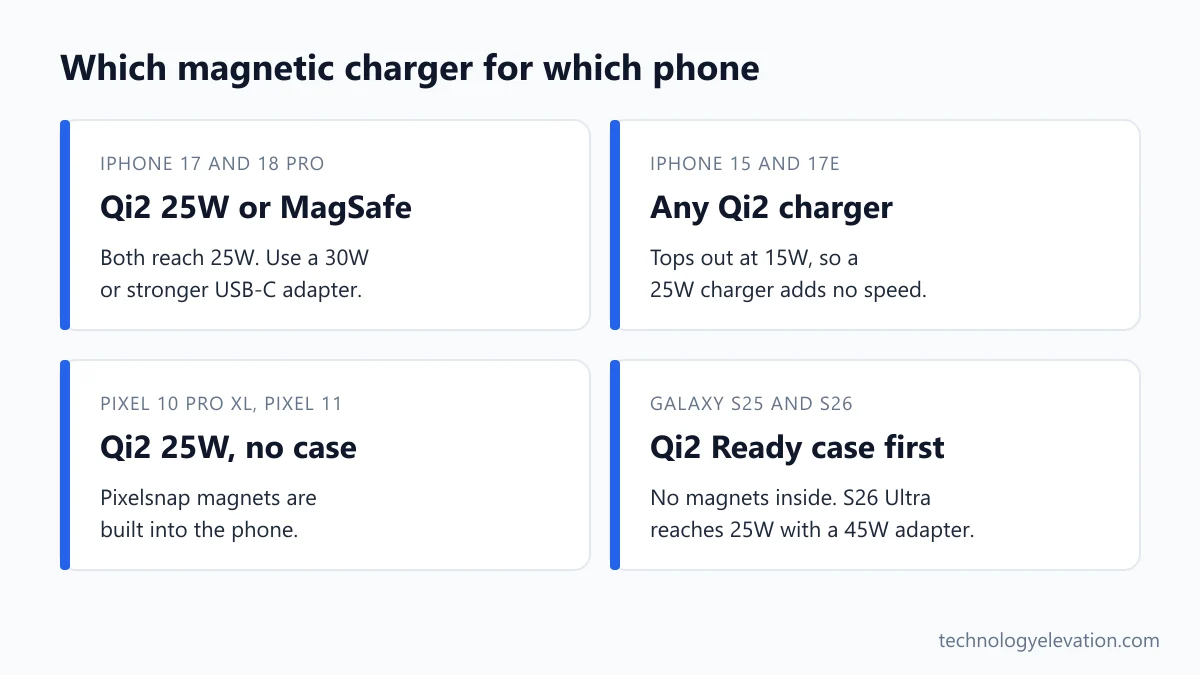
MagSafe charges at up to 25W on iPhone 17, iPhone 17 Pro, iPhone 18 Pro, iPhone 16 Plus and iPhone 16 Pro Max, 22.5W on iPhone 16 and 16 Pro, and 20W on iPhone Air. iPhone 15, earlier models and iPhone 17e stop at 15W.
Those figures come from Apple’s support article on using the MagSafe Charger with iPhone, published September 18, 2026. Apple calls them peak figures, and actual power varies with the iPhone model, the adapter and conditions such as heat.
| iPhone | MagSafe peak | Adapter Apple asks for |
|---|---|---|
| iPhone 18 Pro, 18 Pro Max, 17 Pro, 17 Pro Max, 17, 16 Plus, 16 Pro Max | 25W | 30W or more, rated 15V/2.0A or higher |
| iPhone 16, 16 Pro | 22.5W | 30W or more, rated 15V/2.0A or higher |
| iPhone Air | 20W | 30W or more, rated 15V/2.0A or higher |
| iPhone 17e, iPhone 15 and earlier | 15W | 20W or more, rated 9V/2.22A or 9V/2.56A |
| iPhone 13 mini, 12 mini | 12W | At least 9V/2.03A |
The 25W tier also needs a newer MagSafe Charger. Apple lists part numbers A3502, A3503, A2580 and A3250, printed on the charger or its cable. The older A2140 puck is a 15W charger.
Plugging in headphones changes things. With a USB-C or Lightning accessory connected, Apple caps MagSafe at 16W on iPhone 18 Pro, iPhone 17 and iPhone Air, 10W on iPhone 17 Pro, and 7.5W on iPhone 16 models and iPhone 15 and earlier.
And some iPhones have no magnets at all. Apple names iPhone 16e, iPhone 11, iPhone XS, iPhone XR, iPhone X and iPhone 8 as Qi-only models. They charge on a MagSafe puck, but without the snap and at lower power.
A Qi2 charger matches MagSafe speed on newer iPhones
On iPhone 17 and iPhone 18 Pro, a Qi2 25W charger is just as fast as MagSafe: Apple’s spec pages list both at up to 25W. iPhone Air gets 20W from either. iPhone 15 and iPhone 17e get 15W from either.
Apple’s technical specifications put the two side by side. The iPhone 18 Pro page reads “MagSafe wireless charging up to 25W” and “Qi2 wireless charging up to 25W” on consecutive lines, and the iPhone 17 page does the same. On iPhone 15, both lines read 15W.
That makes a third-party Qi2 25W charger a sensible buy for anyone on a 2025 or 2026 iPhone. You lose nothing in speed, and a Qi2 25W puck also charges a Pixel or a Galaxy phone with the right case. Qi2 25W chargers also come as stands, car mounts and power banks, so you are not stuck with a plain puck.
Plain Qi is the slow lane. Apple’s spec pages list Qi wireless charging at up to 7.5W on iPhone 12 through iPhone 15. If your old flat pad has no magnets and no Qi2 logo, that is what you get, no matter how big its adapter is.
If you are choosing a puck for an iPhone right now, our best MagSafe chargers picks are sorted by the speed each iPhone generation actually reaches.
Android phones get Qi2 two ways: built-in magnets or a case
Google’s Pixel 10 and Pixel 11 phones have Qi2 magnets built in, which Google calls Pixelsnap. Samsung’s Galaxy S25 and S26 phones and the OnePlus 13 are Qi2 Ready instead: they charge on Qi2 pads, but need a magnetic case to snap on.
| Phone | Magnets | Top wireless speed |
|---|---|---|
| Pixel 11, 11 Pro, 11 Pro XL, 11 Pro Fold | Built in | 25W (Qi2.2-certified) |
| Pixel 10 Pro XL | Built in | 25W |
| Pixel 10, 10 Pro, 10 Pro Fold | Built in | 15W |
| Pixel 10a | None | Qi charging only |
| Galaxy S26 Ultra | Needs a magnet case | 25W |
| Galaxy S26+ | Needs a magnet case | 20W |
| Galaxy S26 | Needs a magnet case | 15W |
Google’s store pages list “Pixelsnap wireless charging (Qi2.2-certified) up to 25W” for the Pixel 11 range. The Pixelsnap Charger page confirms 25W for Pixel 10 Pro XL and every Pixel 11, and 15W for the other Pixel 10 models. The cheaper Pixel 10a only lists standard Qi charging.
Samsung’s US comparison page lists “Super Fast Wireless Charging up to 25W” on the Galaxy S26 Ultra, 20W on the S26+ and 15W on the S26. None of them have magnets in the back. Samsung’s own Magnet Wireless Charger tells Galaxy owners to “use a Qi2-ready case.”
Shopping for a new Android phone and want the snap without a case? Right now the Pixel line is the safe bet among the best Android phones.
Qi2 Ready means the magnets live in the case, not the phone
A Qi2 Ready phone has the Qi2 charging electronics but no magnet ring. You add the ring with a certified magnetic case. The WPC says Qi2 Ready phones and cases deliver the full Qi2 experience “when paired together in approved combinations.”
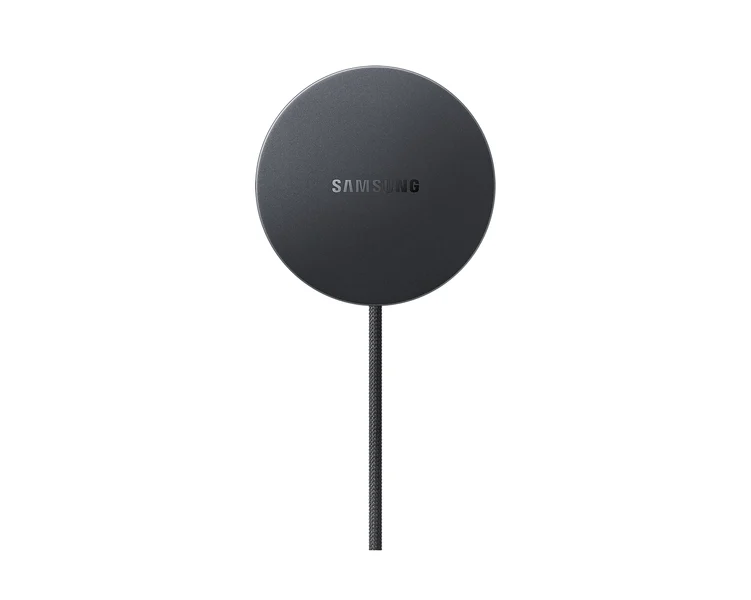
The WPC’s own explainer puts it simply: “The case completes the ring, the phone provides the charging smarts.” It names the Samsung Galaxy S25 and S26 series and the OnePlus 13 as Qi2 Ready, and points out that Google took the other route by building magnets into the Pixel 10 family.
The catch is the case itself. A generic magnet sticker or a no-name ring is not the same as a certified Qi2 Ready case. Certification tests the magnet’s pull and shear force, not just the electronics, and a weak ring lets the phone slide off the coil. Then charging slows and the missed energy turns into heat.
Samsung adds one warning of its own: magnetic accessories may interfere with the S Pen, camera autofocus, compass, wireless charging and NFC. If you use the S Pen a lot on a Galaxy S26 Ultra, try the case before you commit to it.
Five checks get you the full speed from any magnetic charger
Full speed needs four things lined up: a phone that supports the tier, a charger certified for it, an adapter strong enough to feed it, and nothing thick or metal in the way. Miss one and the charger quietly drops to a slower rate.
- Check your phone’s tier. Look up its wireless line on the maker’s spec page. If it says 15W, a 25W charger will not change that.
- Look for the right logo. Buy a charger certified Qi2 or Qi2 25W, or Apple’s MagSafe Charger. You can search any model in the WPC’s certified product database.
- Use a strong enough adapter. Apple asks for 30W or more for 25W MagSafe. Samsung’s Magnet Wireless Charger needs a Samsung 45W adapter (or a higher 20V PPS one) for 25W.
- Plug in the charger first. Apple says to connect the MagSafe Charger to power before placing the iPhone on it. If you did it the other way round, lift the phone off, wait three seconds and put it back.
- Clear the gap. Take cards, badges and key fobs out from between the phone and the charger, and avoid very thick or metal cases.
The adapter step trips up most people. Apple’s MagSafe Charger needs at least a 12W adapter just to work, and it charges slower on one. The box rarely says so in big print. A good USB-C wall charger is part of the purchase, not an extra.
Wireless charging runs warmer, and phones slow down to protect the battery
Every wireless charger makes some heat, and both Apple and the WPC say so. Certified Qi2 and MagSafe chargers watch the temperature and cut power when the phone gets too warm, which protects the battery but slows the charge.
Apple’s MagSafe article says the iPhone or charger “might get slightly warmer” while charging, and that if the battery gets too warm, software “might limit charging above 80 percent.” Its temperature guide lists wireless charging among the normal things that warm an iPhone, and says charging “slows or stops” if the inside gets too hot.
Apple designs iPhones for ambient temperatures between 0 and 35 degrees Celsius (32 to 95 degrees Fahrenheit). A phone charging on a sunny windowsill or a car dashboard in July will hit that ceiling quickly.
The WPC’s case for certification is mostly about heat. Its consumer site says Qi Certified products “are protected from heat and can detect foreign objects,” while non-certified ones “can reach temperatures high enough to cause third-degree burns.” Qi2 25W adds enhanced thermal monitoring on top. Alignment helps too: the WPC explains that a coil a centimeter off center charges slower and turns the missed energy into heat, which is exactly the problem the magnets fix.
For the battery itself, iPhone 15 and later give you a direct control. Open Settings, tap Battery, then tap Charging, and pick a charge limit from 80 to 100 percent in 5 percent steps. At 100 percent you can also use Optimized Battery Charging, which learns your routine and delays charging past 80 percent when it expects you to stay plugged in for a long time. On iPhone 14 and earlier, the switch lives under Settings, Battery, Battery Health & Charging.
The right charger depends on where you charge, not the label
Once your phone’s tier is clear, pick the charger shape for the spot it will live in. A puck or stand for the nightstand, a magnetic mount for the car, a foldable unit for travel. Any certified Qi2 25W model covers both iPhone and Pixel.
For a single phone, a magnetic puck or stand is the simple choice, and our MagSafe charger picks include Qi2 25W options that also work with Android phones. If the phone sits upright while you work, a MagSafe stand keeps the screen readable.
On the nightstand, a bedside lamp with a wireless charger saves one plug and one cable. Families with a phone, a watch and earbuds are usually better served by a charging station for multiple devices.
For trips, a foldable 3-in-1 from the best travel charger picks packs flat in a bag. Away from any wall, a magnetic power bank for iPhone does the same job on the move.
Phones with no wireless charging at all have one more route. A USB-C wireless charging adapter is a thin Qi receiver that plugs into the charging port. It will not give you magnets or Qi2 speeds, but it does let an older phone sit on a pad.
Frequently asked questions about Qi2 vs MagSafe
Is Qi2 the same as MagSafe?
Nearly. Qi2’s Magnetic Power Profile is based on MagSafe technology that Apple contributed to the Wireless Power Consortium, so the magnets and alignment match. MagSafe is Apple’s brand, while Qi2 is the open standard any maker can certify against.
Is Qi2 slower than MagSafe on an iPhone?
Not on recent models. Apple lists both MagSafe and Qi2 at up to 25W on iPhone 17 and iPhone 18 Pro, and both at 15W on iPhone 15. Use a Qi2 25W charger to match the faster MagSafe speeds.
What is the difference between Qi2 and Qi2.2?
Qi2.2 is the common name for Qi v2.2.1, which the WPC brands as Qi2 25W. Original Qi2 tops out at 15W. Qi2 25W keeps the same magnets and raises the ceiling to 25W, nearly 70% more power.
What does Qi2 Ready mean?
Qi2 Ready means the phone supports Qi2 charging but has no magnets built in. You add the magnet ring with a certified magnetic case. Samsung’s Galaxy S25 and S26 series and the OnePlus 13 are Qi2 Ready.
Which Android phones have Qi2 magnets built in?
Google’s Pixel 10 and Pixel 11 phones have Qi2 magnets built in, under the Pixelsnap name. The Pixel 10 Pro XL and every Pixel 11 model reach 25W. The Pixel 10a does not have magnets.
Can I use a MagSafe charger on a Samsung Galaxy phone?
Yes, with a magnetic case. Apple’s MagSafe Charger is certified for Qi2 25W and Qi charging, and Galaxy S25 and S26 phones support Qi2. Without a case, the charger will not stay attached.
Is wireless charging bad for my phone battery?
Not if the charger is certified. Wireless charging runs a little warmer, and phones slow charging when hot to protect the battery. On iPhone 15 and later, a charge limit under Settings, Battery, Charging reduces wear further.
Do I need a special power adapter for 25W wireless charging?
Yes. Apple asks for a 30W or higher adapter rated 15V/2.0A for 25W MagSafe. Samsung’s Magnet Wireless Charger needs a 45W Samsung adapter or a higher 20V PPS one to reach 25W.
Last checked and sources
Last checked on 15 November 2026 by Haris Khan. We compared the charging figures on each maker’s current support and specification pages against the Wireless Power Consortium’s published standard and press releases, and left out any figure where official pages disagreed.
- Apple Support, “How to use your MagSafe Charger with iPhone” (published September 18, 2026)
- Apple technical specifications for iPhone 18 Pro, iPhone 17, iPhone Air, iPhone 17e and iPhone 15
- Apple Support, “About Charge Limit and Optimized Battery Charging on iPhone” and “If your iPhone or iPad gets too hot or too cold”
- Apple Store, MagSafe Charger product page
- Wireless Power Consortium, Qi standard page, Qi v2.0 launch release (November 15, 2023), CES 2025 release (January 6, 2025) and Qi2 25W release (July 23, 2025)
- Wireless Power Consortium, “How Magnetic Phone Chargers Work” and CES 2026 blog posts, and its chargewithqi.com consumer site
- Google Store, Pixel 10, Pixel 11 and Pixel 10a tech specs and the Pixelsnap Charger page
- Samsung, Galaxy S26 series comparison page, Galaxy S26 launch release and Magnet Wireless Charger product page
We update this explainer when Apple, Google, Samsung or the WPC change a charging standard or launch a new phone tier.

GIPHY App Key not set. Please check settings