

 Abdullah Kabeer
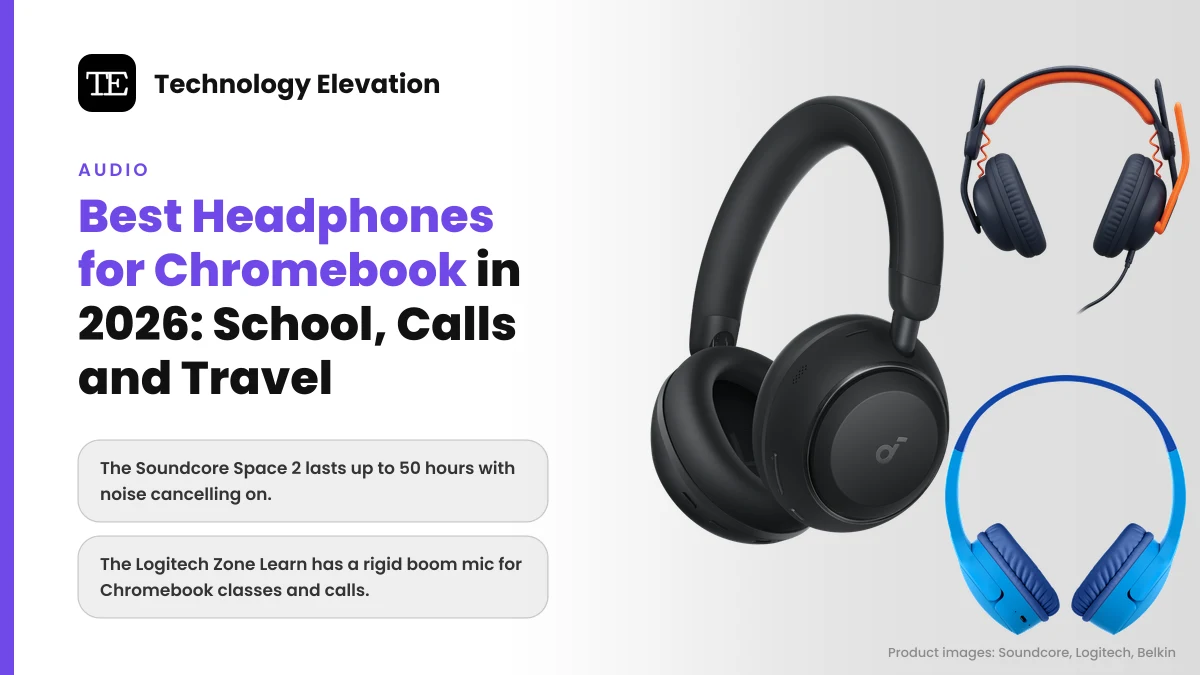
Walk past any classroom during a Google Meet lesson and you will hear the problem before you see it: tinny laptop speakers, a teacher asking someone to unmute, and one kid with earbuds wrapped around a pencil. The best headphones for Chromebook fix all three, but the right pair depends heavily on who is wearing them. A seven-year-old, a high schooler on daily video classes and an adult working from a Chromebook Plus need very different gear.
The good news is that Chromebooks are easy to pair with. Almost any wired or Bluetooth headphone works, and Google’s own help pages explain that a Fast Pair accessory in pairing mode is detected and paired with your Chromebook automatically, then linked to your Google Account.
The harder parts are the plug, the microphone and the volume. Some Chromebooks have no headphone jack at all, many headphones have a weak mic for calls, and most adult headphones can go far louder than a child’s ears should handle.
The best headphones for Chromebook for most people are the Soundcore Space 2
The Soundcore Space 2 is the best pick for most Chromebook owners. It pairs over Bluetooth in seconds, connects to a Chromebook and a phone at the same time, lasts up to 50 hours with noise cancelling on and launched at $129.99.
Every pick, by the job it does best:
- Best overall: Soundcore Space 2
- Best noise cancelling: Sony WH-1000XM6
- Best USB-C headphones for school Chromebooks: JLab JBuddies Studio Type-C
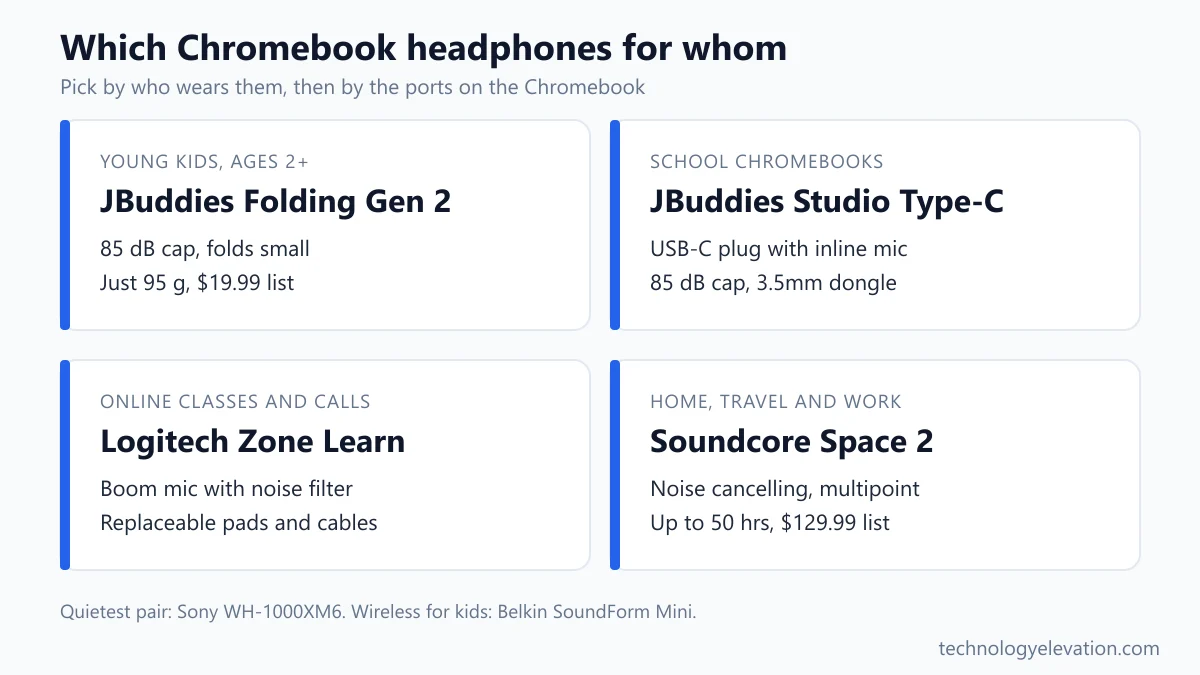
- Best for young kids: JLab JBuddies Folding Gen 2
- Best wireless headphones for kids: Belkin SoundForm Mini
- Best headset with mic for classes and calls: Logitech Zone Learn
| Model | Connection | Microphone | Volume limit | Battery | List price |
|---|---|---|---|---|---|
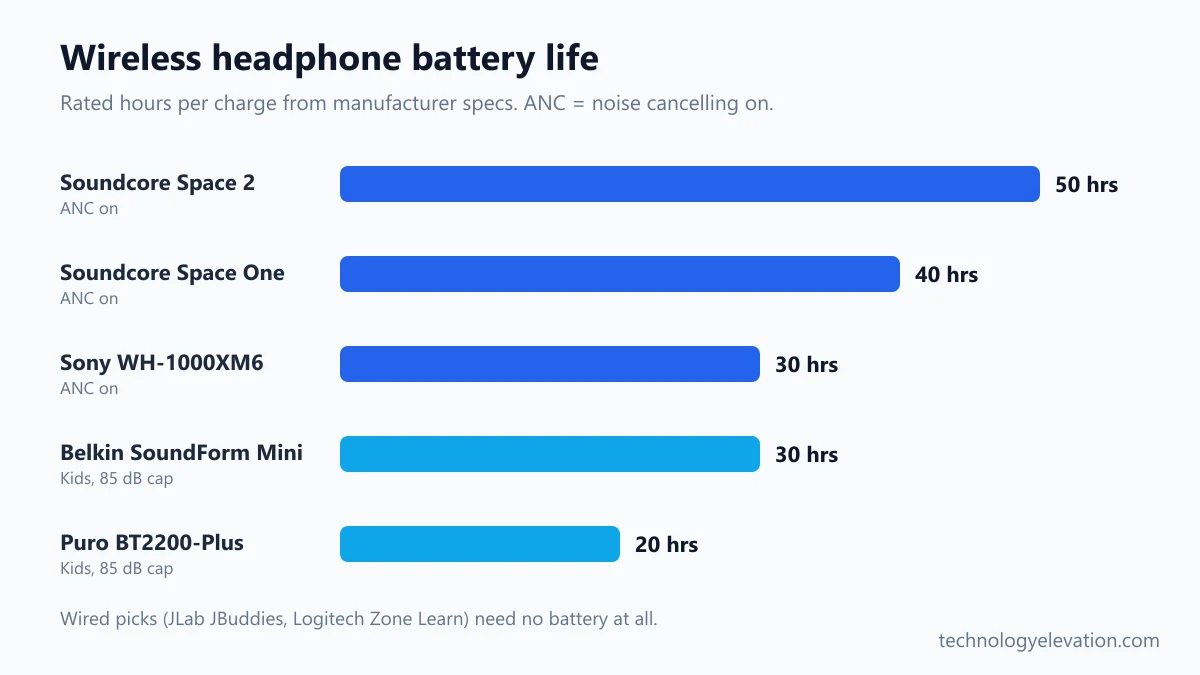
| Soundcore Space 2 | Bluetooth 6.1, 3.5mm | 3 mics | No | Up to 50 hrs (ANC on) | $129.99 |
| Sony WH-1000XM6 | Bluetooth, LE Audio | 6-mic beamforming | No | Up to 30 hrs (ANC on) | $449.99 |
| JLab JBuddies Studio Type-C | USB-C wired, 3.5mm dongle | Inline mic | 85 dB | None needed | $24.99 |
| JLab JBuddies Folding Gen 2 | 3.5mm wired | None | 85 dB | None needed | $19.99 |
| Belkin SoundForm Mini | Bluetooth, 3.5mm cable | Built-in mic | 85 dB (Bluetooth) | Up to 30 hrs | Varies by color |
| Logitech Zone Learn | 3.5mm wired | Boom mic | No | None needed | $39.99 |
Soundcore Space 2: the best headphones for Chromebook overall
The Soundcore Space 2 wins because it does everything a Chromebook user needs at a fair price. You get strong noise cancelling, two-device multipoint, three call microphones, a wired jack for backup and huge battery life, all for $129.99 at launch in April 2026.
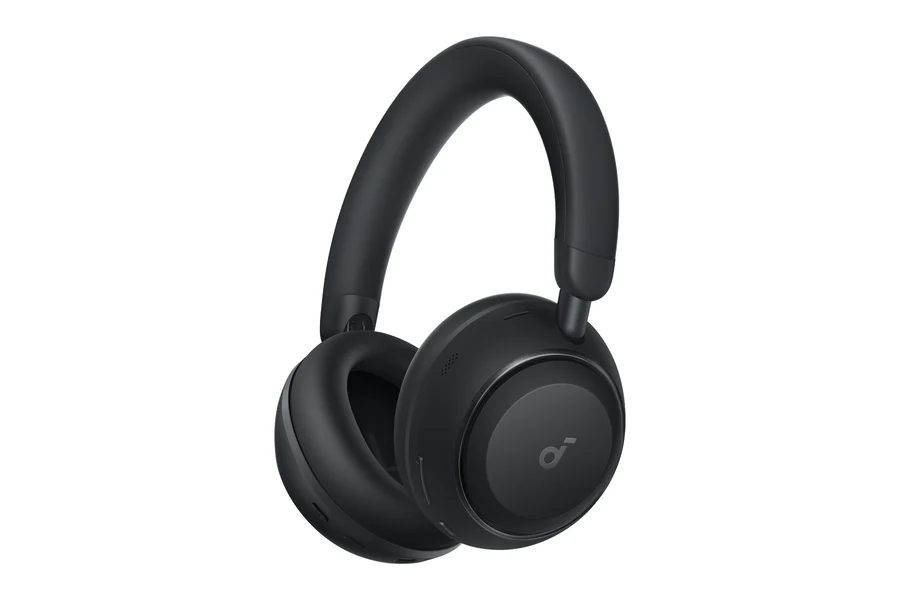
Key specs: over-ear, Bluetooth 6.1, multipoint for two devices, 3 microphones with AI enhancement for calls, LDAC support, 3.5mm aux input, up to 50 hours with noise cancelling on and 70 hours with it off, 5 minutes of charging for 4 hours of play, 264 g (9.31 oz).
Multipoint is the feature Chromebook owners underrate. It means the headphones stay connected to two devices at once. Watch a lecture on the Chromebook, and when your phone rings, the call comes through without any re-pairing.
The 3.5mm input matters more on a Chromebook than you might think. Plug into the headphone jack and the headphones work even with Bluetooth switched off, which some schools do on managed devices.
The catch is LDAC. That higher-quality Bluetooth mode is an Android feature and does nothing for a Chromebook, so ignore it in the spec sheet. If $129.99 is too much, the older Soundcore Space One launched at $99.99 with up to 40 hours of noise-cancelled battery and is still widely sold.
Check the Soundcore Space 2 price on Amazon
Sony WH-1000XM6: the best noise cancelling headphones for a Chromebook
The Sony WH-1000XM6 is the pick if you work or study from a Chromebook in noisy places and want the quietest headphones available. It launched on May 15, 2025, at $449.99, with Sony’s QN3 chip, a six-mic call system and Google Fast Pair.
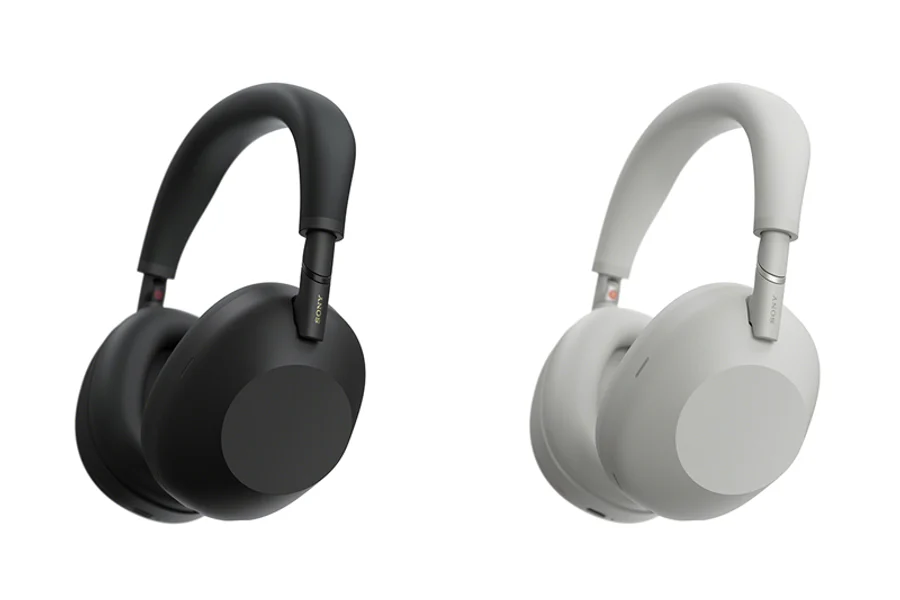
Key specs: over-ear, foldable design, QN3 noise-cancelling processor, six-microphone AI beamforming for calls, multipoint with auto switch, LE Audio support, Google Fast Pair, up to 30 hours with noise cancelling on, 3 minutes of charging for up to 3 hours of play, case with magnetic closure.
Noise cancelling is the whole reason to spend this much. A train carriage or a busy dorm fades into the background.
Fast Pair support makes setup on a Chromebook close to effortless. Put the headphones in pairing mode near a signed-in Chromebook, select Connect, and they are linked to your Google Account.
The honest catch is price and battery. Thirty hours is plenty, but the Soundcore Space 2 lasts much longer for under a third of the money. The older WH-1000XM5 launched $50 cheaper and is a smart buy on sale. For more brands, browse the best over-ear headphones.
Check the Sony WH-1000XM6 price on Amazon
JLab JBuddies Studio Type-C: the best USB-C headphones for school Chromebooks
The JLab JBuddies Studio Type-C is the best pair for a school Chromebook. It plugs straight into USB-C, caps volume at 85 dB, has an inline mic for Google Meet and comes with a 3.5mm dongle for older devices. JLab lists it at $24.99.
Key specs: on-ear, wired USB-C, USB-C to 3.5mm dongle in the box, 85 dB volume limit, inline mic with call and track controls, 40mm drivers, braided nylon cord, foldable, stainless steel adjustable headband, 136 g, ages 6 and up, JLab lifetime limited warranty.
USB-C is the reason this pair earns its spot. Some Chromebooks, especially detachable tablets like the Lenovo Duet line, have no headphone jack. A USB-C headset plugs into the same port as the charger and just works.
The catch: on-ear pads press on the ears rather than around them, so older teens may find them snug after a long day. For a high schooler, the Logitech Zone Learn below is the more grown-up headset.
Check the JLab JBuddies Studio Type-C price on Amazon
JLab JBuddies Folding Gen 2: the best headphones for young kids
The JLab JBuddies Folding Gen 2 is the best headphone for young children using a Chromebook or tablet. It is made for ages 2 and up, limits volume to 85 dB, folds small, weighs just 95 g and costs $19.99 at JLab.
Key specs: on-ear, wired 3.5mm, 85 dB volume limit, 30mm drivers, 32 ohm impedance, single volume button, foldable, 95 g, ages 2 and up, JLab 2-year limited warranty.
The 85 dB cap is built into the headphones, not the device. That means a child cannot crank a Chromebook to full volume and blast their ears, no matter what the slider says.
The catch is the missing microphone. These are for listening only. For an older child who joins online lessons, JLab’s JBuddies Studio 2 adds a microphone with the same 85 dB limit, also at $19.99. And if the Chromebook only has USB-C, you will need a small USB-C to 3.5mm adapter.
Check the JLab JBuddies Folding Gen 2 price on Amazon
Belkin SoundForm Mini: the best wireless headphones for kids
The Belkin SoundForm Mini is the best wireless pick for kids who use a Chromebook away from a desk. It caps volume at 85 dB in Bluetooth mode, runs up to 30 hours per charge, has a built-in mic and includes a 3.5mm cable as backup.
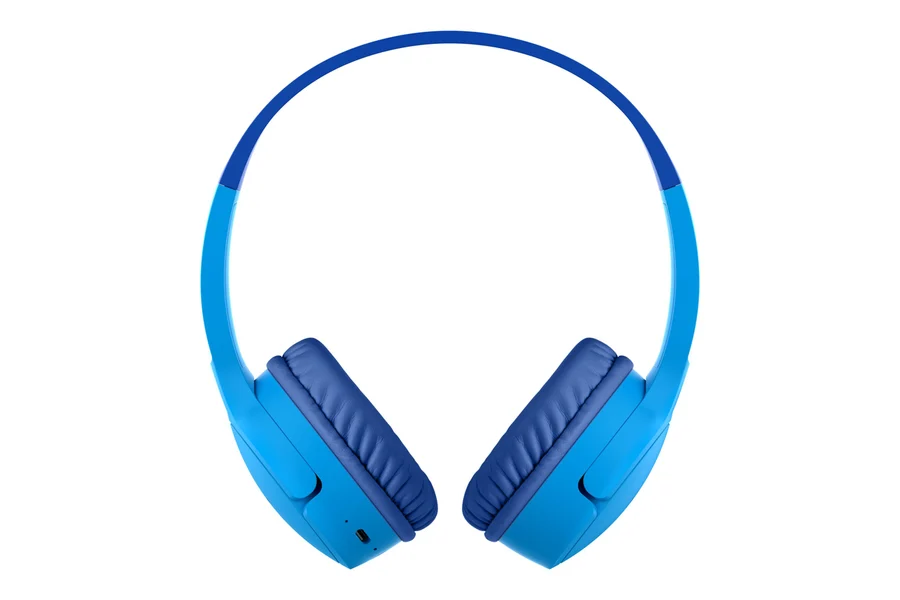
Key specs: on-ear, Bluetooth with a 3.5mm cable included, 85 dB maximum in Bluetooth mode, built-in microphone, up to 30 hours of battery, 10 minutes of USB-C charging for up to 3 hours of play, ages 3 and up.
No cable is a real win with kids. Nothing snags on a chair, nothing gets yanked out of the port, and the Chromebook can sit on a table while your child moves around.
The catch is the fine print on volume. Belkin quotes its 85 dB cap for Bluetooth mode, so stick to Bluetooth if the limit is the reason you are buying. Puro Sound Labs’ BT2200-Plus is the premium alternative, at a $99 list price, with 20 hours of battery, an included 3.5mm cable and ear cups that switch between on-ear and over-ear.
Check the Belkin SoundForm Mini price on Amazon
Logitech Zone Learn: the best headset with mic for Chromebook classes
The Logitech Zone Learn is the best headset with a mic for Chromebook classes and calls. Its rigid boom mic sits close to the mouth with a noise-suppression filter, the cables and ear pads are replaceable, and it lists at $39.99.
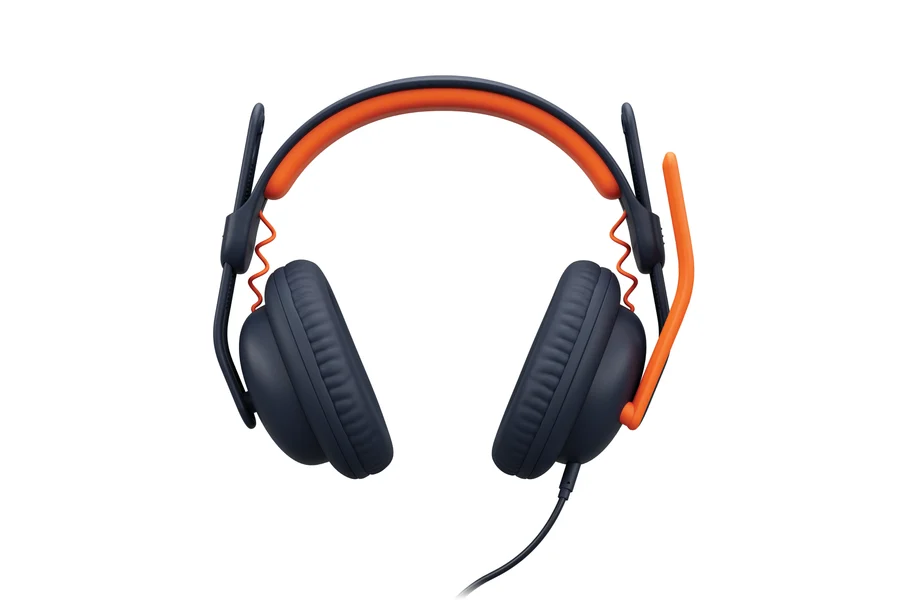
Key specs: over-ear, wired 3.5mm, rigid boom microphone with gasket and noise-suppression filter, replaceable ear pads and cables, tested against repeated use of cleaners, sized for younger learners. Versions with USB-C and USB-A plugs are also sold through school suppliers.
A boom mic beats every other kind for video calls. It sits a couple of inches from your mouth, so your voice is loud and the room is quiet. Headphone mics, even good ones, have to guess where your voice is coming from.
The catch is volume. The Zone Learn has no built-in limiter, so set limits on the Chromebook for younger children. Gamers who want the same boom-mic idea with more bass should look at PC gaming headsets, though many of those use USB-A dongles.
Check the Logitech Zone Learn price on Amazon
Bluetooth, USB-C and 3.5mm all work with a Chromebook
Chromebooks support all three headphone connections. Bluetooth is the most convenient, USB-C is the safest bet on newer and jackless models, and the 3.5mm jack is the simplest for shared school devices. Choose by the ports your Chromebook actually has.
Bluetooth. Select the time in the bottom right corner, turn on Bluetooth, put the headphones in pairing mode, then choose Pair new device. Headphones you have paired before reconnect automatically.
Fast Pair. Headphones with Google Fast Pair, like the Sony WH-1000XM6, skip most of those steps. Put them in pairing mode near the Chromebook and a Connect prompt appears. Fast Pair also saves them to your Google Account.
USB-C. Several Chromebooks have no 3.5mm jack at all. Lenovo’s Duet, Duet 3 and Duet 5 all shipped without one. USB-C headsets and USB-C to 3.5mm adapters solve that. Check that an adapter supports audio, because some cheap ones only charge.
3.5mm. Most Chromebook laptops still have a combined headphone and mic jack. Google’s headset specification for Chromebooks calls for a four-conductor 3.5mm plug, so a headset with a single plug carries both sound and mic. Old PC headsets with two separate plugs, one pink and one green, need a splitter adapter.
Bluetooth headphones on school-managed Chromebooks deserve a quick check first. School IT can switch Bluetooth off, and the audio settings may be greyed out. A wired pair is the no-drama choice for those devices. Keep it in the zip pouch of one of the Chromebook cases for students, so it does not vanish by October.
Microphone quality decides how you sound in Google Meet
Microphone type matters more than headphone price for video calls. Boom mics sound clearest, inline mics on the cable work well for school, and headphone-body mics depend on processing. Headphones with no mic leave the Chromebook using its own built-in microphone.
Your Chromebook usually switches to a plugged-in headset automatically. If it does not, open Quick Settings, select the arrow next to the volume slider and choose the headset under both Output and Input. Google Meet has its own microphone setting too, inside the call’s settings menu, and it does not always follow the system choice.
Bluetooth calls have a hidden cost. When the microphone is active, many Bluetooth headphones drop to a lower-quality audio mode, so music and lesson videos can sound thinner during a call. Wired headsets do not have that problem.
For adults on calls all day, a headset or earbuds for making phone calls usually beat big music headphones for voice pickup.
Volume limits protect kids’ hearing on school Chromebooks
Volume-limited headphones are the simplest way to protect a child’s hearing. The World Health Organization says listening at 80 dB is safe for up to 40 hours a week, and safe time drops fast as volume rises. Most kids’ headphones cap output at 85 dB.
The maths is unforgiving. According to the WHO’s safe listening guidance, 85 dB is safe for about 12 hours and 30 minutes a week, and 90 dB for only four hours a week. A child doing online lessons and then gaming on the same headphones can pass 12 hours by Wednesday.
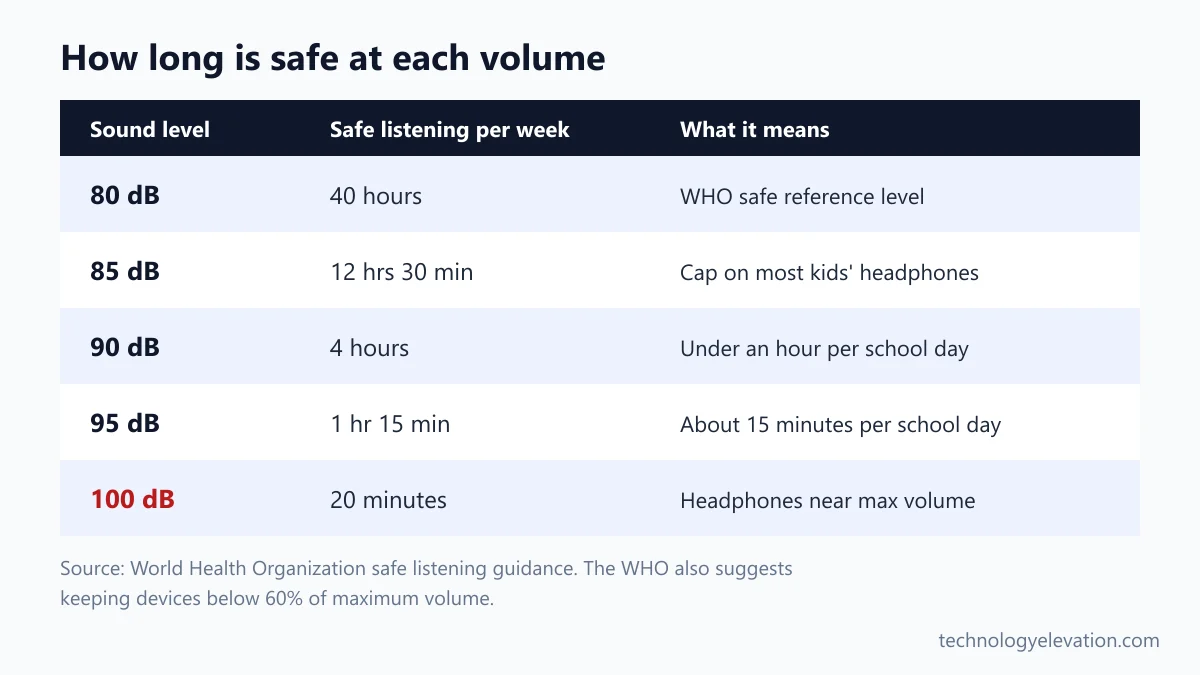
The WHO also suggests keeping devices at no more than 60% of maximum volume and choosing headphones with built-in volume limiting. Its advice for children is the same: teach them to stay below 60%.
The US National Institute on Deafness and Other Communication Disorders puts the risk line at the same place. Sounds at or below 70 dBA are unlikely to cause hearing loss, while long or repeated exposure at or above 85 dBA can. NIDCD also estimates that as many as 17% of teens aged 12 to 19 showed signs of noise-induced hearing loss in 2005 to 2006 data.
Seven checks for choosing headphones for a Chromebook
Choose Chromebook headphones by checking the ports first, then the user’s age, then the microphone. After that, decide between wired and wireless, and only then compare comfort and price. A second grader and a remote worker rarely need the same pair.
- Look at the ports. No 3.5mm jack means USB-C or Bluetooth. A school Chromebook with Bluetooth switched off means wired.
- Match the age. Under about 10, buy volume-limited headphones capped at 85 dB. Check the age range on the box, since small heads need small headbands.
- Decide on the mic. Online classes and calls need one. A boom mic is best, an inline mic is fine, and no mic means the Chromebook’s own microphone picks up the whole room.
- Pick wired or wireless. Wired never needs charging and never drops out. Bluetooth is freer, but needs a charger and occasional re-pairing.
- Think about noise. Busy homes, buses and offices are where active noise cancelling (ANC), which uses microphones to cancel outside sound, earns its price.
- Check durability. Braided cables, replaceable ear pads and long warranties matter for shared or school devices.
- Skip the plug traps. USB-A-only headsets need an adapter on USB-C-only Chromebooks, and two-plug PC headsets need a splitter.
Still choosing the laptop itself? Check the port list before you buy. A headphone jack is worth having on any Chromebook for students, and even the cheapest laptops under $100 work fine with every pair on this list.
Frequently asked questions about headphones for Chromebook
What are the best headphones for Chromebook?
The Soundcore Space 2 is the best choice for most people. It has noise cancelling, multipoint, three call mics, a 3.5mm input and up to 50 hours of battery, at a launch price of $129.99. Kids should use a volume-limited pair like the JLab JBuddies.
Do all headphones work with a Chromebook?
Almost all do. Chromebooks support Bluetooth, USB-C and 3.5mm headphones. Older headsets with two separate plugs need a splitter, and USB-A headsets need an adapter on Chromebooks that only have USB-C ports.
How do I connect Bluetooth headphones to a Chromebook?
Select the time in the bottom right corner, turn on Bluetooth, then choose Pair new device. Put the headphones in pairing mode and select them from the list. Headphones with Google Fast Pair show a Connect prompt automatically.
What size is the Chromebook headphone jack?
Chromebook headphone jacks are 3.5mm. Google’s headset specification calls for a four-conductor plug, so a single plug handles both sound and the microphone. Some Chromebook tablets, including Lenovo’s Duet models, have no jack and need USB-C instead.
Why is my headset mic not working on my Chromebook?
The Chromebook may still be using its built-in microphone. Open Quick Settings, select the arrow next to the volume slider and choose your headset under Input. Then check the microphone setting inside Google Meet, which can differ from the system choice.
What volume is safe for kids’ headphones?
The WHO says 80 dB is safe for up to 40 hours a week, while 85 dB is safe for about 12 and a half hours a week. Most kids’ headphones cap output at 85 dB, and the WHO suggests keeping devices below 60% of maximum volume.
Are wired or wireless headphones better for a school Chromebook?
Wired headphones are usually better for school Chromebooks. They never need charging, cannot drop out during a lesson and still work when school IT switches Bluetooth off. Wireless pairs suit home use, where charging is easier to manage.
Last checked and sources
Last checked on 15 November 2026 by Abdullah Kabeer. We compared headphones and headsets on sale in the US against manufacturer product pages and launch announcements, checked ChromeOS pairing steps on Google’s own help pages, and took hearing safety figures from the WHO and NIDCD.
- Google, Chromebook Help: connecting Bluetooth devices and Fast Pair (support.google.com)
- Google, ChromeOS peripheral specification for 3.5mm wired headsets (developers.google.com)
- Sony, WH-1000XM6 launch announcement, May 15, 2025, and product page
- Soundcore, Space 2 and Space One product pages
- JLab, JBuddies Folding Gen 2, JBuddies Studio Type-C and JBuddies Studio 2 product pages
- Belkin, SoundForm Mini product page; Puro Sound Labs, BT2200-Plus product page
- Logitech, Zone Learn wired headset product page
- World Health Organization, safe listening questions and answers
- National Institute on Deafness and Other Communication Disorders, noise-induced hearing loss
- TechRadar and Notebookcheck (Soundcore Space 2 launch); Chrome Unboxed (Lenovo Duet ports)
We update this buying guide when headphone makers launch, discontinue or significantly change a model.
Technology Elevation is reader-supported. As an Amazon Associate, we earn from qualifying purchases. When you buy through links on this page, we may earn a small commission at no extra cost to you.

GIPHY App Key not set. Please check settings