

 Haris Khan
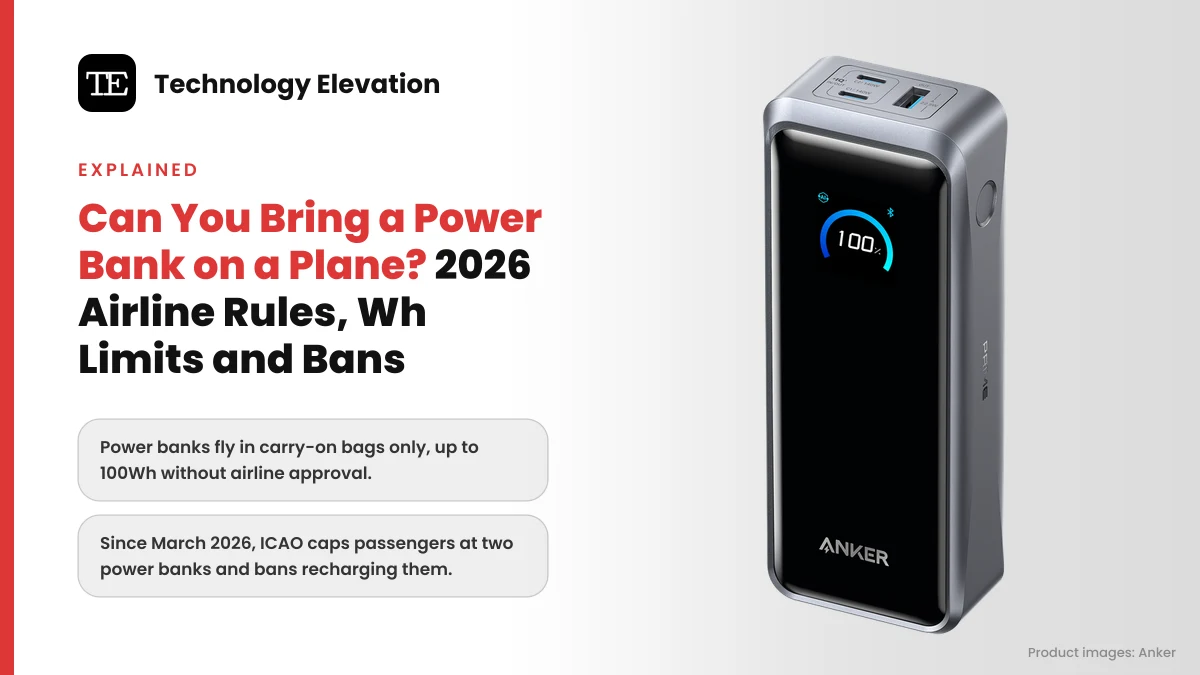
The holiday security line moves fast until someone’s checked suitcase gets pulled aside and a fat 20,000mAh brick comes out of a sock. Every November the same question floods search: can you bring a power bank on a plane? You can, but the answer now depends on where it sits, how big it is and which airline you picked.
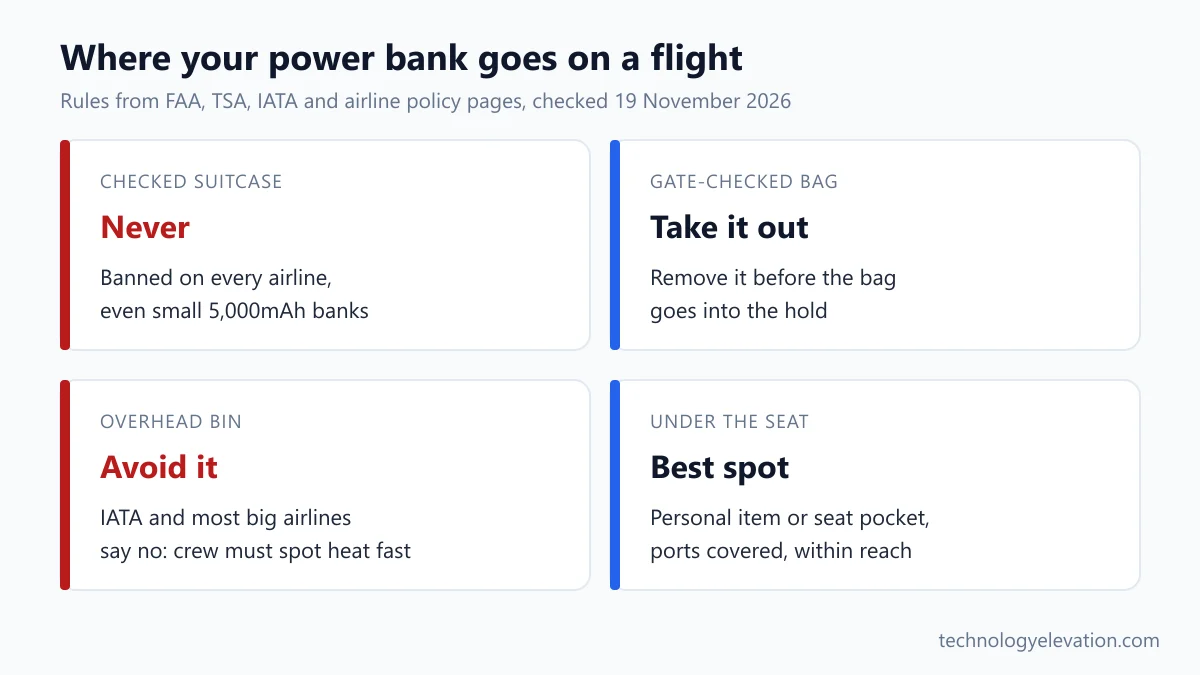
The basic rule has not changed in years. The FAA says power banks must be carried in carry-on baggage only, and that includes the moment a full overhead bin forces your roller bag into the hold at the gate.
What changed is everything around that rule. Emirates started it in October 2025, Qantas followed in December, and Cathay Pacific and Singapore Airlines now also stop passengers from using power banks in flight at all. On 27 March 2026, the UN’s aviation agency, ICAO, capped passengers at two power banks each and banned recharging them on board. Then Southwest cut its own limit to one.
Below is what applies on a US flight, what changes when you fly abroad, how to turn the mAh number on your charger into the watt-hours airlines actually check, and which airlines let you use a power bank once the seatbelt sign goes off.
Yes, a power bank can fly, but only in your carry-on bag
Yes, you can bring a power bank on a plane, but only in your carry-on bag or on your person, never in checked luggage. Each one must be 100Wh or less to fly without approval, the terminals must be protected, and many airlines now limit you to one or two.
Run through these steps before any flight:
- Find the Wh rating printed on the power bank. If only mAh is shown, convert it (the maths is below).
- Confirm it is 100Wh or less. Between 100Wh and 160Wh, ask your airline for approval before the trip.
- Count your power banks. Two is the international maximum under the 2026 ICAO rule, and some airlines allow only one.
- Check the power bank against recall lists. Recalled units are banned on every flight.
- Pack it in your carry-on, with the ports covered or the bank in its own pouch.
- Take it out of any bag that gets checked at the gate or planeside.
- Read your airline’s in-flight rule. Some allow use, some ban it completely.
The checked bag rule trips up the most people. TSA lists power banks as carry-on yes, checked bags no, and that applies even to a small 5,000mAh stick.
The 100Wh and 160Wh limits decide which power banks can fly
Power banks rated 100Wh or less can fly in carry-on bags without airline approval. Between 100Wh and 160Wh, US rules allow up to two spare batteries with airline approval. Anything above 160Wh cannot go on a passenger flight as personal baggage, so it must ship as cargo.
The FAA sets a limit of 100Wh per lithium ion battery for passengers. With airline approval, you may carry up to two larger spares between 101Wh and 160Wh. That bigger tier exists mainly for extended laptop batteries and professional camera packs.
Power banks are now treated more strictly than camera batteries. IATA’s 2026 passenger guidance lists a power bank between 100Wh and 160Wh as forbidden, even though a spare camera battery of the same size can still fly with approval. IATA marks that line as stricter than ICAO’s own text, and individual airlines decide which version they follow.
In practice, almost every phone and tablet power bank sits well under 100Wh. The ones that get close are the chunky laptop chargers, and the portable power stations people buy for camping, which almost always exceed 160Wh. American Airlines bans those large portable power banks outright, in carry-on and checked bags.
How to convert mAh to Wh with one line of maths
To convert mAh to Wh, multiply the mAh figure by the battery’s voltage, usually 3.7V, then divide by 1,000. A 10,000mAh power bank is 37Wh, a 20,000mAh bank is 74Wh, and the 100Wh limit lands at about 27,000mAh.
The FAA’s version of the formula is volts times amp-hours. American Airlines prints the everyday version on its restricted items page: Wh = mAh x 3.7 / 1,000. So 10,000 x 3.7 = 37,000, and 37,000 / 1,000 = 37Wh.
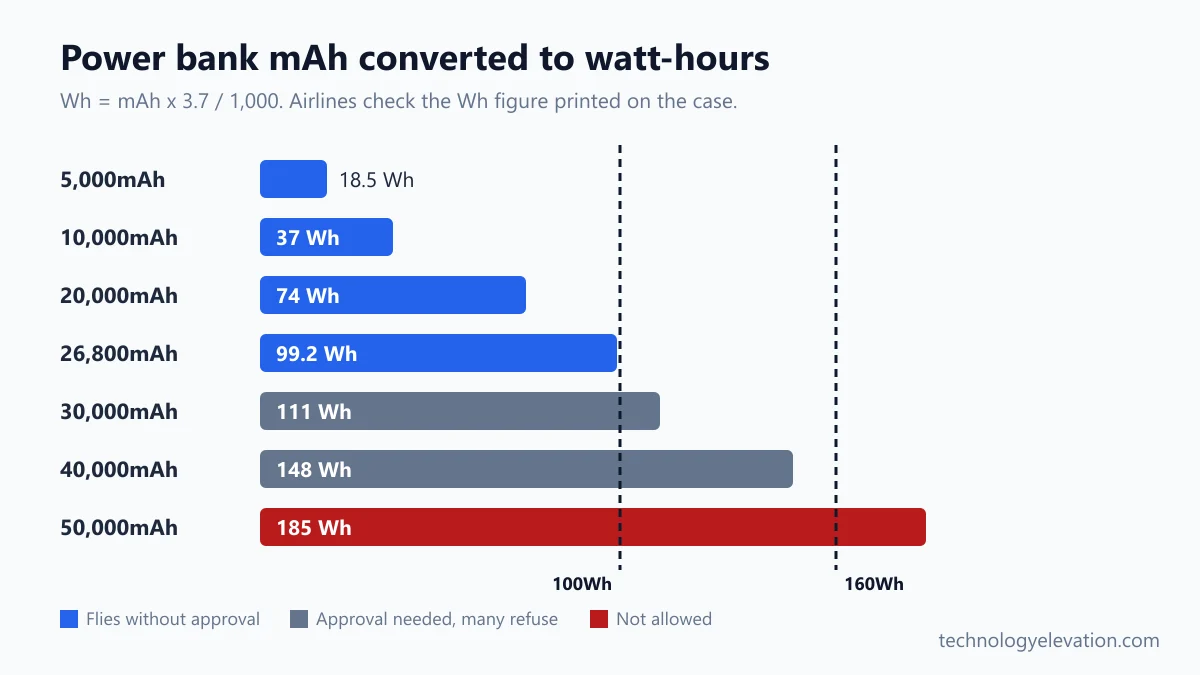
| Capacity on the label | Watt-hours at 3.7V | Can it fly? |
|---|---|---|
| 5,000mAh | 18.5Wh | Yes, carry-on only |
| 10,000mAh | 37Wh | Yes, carry-on only |
| 20,000mAh | 74Wh | Yes, carry-on only |
| 26,800mAh | 99.2Wh | Yes, just under the limit |
| 30,000mAh | 111Wh | Only with airline approval, and many airlines refuse |
| 40,000mAh | 148Wh | Only with airline approval, and many airlines refuse |
| 50,000mAh | 185Wh | No, not as baggage |
Always trust the printed Wh figure over your own maths. Cells are not all rated at exactly 3.7V, so two power banks with the same mAh can carry slightly different Wh ratings. Gate agents check the label, not your calculator.
Laptop power banks like the Anker Prime 26K sit right under 100Wh
The Anker Prime Power Bank (26K, 300W) shows how close laptop chargers run to the line. Anker rates its 26,250mAh battery at 99.75Wh, just under the 100Wh limit, so it flies in carry-on bags without approval on airlines that follow the standard rules.
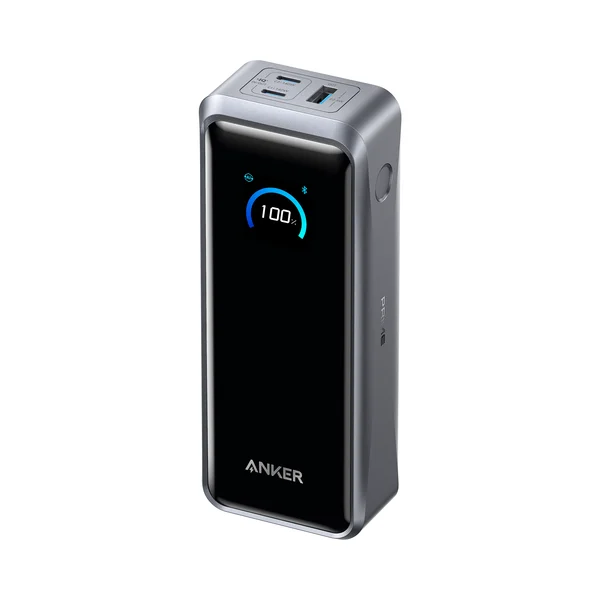
Run the plain 3.7V maths on 26,250mAh and you get about 97Wh. Anker’s printed 99.75Wh is higher because the cells are rated at a slightly higher voltage. Both numbers are legal, but the printed one is what counts at the gate.
That margin explains why so many laptop power banks stop at 25,000 to 27,000mAh. Makers design them to hit the biggest capacity that still clears 100Wh. A 30,000mAh model sounds like a better deal until an airline asks for approval you never requested.
Bigger is not always better for a phone anyway. A 10,000mAh bank at 37Wh covers a long travel day for most phones and weighs far less. The best power banks for iPhone mostly sit in that 5,000 to 20,000mAh range, comfortably inside every airline’s limit.
The 2026 ICAO rule caps you at two power banks and bans recharging them in flight
Since 27 March 2026, ICAO’s dangerous goods rules limit each passenger to two power banks, ban recharging a power bank while on board, and recommend against using one to charge a phone or laptop in flight. Carry-on only and short-circuit protection stay in place.
ICAO sets the baseline that national regulators and airlines build on worldwide. Its addendum to the Technical Instructions also split power banks away from ordinary spare batteries for the first time. IATA explains why in its operator guidance: power banks are cheap to make, easy to counterfeit, and some skip the UN safety tests, while spare batteries are built to fit one specific device.
IATA’s 2026 passenger guidance on lithium batteries turns that into plain rules: a maximum of two power banks not exceeding 100Wh, no recharging from aircraft power, no storage in overhead lockers, and no powering other devices during taxi, take-off or landing.
Note the wording on use. ICAO says passengers “should not” charge devices from a power bank in flight, which is a recommendation. Recharging the power bank itself is a hard “must not”. Airlines are free to go further, and many have.
Airline power bank rules in 2026 range from free use to a total ban
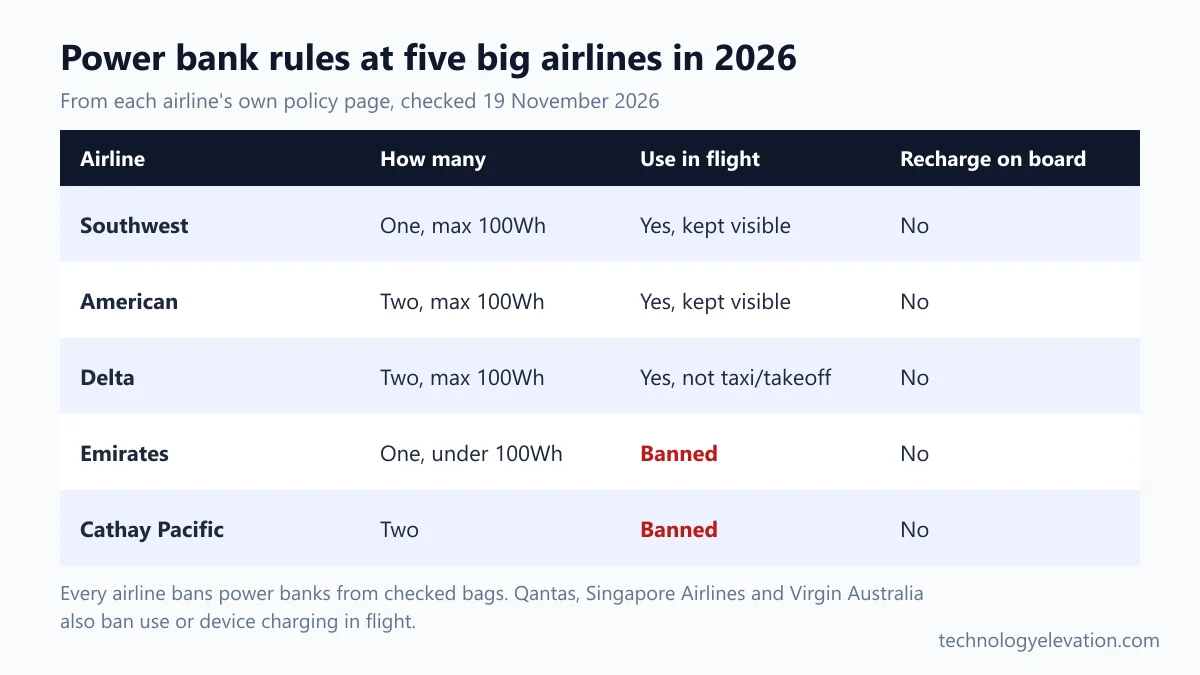
Airline power bank rules now split into two camps. US carriers such as American, Delta and Southwest still let you charge a phone from a power bank in flight, with limits. Emirates, Qantas, Singapore Airlines and Cathay Pacific ban using power banks on board entirely.
| Airline | Power banks allowed | Use in flight | Other rules |
|---|---|---|---|
| Southwest | One, up to 100Wh (since 20 April 2026) | Allowed, must stay visible while in use | Not in the overhead bin, no charging it from in-seat power |
| American Airlines | Two, up to 100Wh each | Allowed, keep it within reach and visible | Not in overhead bins, no recharging from seat outlets |
| Delta | Two, up to 100Wh each, no exceptions | Allowed outside taxi, take-off and landing | Not in an overhead bin, no recharging on board |
| Emirates | One, under 100Wh (since 1 October 2025) | Banned | Capacity rating must be shown, not in overhead bins |
| Qantas, QantasLink and Jetstar | Two, up to 160Wh each (since 15 December 2025) | Banned | Battery specifications must be displayed |
| Virgin Australia | Two, up to 160Wh each | Banned for charging another device | Over 100Wh needs approval and a declaration at check-in |
| Singapore Airlines | Two; over 100Wh needs approval | Banned | Not in overhead compartments, nothing over 160Wh |
| Cathay Pacific | Two | Banned at any time during the flight | Under the seat in front, extras confiscated at Hong Kong airport |
Every airline here also bans power banks from checked bags. We read each rule on the airline’s own help or newsroom page on 19 November 2026, and these pages change often, so look again a few days before you fly.
Emirates still offers in-seat charging on all its aircraft. On long-haul flights with a use ban, a short USB-C cable and a fully charged phone at boarding do more than a power bank you are not allowed to switch on.
US domestic flights follow the FAA, with airline limits on top
On a US domestic flight, the FAA rules apply: carry-on only, 100Wh per battery without approval, and up to two spares between 101Wh and 160Wh with airline approval. The FAA sets no general cap on how many small power banks you carry, but airlines now do.
The FAA’s own page, last updated in August 2026, says many airlines may have stricter quantity and Wh limits for power banks regardless of capacity. That is exactly what happened. Delta and American cap you at two, and Southwest at one.
Gate checks are where US travellers slip up. Holiday flights fill the bins early, and agents start tagging roller bags at the door. The FAA says every spare battery and power bank must come out of that bag and stay with you in the cabin, so keep the power bank in a jacket pocket or your personal item from the start.
Connecting abroad changes things. A two-bank allowance on Delta from Atlanta will not help on the onward Emirates leg, where only one is allowed and it stays switched off. Pack for the strictest airline on your ticket.
A readable capacity label is now part of the rule
A power bank needs a clear capacity label to fly. IATA says lithium ion batteries must show their Wh rating on the case, and staff may refuse one they cannot verify. Emirates and Qantas now require the capacity or battery specifications to be shown.
Cheap power banks often print only mAh, or print it in tiny raised plastic that wears off. If the label is gone, IATA’s guidance lets staff check the user documentation instead, so a photo of the box or the maker’s spec page on your phone can help.
Look for three numbers on the case: the capacity in mAh, the voltage and the Wh rating. If you only see mAh and voltage, multiply them and divide by 1,000. A power bank with no markings at all is the one most likely to stay behind at the gate.
Buying a new power bank for holiday travel? Pick one with the Wh figure printed clearly on the case, not just on the box. The iPhone power banks worth packing all list it.
Recalled power banks are banned on every flight
Recalled or damaged power banks may not be carried on a plane at all, in carry-on or checked bags, unless the faulty battery has been removed or made safe. Check your model number against the maker’s recall page and the CPSC recall list before you pack.
Recent US recalls show why airlines are nervous:
- Anker: recalled about 1.16 million PowerCore 10000 power banks (model A1263) in the US in June 2025, through the CPSC. In the same month, Anker separately recalled power bank models A1647, A1652, A1681, A1689 and A1257 worldwide.
- INIU: recalled about 210,000 BI-B41 10,000mAh power banks on 5 December 2025 after 15 reports of overheating, including 11 fires.
- Casely: reannounced its recall of about 429,200 E33A wireless MagSafe-style power banks on 16 April 2026, after 28 more incident reports, one fatality and one serious incident on an airplane.
- NEWDERY: recalled about 21,380 ZHX-PB22 power banks on 24 September 2026 after nine reports of explosions and fires.
Model and serial numbers are usually printed on the back or base. If your power bank matches a recall, stop using it, leave it at home and follow the maker’s recall instructions.
Wireless power banks get extra attention in IATA’s operator guidance, which says several passengers have reported them going into thermal runaway. If you carry a MagSafe battery pack, switch it off and keep it away from your phone in your bag so it cannot start charging by accident.
How to pack a power bank for holiday travel
Pack a power bank in your carry-on or personal item, keep it out of the overhead bin, cover the ports or use a pouch, and travel with it partly charged. That keeps it within reach, protected from short circuits and ready for the crew to spot if it overheats.
- Put it in the bag that goes under the seat, or in the seat pocket once you board.
- Use the original box, a zip pouch or tape over exposed contacts so nothing metal touches the ports.
- Do not top it up at the gate and then bury it in an overhead bin. IATA says airlines prefer spare batteries and power banks below 25% charge.
- Keep cables separate from coins and keys.
- Tell the crew immediately if a power bank gets hot, swells, smokes or smells odd.
Charging gear that plugs into the wall, such as a multi-port brick or a travel charging station, has no battery inside, so none of these limits apply to it. Packing one means you can charge everything at the hotel and fly with a smaller power bank.
Luggage trackers are not on the restricted list either. IATA’s 2026 guidance says bag tags and GPS tracking devices are not restricted, so a GPS tracker for wallets and keys can stay inside a checked suitcase. Smart bags with a built-in battery are different: the battery usually has to come out and travel with you.
Large power banks lose their approval route on 1 January 2027
From 1 January 2027, IATA’s new Dangerous Goods Regulations drop the approval route for power banks between 100Wh and 160Wh. Airlines that follow IATA will then accept only power banks of 100Wh or less, so a 30,000mAh model becomes much harder to fly with.
IATA’s operator guidance says the 100Wh to 160Wh power bank option in the ICAO addendum will not carry into the 68th edition of its regulations. IATA gave two reasons: weak oversight of some power bank makers, and the 100Wh cap that already applies to crew power banks.
Spare camera and laptop batteries are not part of that change. A 130Wh spare for a professional camera can still fly with airline approval, because IATA treats a battery made for one device differently from a universal power bank.
If you are buying a power bank now for trips next year, stay at or under 100Wh. For most travellers that means 20,000mAh for phones and tablets, or about 26,000mAh for a laptop. Anything bigger belongs in the car, next to the portable solar chargers and camping gear.
Frequently asked questions about power banks on planes
Can I bring a power bank in my checked luggage?
No. Power banks are banned from checked luggage on every airline because they are spare lithium batteries. Carry them in your cabin bag or on your person, and remove them from any bag that gets checked at the gate.
Is a 20,000mAh power bank allowed on a plane?
Yes. A 20,000mAh power bank is about 74Wh at 3.7V, well under the 100Wh limit, so it can fly in your carry-on without approval. Check how many power banks your airline allows, since some now permit only one.
How many power banks can I take on a plane?
Two is the international maximum under the ICAO rule that took effect on 27 March 2026. Delta, American and Cathay Pacific allow two. Southwest and Emirates allow only one.
Can I use a power bank during a flight?
The answer depends on the airline. Southwest, American and Delta still allow you to charge a phone from a power bank in flight, with limits. Emirates, Qantas, Singapore Airlines and Cathay Pacific ban using power banks on board.
How do I know how many watt-hours my power bank has?
Look for the Wh figure printed on the case. If it only shows mAh, multiply the mAh by 3.7 and divide by 1,000. A 10,000mAh power bank works out to 37Wh.
Can I charge my power bank from the seat outlet?
No. Recharging a power bank on board is banned under the 2026 ICAO rule, and airlines including Southwest, American, Delta, Emirates and Qantas spell it out. Charge your phone directly from the seat outlet instead.
What happens if my power bank has no label?
Airline staff can refuse it. IATA says operators may not permit a lithium battery if they cannot verify its watt-hour rating from the battery or its documentation, and Emirates and Qantas require the capacity to be shown.
Last checked and sources
Last checked on 19 November 2026 by Haris Khan. We read the current regulator pages and each airline’s own policy page, compared them rule by rule, and left out any airline whose official page we could not read in full.
- FAA PackSafe: lithium batteries, including power banks (updated 11 August 2026)
- TSA What Can I Bring: power banks
- ICAO news release on new power bank restrictions, 27 March 2026, and Addendum No. 1 to the Technical Instructions (Doc 9284)
- IATA: Passengers Travelling with Lithium Batteries (2026) and Changes Regarding Power Banks, guidance for operators
- Airline policy pages: Southwest Help Center, American Airlines restricted items, Delta battery-powered items, Emirates media centre, Qantas newsroom, Virgin Australia batteries, Singapore Airlines safety regulations FAQ, Cathay Pacific lithium batteries
- US Consumer Product Safety Commission recall notices for INIU, Casely and NEWDERY power banks; Anker product recalls page
- Anker product page for the Anker Prime Power Bank (26K, 300W)
We update this guide when regulators or major airlines change their power bank rules.


GIPHY App Key not set. Please check settings