

 Abdullah Kabeer
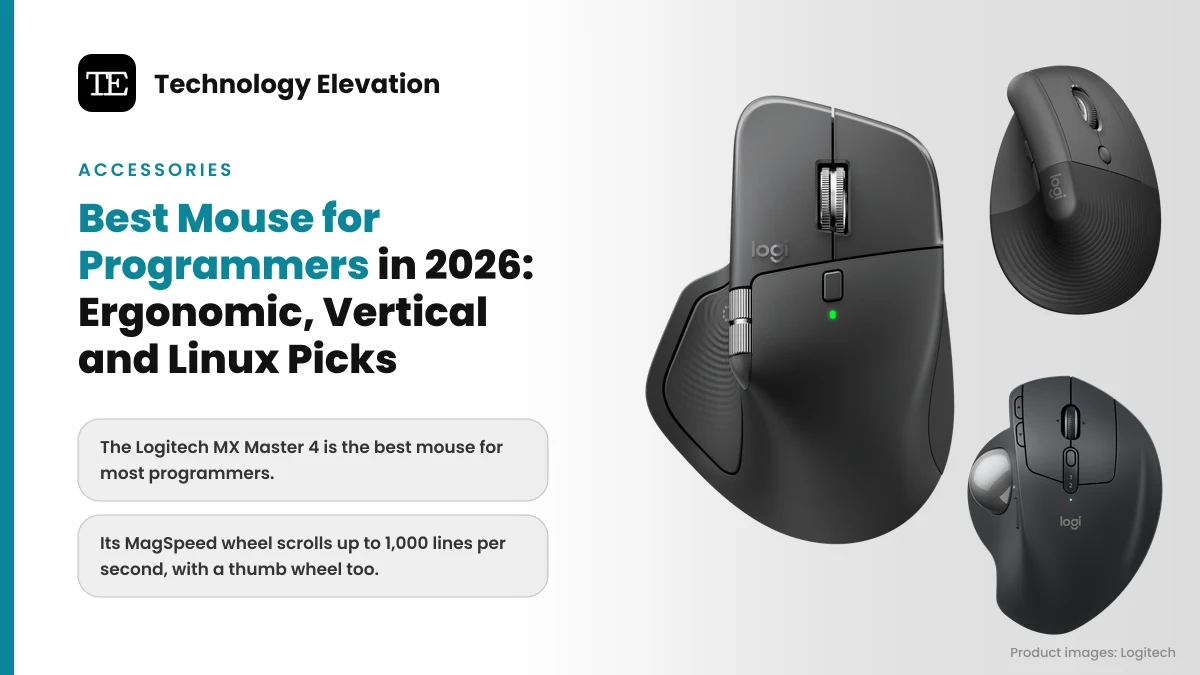
Watch a developer work for ten minutes and the mouse barely moves. It scrolls through a 3,000-line file, jumps back to the last function, clicks a tab, then sits still while the keyboard does the real work. The best mouse for programmers is built for that pattern: fast scrolling, buttons you can map to editor shortcuts, and a shape your wrist can live with for eight hours.
The Canadian Centre for Occupational Health and Safety explains that the small, exact movements of mousing tire the same muscles over and over, which can lead to pain in the hand, wrist, forearm and elbow, plus numbness in the thumb and index finger.
Then there is Linux. Plenty of coders run Ubuntu, Fedora or Arch, and most mouse makers only ship their setup apps for Windows and macOS. So we checked every pick below for what still works when the official software does not.
The best mouse for programmers is the Logitech MX Master 4
The Logitech MX Master 4 is the best mouse for programmers. Its MagSpeed wheel spins through up to 1,000 lines per second, the thumb wheel scrolls sideways through wide files, and its buttons still work on Linux. It launched at $119.99 in September 2025.
Every pick, by the job it does best:
- Best overall: Logitech MX Master 4
- Best for laptops and travel: Logitech MX Anywhere 3S
- Best vertical mouse: Logitech Lift
- Best trackball: Logitech MX Ergo S
- Best budget trackball: Logitech Ergo M575S
- Best for macros and programmable buttons: Razer Basilisk V3 35K
| Mouse | Type | Power | Connection | Linux | List price |
|---|---|---|---|---|---|
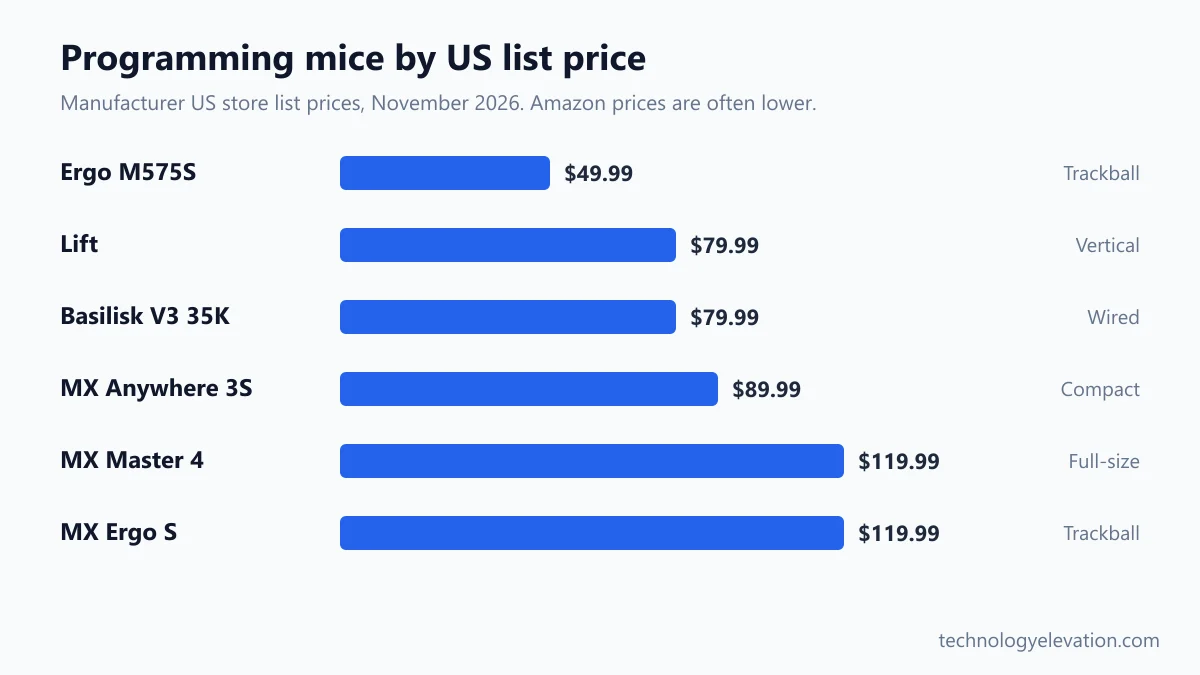
| Logitech MX Master 4 | Full-size | Rechargeable, up to 70 days | Logi Bolt, Bluetooth | Basic functions, no drivers | $119.99 |
| Logitech MX Anywhere 3S | Compact | Rechargeable, up to 70 days | Bluetooth (Bolt sold separately) | Listed by Logitech | $89.99 |
| Logitech Lift | Vertical, 57 degrees | 1 AA, up to 24 months | Logi Bolt, Bluetooth | Listed by Logitech | $79.99 |
| Logitech MX Ergo S | Thumb trackball | Rechargeable, up to 120 days | Logi Bolt, Bluetooth | Listed by Logitech | $119.99 |
| Logitech Ergo M575S | Thumb trackball | 1 AA, up to 18 months | Logi Bolt, Bluetooth | Standard mouse | $49.99 |
| Razer Basilisk V3 35K | Wired, full-size | USB cable | Wired | OpenRazer | $79.99 |
List prices are what Logitech and Razer charge on their own US stores. Amazon is usually cheaper, especially around Black Friday.
Logitech MX Master 4: the best mouse for programmers overall
The MX Master 4 wins because it does the two things coders use most, scrolling and shortcuts, better than anything else here. The MagSpeed wheel flies through long files, a new haptic thumb panel opens a ring of custom actions, and the shape suits a full workday.
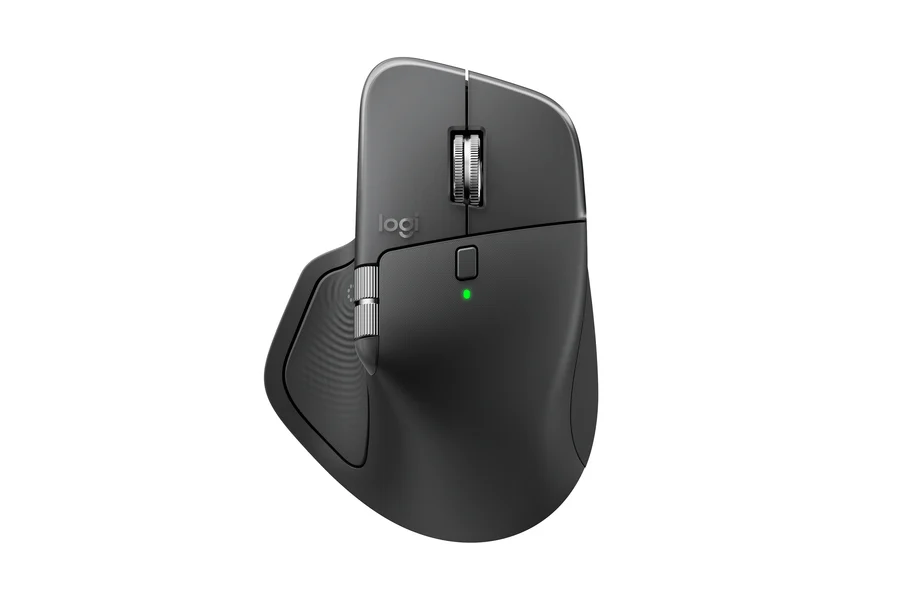
Key specs: 200 to 8,000 DPI Darkfield sensor that tracks on glass, MagSpeed wheel up to 1,000 lines per second, horizontal thumb wheel, Haptic Sense Panel, gesture, back, forward and top buttons, 650 mAh battery rated for up to 70 days, 1-minute quick charge for about 3 hours, Logi Bolt receiver and Bluetooth Low Energy, 150 g. Launch price: $119.99.
Flick the MagSpeed wheel and it free-spins through a long log file, then clicks back into notched steps when you slow down to read. The thumb wheel scrolls sideways through a wide diff or spreadsheet.
The Haptic Sense Panel is the headline change from the MX Master 3S. Press it with your thumb and the Actions Ring pops up, a circle of shortcuts you set up in Logi Options+. Map it to “run tests” or “toggle terminal” and you skip a three-key chord dozens of times a day.
Linux users get less, but not nothing. Logitech says the sensor, wheel and buttons work without extra drivers on most popular Linux distributions. The haptics and Actions Ring depend on Logi Options+, which only runs on Windows and macOS.
The catch is weight. At 150 g it is heavy, and the right-handed shape rules out left-handed coders.
Check the Logitech MX Master 4 price on Amazon
Logitech MX Anywhere 3S: the best mouse for coding on a laptop
The MX Anywhere 3S is the best mouse for coding on the move. It shrinks the MX Master idea into a pocketable body but keeps the 1,000-line MagSpeed wheel and an 8,000 DPI sensor that works on a cafe table. Logitech lists it at $89.99.
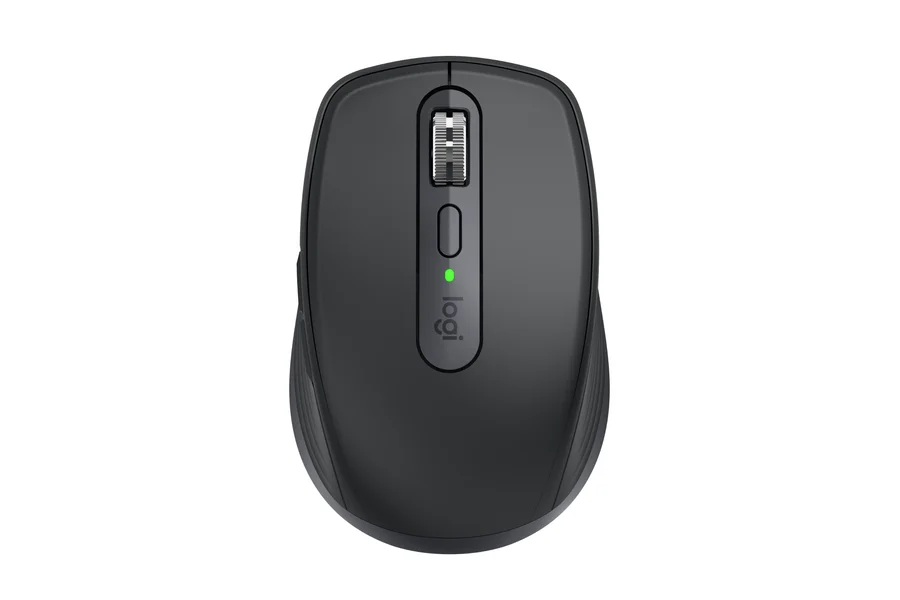
Key specs: 8,000 DPI sensor that tracks on glass, MagSpeed wheel with ratchet and hyper-fast modes up to 1,000 lines per second, USB-C charging, up to 70 days per charge, 1-minute charge for about 3 hours, Bluetooth for up to 3 devices, Logi Bolt receiver sold separately. Logitech lists Windows, macOS, ChromeOS and Linux support.
Laptop trackpads are miserable for selecting a block of code line by line. A small mouse fixes that without eating bag space.
The MagSpeed wheel is the reason to choose this over a cheaper travel mouse. Where a basic notched wheel needs flick after flick, one spin gets through a long file.
The catch is the size for long desk sessions. Larger hands end up in a claw grip, and there is no thumb wheel for sideways scrolling. If the mouse lives on a desk, the MX Master 4 is more comfortable. If you still use a palm grip on a small mouse, the picks for the best mouse for palm grip are worth comparing.
Check the Logitech MX Anywhere 3S price on Amazon
Logitech Lift: the best vertical mouse for programmers
The Logitech Lift is the best vertical mouse for programmers with small to medium hands. Its 57-degree angle holds your hand in a handshake position instead of twisted flat, it comes in a left-handed version, and one AA battery lasts up to 24 months.
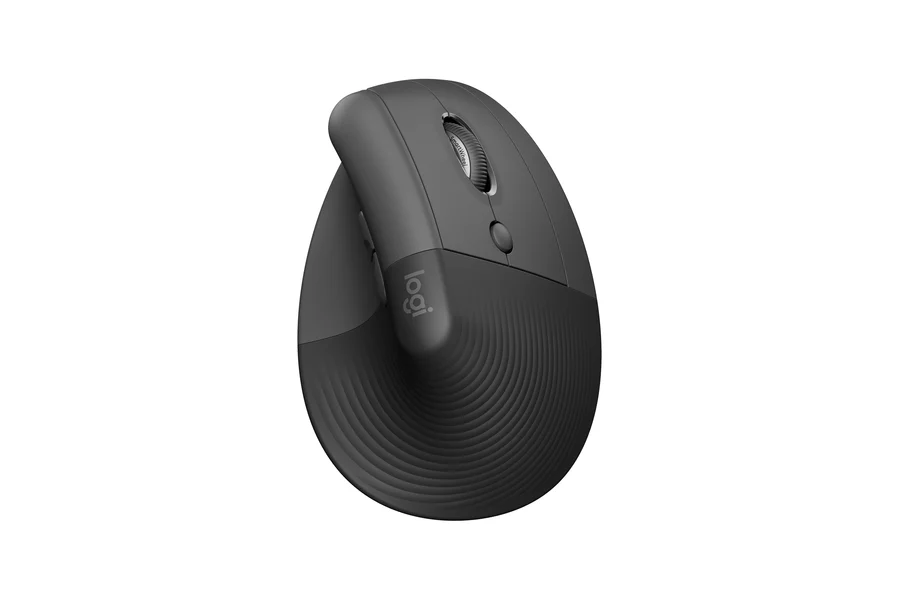
Key specs: 57-degree vertical design, 400 to 4,000 DPI, 6 buttons with quiet clicks, SmartWheel scrolling, 1 AA battery rated for up to 24 months, Logi Bolt receiver and Bluetooth with 3 Easy-Switch channels, 125 g. Logitech lists Windows, macOS, ChromeOS, Linux, iPadOS and Android support. List price: $79.99.
A regular mouse makes you rotate your forearm so the palm faces the desk. On a vertical mouse, your hand rests on its side as if for a handshake. Expect the first couple of days to feel clumsy while your hand adjusts.
Logitech recommends the Lift for small to medium hands. If yours are bigger, the larger Logitech MX Vertical is the better fit.
The catch is precision. Selecting a single character takes practice on a vertical mouse, though clicking and dragging a selection is easy.
Check the Logitech Lift price on Amazon
Logitech MX Ergo S: the best trackball for programmers
The Logitech MX Ergo S is the best trackball for programmers who want to stop moving their arm at all. You roll the ball with your thumb while the mouse stays put, and a hinged base tilts it 20 degrees for a more relaxed wrist. Logitech lists it at $119.99.
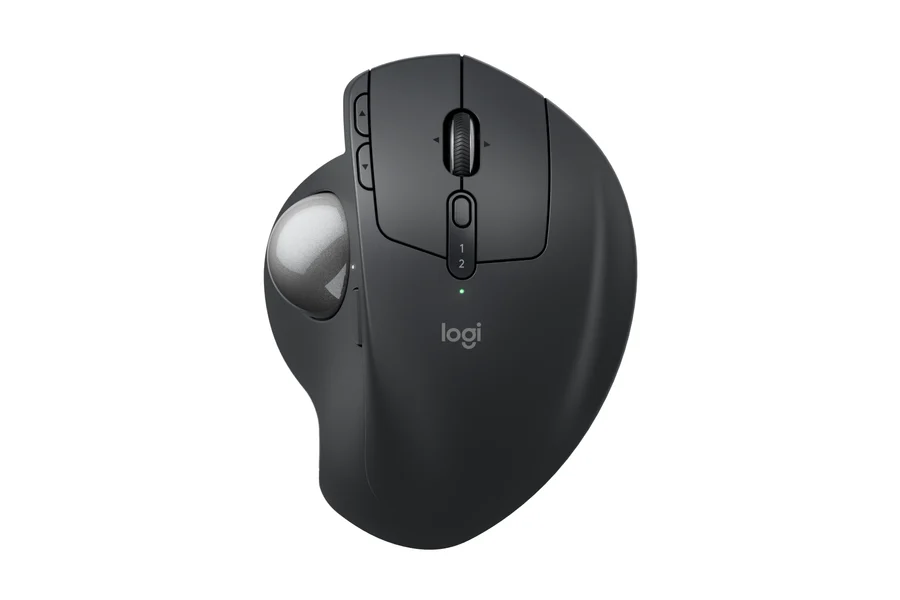
Key specs: thumb-operated trackball, adjustable tilt of 0 or 20 degrees, 8 buttons with 6 customizable, precision mode button, tilt scroll wheel, USB-C charging with up to 120 days per charge and a 1-minute charge for about 24 hours, Logi Bolt receiver and Bluetooth 5.2, 164 g (259 g with the metal base plate). Logitech lists Linux and ChromeOS support.
Trackballs remove arm movement completely. Your shoulder and forearm stay still, which matters because CCOHS links reaching for a distant mouse to shoulder and upper back strain.
The precision mode button is handy for coders. Press it and the cursor slows down, so you can hit a tiny breakpoint gutter or a 1-pixel window edge without overshooting.
The catch is the learning curve: expect a week or two of clumsy cursor work. The USB-C cable is also not in the box. The MX Ergo S Plus adds an extra 10-degree wedge if you want an even steeper angle.
Check the Logitech MX Ergo S price on Amazon
Logitech Ergo M575S: the best budget trackball for coding
The Logitech Ergo M575S is the cheapest way to find out whether a trackball suits you. It costs $49.99 at list price, runs up to 18 months on one AA battery, and uses the same thumb-ball layout as the MX Ergo S without the tilt hinge.
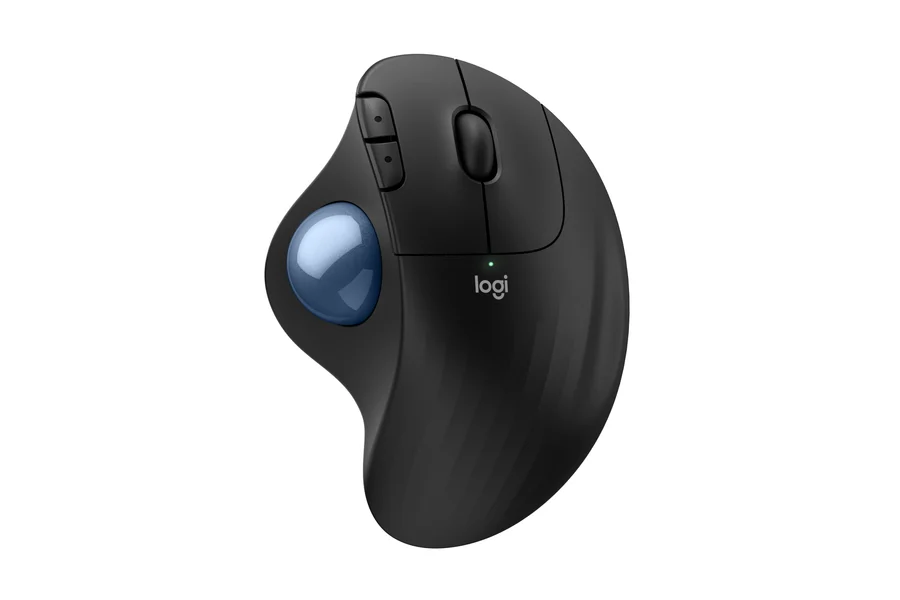
Key specs: thumb-operated trackball, back, forward and middle-click buttons customizable in Logi Options+, 1 AA battery rated for up to 18 months, Logi Bolt receiver included and Bluetooth Low Energy. List price: $49.99.
Next to the MX Ergo S, you lose the tilt hinge, the precision button and the rechargeable battery. In exchange you get a battery you can forget about for more than a year.
On Linux the ball, buttons and wheel work out of the box. You will still see the older M575 with a Unifying receiver in listings. The M575S is the current Logi Bolt model.
The catch is the wheel. It is a plain notched wheel, not MagSpeed, so long files take more scrolling.
Check the Logitech Ergo M575S price on Amazon
Razer Basilisk V3 35K: the best mouse for programmable buttons and macros
The Razer Basilisk V3 35K is the best programmable mouse for coders who live on keyboard shortcuts. It has 11 programmable buttons, a HyperShift layer that gives each control a second job, and a free-spin wheel. Razer lists it from $79.99.
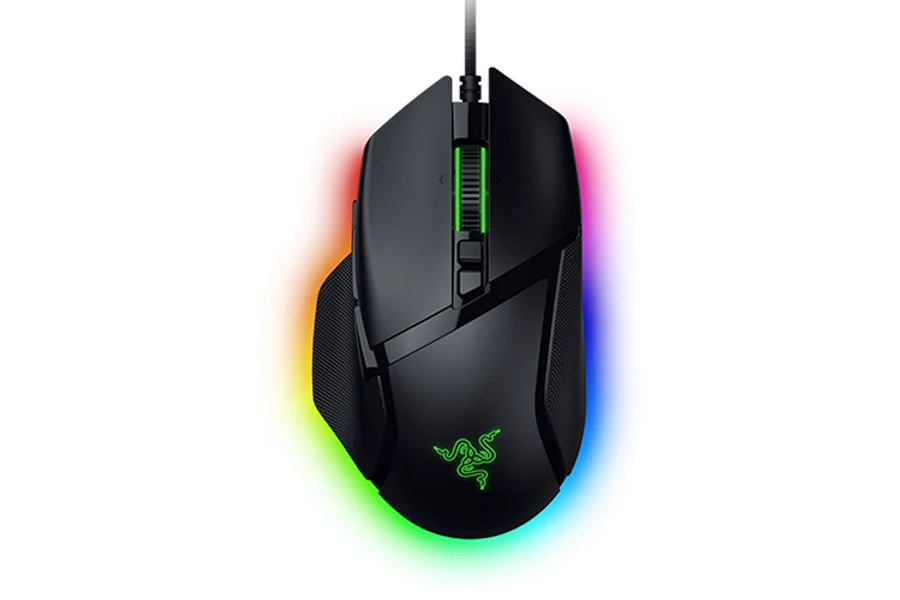
Key specs: wired, Focus Pro 35K Optical Sensor Gen-2 up to 35,000 DPI, 11 programmable buttons, Razer HyperShift second layer for each of its 13 controls, HyperScroll tilt wheel with tactile, free-spin and Smart-Reel modes, 11-zone Chroma RGB lighting, set up in Razer Synapse 4. List price: from $79.99.
Those buttons work just as well for “go to definition” and “toggle comment” as for game abilities. Hold the HyperShift button and every other button switches to a second set of functions, which gives you up to 22 inputs on one hand. Smart-Reel switches the wheel to free-spin automatically when you scroll fast, then back to notched steps for slow reading.
The catch is software. Razer Synapse 4 runs on Windows 10 and 11 only, and Razer offers no Linux version. The community OpenRazer driver supports the Basilisk V3 35K, so Linux users can still change settings, but the setup takes more effort than with Logitech.
Check the Razer Basilisk V3 35K price on Amazon
Kensington trackballs suit left-handed programmers
Kensington’s Expert Mouse range is the classic choice for left-handed programmers, because the big 55 mm ball sits in the middle and works with either hand. The newest model, the Expert Mouse Pro TB900 EQ, has a $129.99 list price.
Kensington pulled the TB800 EQ in 2026 after owners reported tracking problems, and the TB900 EQ adds dual sensors to fix them. It keeps the adjustable scroll ring, adds two side scrolls, and connects to up to four devices over Bluetooth, 2.4GHz wireless and USB-C.
Stock has been patchy, and Kensington’s Konnect software supports Windows and macOS only. Right-handers will find the Logitech pair above easier to buy.
Six checks for choosing a mouse for programming
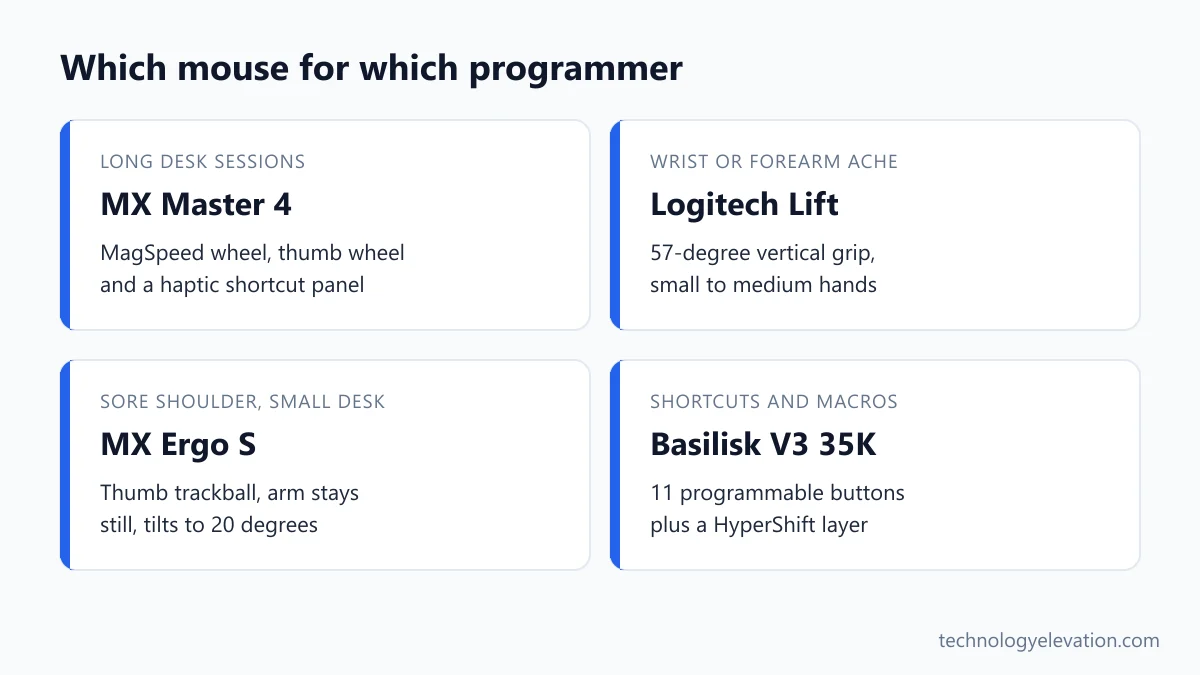
Choose a mouse for programming by comfort first, then scrolling, then buttons and software. Pick the shape your wrist needs, make sure the wheel can cover a long file quickly, and check that the setup app runs on your operating system before you pay.
- Start with your wrist. No pain? A full-size mouse like the MX Master 4 is fine. Sore wrist or forearm? Try a vertical mouse. Shoulder ache or a cramped desk? A trackball keeps your arm still.
- Test the scroll wheel. A free-spin or MagSpeed wheel moves through hundreds of lines in one flick. A thumb wheel handles sideways scrolling in wide files.
- Count the buttons you will really use. Back and forward cover navigation in most editors and browsers. Beyond four or five extra buttons, most people forget what each one does.
- Check the software on your OS. Logi Options+ needs Windows 10 or later or macOS 14 or later. Razer Synapse 4 is Windows only. Linux needs a community tool.
- Match your hand size and grip. The Lift suits small to medium hands. Large hands and palm grips suit the MX Master 4.
- Decide on battery or cable. AA mice last 18 to 24 months. Rechargeable MX models last 70 to 120 days. Wired mice never need charging.
The keyboard matters as much as the mouse for long coding days. A compact board without a number pad lets the mouse sit closer to your body, which is the exact problem CCOHS describes. The best business keyboards include several tenkeyless options, and a large desk pad gives both devices a smooth surface.
Linux mouse support comes down to Solaar and OpenRazer
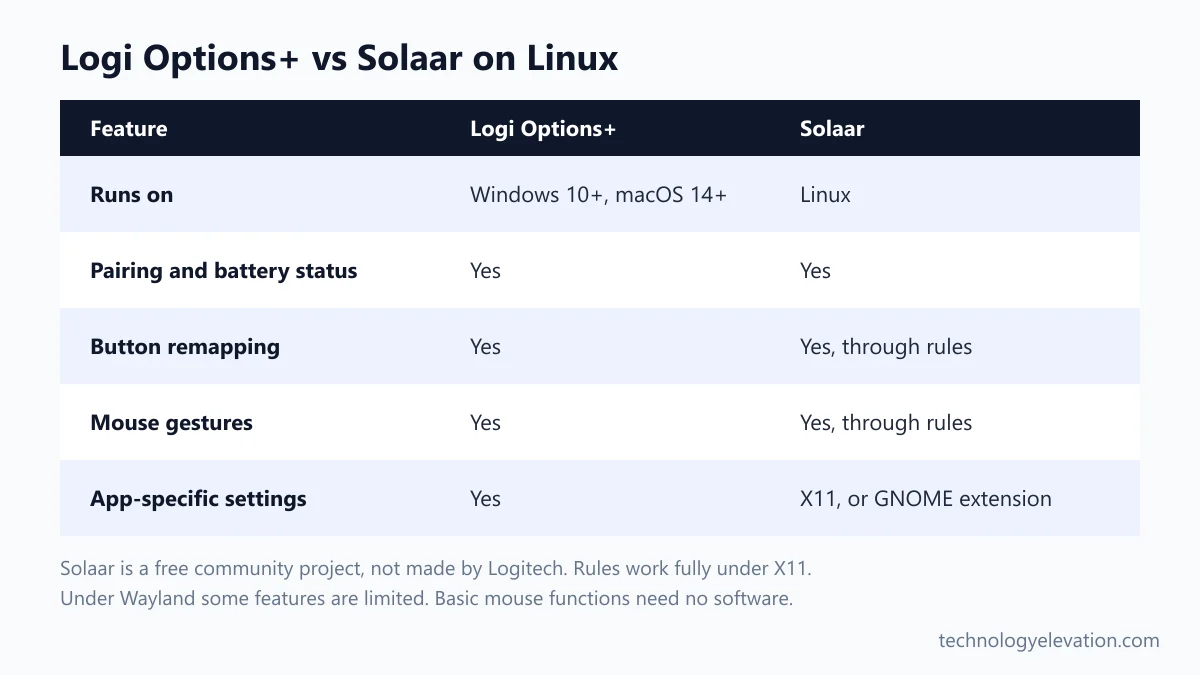
The best mouse for Linux is any Logitech MX or Ergo model, because the community app Solaar handles pairing, battery status and button remapping. Logi Options+ has no Linux version. Razer mice need the community OpenRazer driver instead of Razer Synapse.
Solaar is a free Linux manager for Logitech devices that works with Unifying, Bolt and Lightspeed receivers and detects many Bluetooth devices too. It shows battery levels, pairs new devices and changes settings like scroll direction. Volunteers build it, not Logitech.
Solaar’s rules are where coders get the most value. You can divert a button so pressing it sends a key combination such as Ctrl plus Shift plus P, runs a script, or triggers a mouse gesture. Rules work fully under X11. On Wayland, some features are limited, and app-specific rules only work on GNOME with the Solaar extension.
Razer owners on Linux use OpenRazer, a community driver whose device list includes the Basilisk V3 35K. Setup involves a kernel module, so expect a few terminal commands.
If you spend most of your day in Linux, that tips the balance toward Logitech, which lists Linux support for basic functions on its MX and Ergo mice. A machine from the best laptops for Python programming pairs well with an MX Anywhere 3S.
Ergonomic mice reduce strain, but placement matters more
An ergonomic mouse for programmers helps, but where it sits on the desk matters just as much. CCOHS warns that a mouse placed out of easy reach makes you lean forward, loading the muscles of your upper back and shoulder for as long as you use it.
Keep the mouse right beside the keyboard, at the same height, with your elbow close to your side. If you have to stretch to reach it, no shape will save your shoulder.
Small habits help too:
- Move the mouse from your elbow, not by flicking your wrist.
- Learn your editor’s keyboard shortcuts for the jobs you mouse most often.
- Take short breaks to stretch your hands and look away from the screen.
A standing desk lets you switch positions through the day, and good lighting from a monitor light bar stops you leaning in to read small code.
Pain that lasts more than a few days, or numb fingers, is a reason to see a doctor, not to buy another mouse.
Frequently asked questions about mice for programmers
What is the best mouse for programmers?
The Logitech MX Master 4 is the best mouse for most programmers. It has a MagSpeed wheel that scrolls up to 1,000 lines per second, a thumb wheel for sideways scrolling, customizable buttons and basic Linux support, at a launch price of $119.99.
Is a vertical mouse better for programming?
A vertical mouse is better if your wrist or forearm aches after long sessions. It holds your hand in a handshake position instead of twisted flat. The Logitech Lift is the best place to start for small to medium hands.
Does Logi Options+ work on Linux?
No. Logi Options+ is available for Windows 10 or later and macOS 14 or later. On Linux, the free community app Solaar handles pairing, battery status, settings and button remapping for most Logitech mice.
What is the best mouse for Linux programmers?
A Logitech MX or Ergo mouse is the best choice for Linux programmers because Logitech lists Linux support for them. The MX Master 4 works on most Linux distributions without extra drivers, and Solaar works with many Logitech mice.
Are trackballs good for coding?
Yes, trackballs are good for coding, especially on small desks or if your shoulder aches. You move the cursor with your thumb while your arm stays still. Expect one to two weeks before thumb control feels natural.
How many buttons does a programming mouse need?
Most programmers need five to seven buttons: left and right click, a clickable wheel, back and forward, and one or two extras for editor shortcuts. Mice like the Razer Basilisk V3 35K offer 11 programmable buttons for heavier macro use.
Is a gaming mouse good for programming?
A gaming mouse can be very good for programming. Extra buttons and free-spin wheels suit editor shortcuts and long files. The main drawback is software, since Razer Synapse 4 runs only on Windows.
Last checked and sources
Last checked on 15 November 2026 by Abdullah Kabeer. We compared the programming mice on sale in the US using manufacturer spec sheets, support pages and launch announcements, checked Linux support against each project’s own documentation, and used official occupational health guidance for the ergonomics advice.
- Logitech, MX Master 4 specifications and product page (logitech.com)
- Logitech support, specifications for the Lift, MX Ergo S, MX Anywhere 3S and Ergo M575S
- Logitech, Logi Options+ download page and system requirements
- Razer, Basilisk V3 35K product page and Razer Synapse 4 requirements
- Kensington, Expert Mouse Pro TB900 EQ product page
- Solaar project documentation and OpenRazer device list
- Canadian Centre for Occupational Health and Safety, computer mouse hazards
- Independent coverage by 9to5Mac, Engadget and PCWorld
We update this buying guide when Logitech, Razer or Kensington launch, discontinue or significantly change a model.
Technology Elevation is reader-supported. As an Amazon Associate, we earn from qualifying purchases. When you buy through links on this page, we may earn a small commission at no extra cost to you.


GIPHY App Key not set. Please check settings