

 Abdullah Kabeer
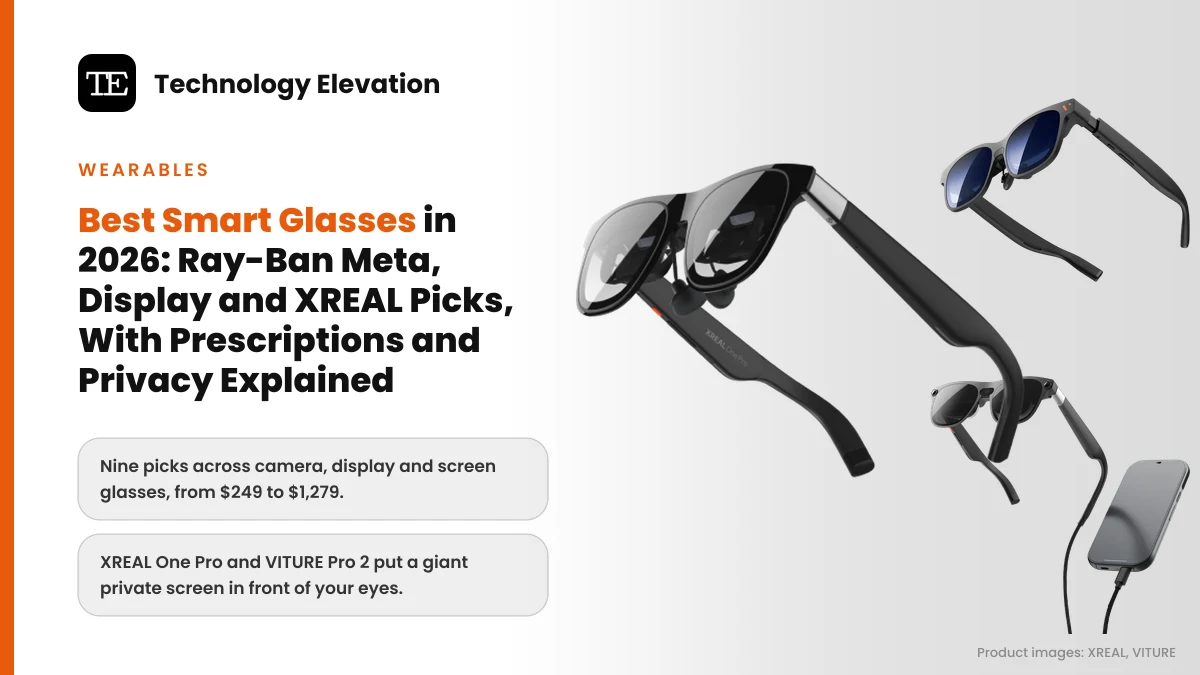
Sit in any airport gate this month and count the thick black frames. Some of those people are filming the runway with a tap on the temple, some are listening to a podcast nobody else can hear, and a few are watching a movie on a screen only they can see. Smart glasses stopped being a gadget-show novelty in 2026, and the best smart glasses now come in four quite different types.
The first type is camera glasses like the Ray-Ban Meta. Next come display glasses that put messages in your lens. Then there are tethered screen glasses from XREAL and VITURE for movies and games. Last are camera-free glasses for people who want help without a lens pointed at anyone.
Meta launched the most at its September Connect event. The new Ray-Ban Meta (Gen 3) starts at $449 and Ray-Ban Meta Audio at $349, and Meta says it will offer more than 100 frame and lens options by the end of the year.
We compared the official specs, prices, privacy features and prescription options of every major model on sale in the US, then sorted them by the job each one does best.
The best smart glasses for most people are the Ray-Ban Meta (Gen 3)
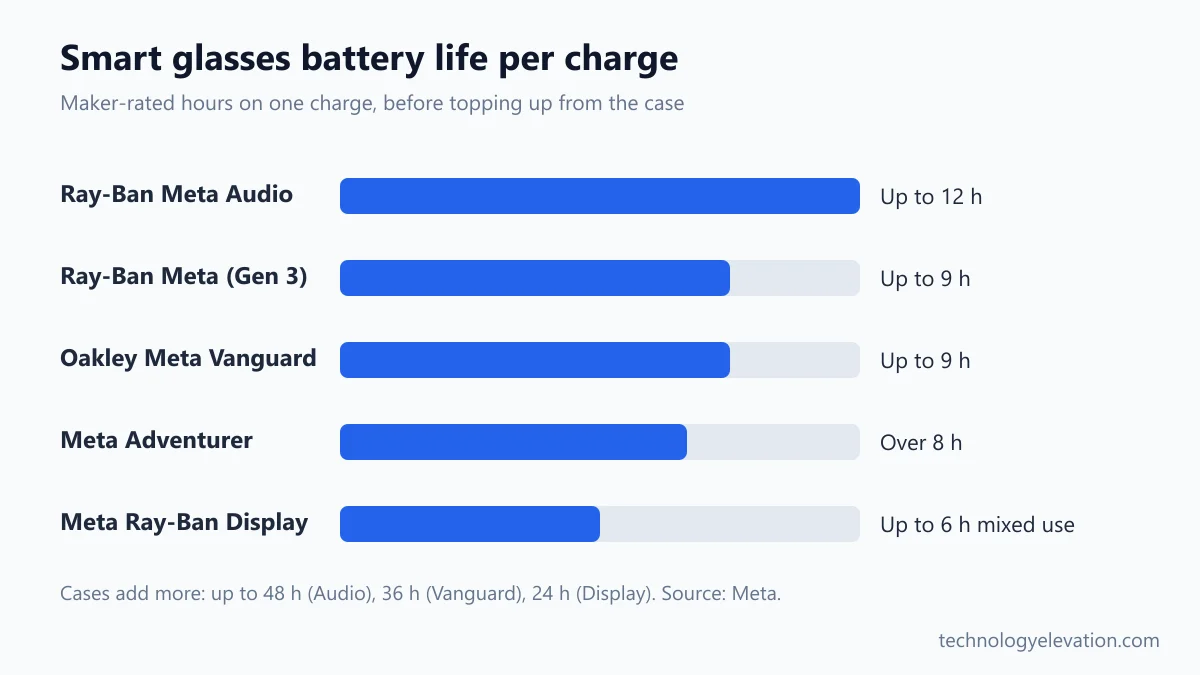
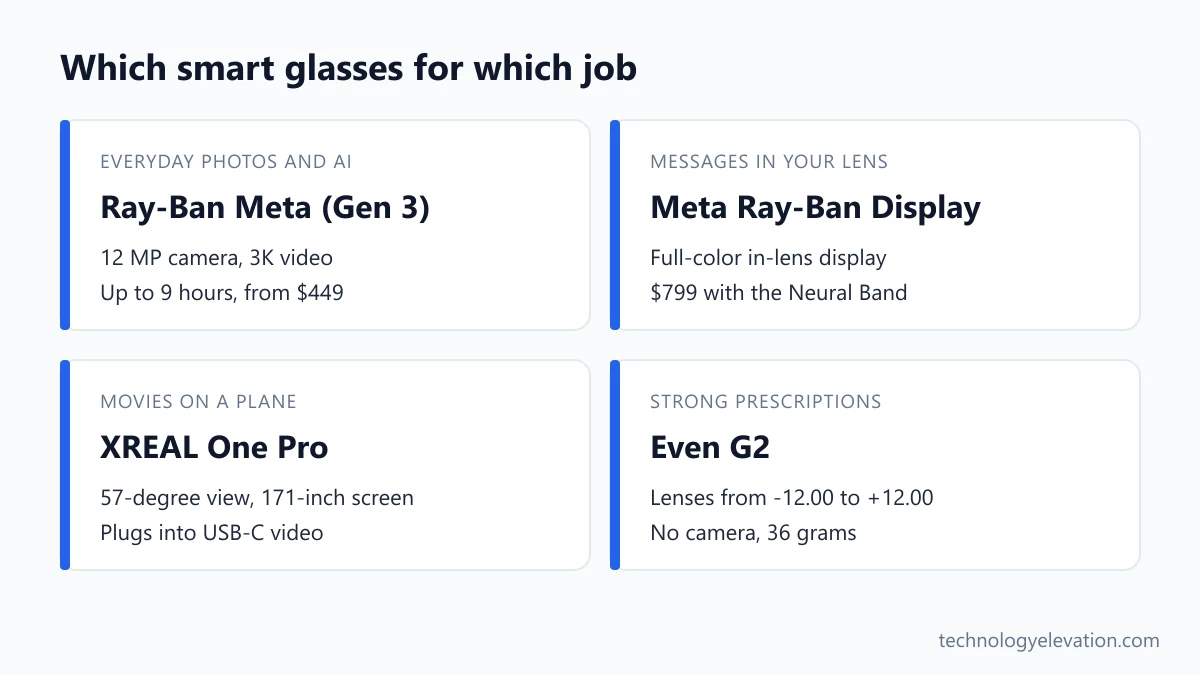
The Ray-Ban Meta (Gen 3) are the best smart glasses for most people. They look like normal Ray-Bans, shoot 12 MP photos and 3K video, play music through open-ear speakers, last up to 9 hours, and accept prescription lenses. They start at $449.
Every pick, by the job it does best:
- Best overall: Ray-Ban Meta (Gen 3)
- Best with a built-in display: Meta Ray-Ban Display
- Best for sports: Oakley Meta Vanguard
- Best on a budget: Meta Adventurer
- Best for music and calls: Ray-Ban Meta Audio
- Best for prescriptions and privacy: Even G2
- Best for movies and gaming: XREAL One Pro
- Best cheap display glasses: VITURE Pro 2
- Best for spatial computing: XREAL AURA
| Model | Type | Camera | Battery or power | Launch price |
|---|---|---|---|---|
| Ray-Ban Meta (Gen 3) | Camera AI glasses | 12 MP, 3K video | Up to 9 hours | From $449 |
| Meta Ray-Ban Display | Display AI glasses | Yes | Up to 6 hours mixed use | $799 with Neural Band |
| Oakley Meta Vanguard | Sport AI glasses | 12 MP, 3K video | Up to 9 hours | $499 |
| Meta Adventurer | Camera AI glasses | Yes | Over 8 hours | From $249 |
| Ray-Ban Meta Audio | Audio glasses | No | Up to 12 hours | From $349 |
| Even G2 | Display glasses | No | Up to two days | From $599 |
| XREAL One Pro | Tethered screen glasses | No | Powered by your device | $599 |
| VITURE Pro 2 | Tethered screen glasses | No | Powered by your device | $299 |
| XREAL AURA | Android XR glasses | RGB camera | Battery in a compute puck | $1,279 |
VITURE and Even Realities are already running Black Friday offers, and Meta frames are sold at optical shops as well as electronics stores. Treat the launch prices above as a ceiling.
Ray-Ban Meta (Gen 3): the best smart glasses overall
The Ray-Ban Meta (Gen 3) are the best all-round smart glasses. Meta made the frame slimmer, added an hour of battery over Gen 2, fitted a 6-microphone array for clearer calls, and added a customizable action button. They still look like ordinary Ray-Bans.
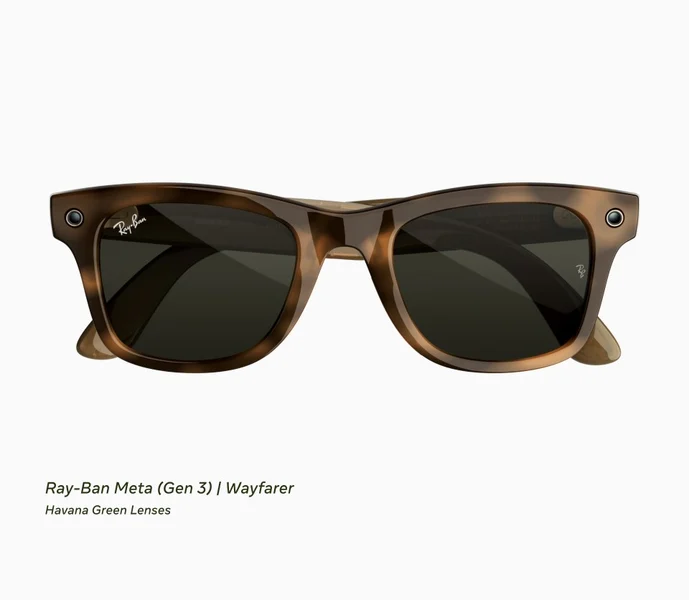
Key specs: 12 MP camera, 3K Ultra HD video, open-ear speakers, 6-microphone array that Meta says cuts more than 90% of background noise, up to 9 hours of battery, customizable action button, professional-adjustable temple tips, white capture LED. 27 color and lens combinations across the Aviator, Zena and Wayfarer styles. Released September 23, 2026, from $449.
These are the glasses most people mean when they say smart glasses. You say “Hey Meta, take a photo” and the camera in the corner of the frame does it, with no phone in your hand. Music and calls come through small speakers aimed at your ears, so you still hear traffic.
Meta AI is the other half. Look at a menu in another language or a plant in the garden and ask what it is. Meta also added dynamic photos, which grab several frames and let you pick the best one.
The honest catch is the camera itself. Some people dislike being near one, and a few venues ask you to take camera glasses off. The battery is also fine for a day of light use, not for hours of video, so the charging case comes along on trips.
Buy the Ray-Ban Meta (Gen 3) now on Amazon
Meta Ray-Ban Display: the best smart glasses with a built-in display
The Meta Ray-Ban Display are the best smart glasses with a screen in the lens. A small full-color display shows messages, walking directions, live captions and a camera viewfinder, and the included Meta Neural Band wristband lets you control it with finger movements. They cost $799.
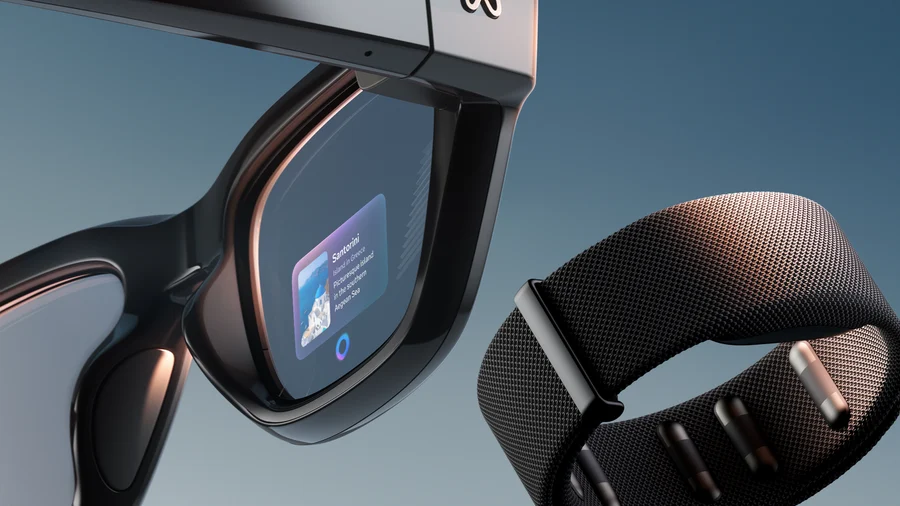
Key specs: Full-color in-lens display placed off to the side of your view, camera, open-ear speakers, Transitions lenses, up to 6 hours of mixed use and up to 30 hours in total with the collapsible case. Meta Neural Band: EMG wristband, up to 18 hours of battery, IPX7, three sizes. Black or Sand. On sale since September 30, 2025, at $799 including the band.
The wristband is the clever part. It reads the electrical signals your muscles make, so a pinch selects, a thumb swipe scrolls and a twist of the wrist turns up the volume. Meta says it built the band on research with nearly 200,000 participants, so it works out of the box for most people.
What you do with the display is practical. Read a WhatsApp message without pulling out your phone, follow turn-by-turn walking directions, or read live captions of the person talking to you. Since its September 2026 update, Meta has added cycling and transit directions in the US and Canada and a calendar that shows who is in your next meeting.
The catches: $799 is a lot, and battery life is shorter than on camera-only frames. Meta also designed the display for quick glances, not for reading a long article. Online ordering opened in the US in September 2026, so you no longer need a store demo to buy a pair.
Buy the Meta Ray-Ban Display now on Amazon
Oakley Meta Vanguard: the best smart glasses for sports
The Oakley Meta Vanguard are the best smart glasses for running, cycling and skiing. The wraparound frame is rated IP67 for dust and water, the speakers are Meta’s loudest, and the glasses link to Garmin and Strava for hands-free stats. They launched at $499.
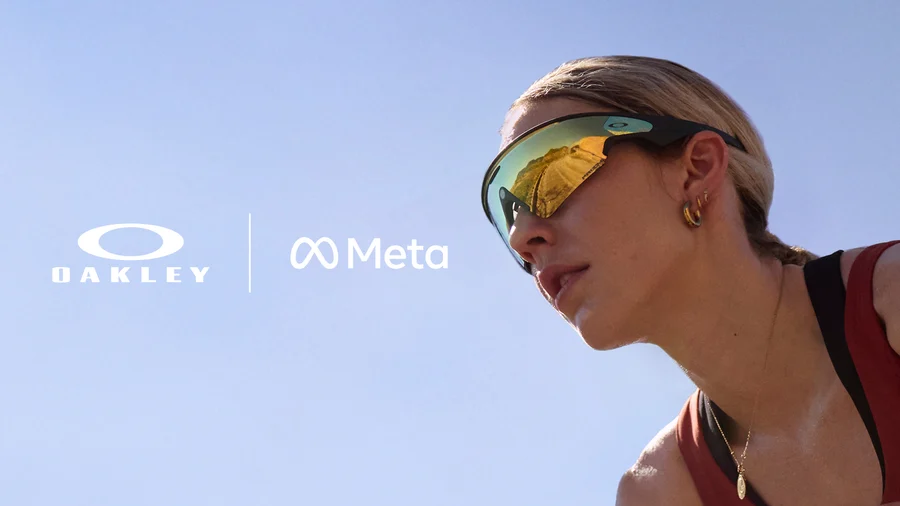
Key specs: Centered 12 MP camera with a 122-degree lens, video up to 3K with Slow Motion and Hyperlapse modes, Oakley PRIZM lenses, open-ear speakers 6 dB louder than the Oakley Meta HSTN, 5-microphone array tuned for wind, up to 9 hours of battery (6 hours of continuous music), 36 more hours from the case, 50% charge in 20 minutes, IP67. Launched October 21, 2025, at $499.
The camera sits in the middle of the frame, above your nose, so footage looks the way you saw it. Meta says the centered position gives a more balanced view than a corner camera.
Garmin owners get the most out of these. Ask “Hey Meta, what’s my heart rate?” mid-run and hear the answer, or set the glasses to film automatically when you hit a distance milestone. Strava users can lay their stats over the video before posting.
The catch is style. Nobody will mistake these for everyday glasses at dinner. If you want an Oakley look you can wear all day, the Oakley Meta HSTN starts at $399 with an IPX4 rating for sweat and light rain. Runners who prefer audio without the camera should also compare the open-ear earbuds built for training.
Buy the Oakley Meta Vanguard now on Amazon
Meta Adventurer: the best cheap smart glasses
The Meta Adventurer are the best cheap smart glasses. They come from Meta’s own eyewear line, made with EssilorLuxottica, and cost $249 in black with grey lenses and a plug-in case. You still get the camera, open-ear speakers, Meta AI and an action button.
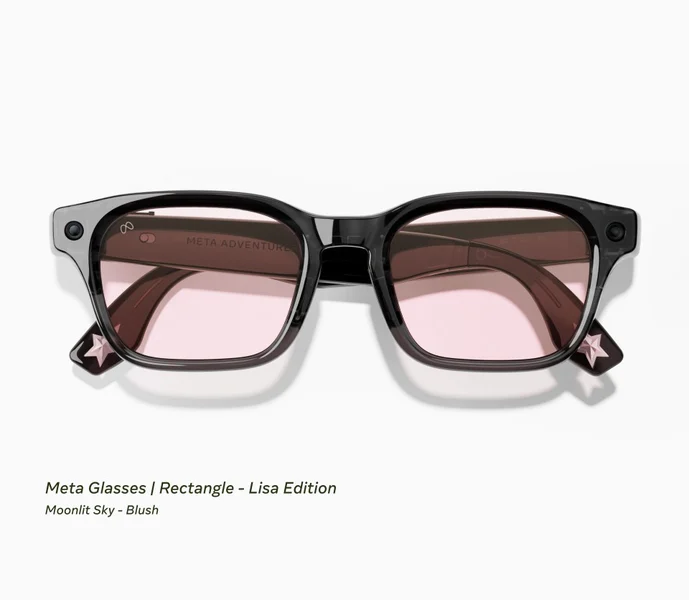
Key specs: Rectangular frame in Standard and Large sizes, camera for hands-free photos and video, open-ear speakers, multi-microphone array with wind noise reduction, dedicated action button, over 8 hours of battery, three-way adjustable nose pads, prescription compatible. The $249 version ships with a plug-in case and went on sale October 23, 2026; other Meta Glasses styles start at $299.
Meta Glasses are the brand’s newest line, launched in June 2026 without the Ray-Ban or Oakley name. Meta says they were its first glasses to launch with Meta AI powered by its Muse Spark model in the US and Canada.
The $249 price is the cheapest way into Meta’s AI glasses. That makes it a sensible gift for someone curious about the category but unsure they will wear smart glasses every day. The wider list of tech gifts we picked this season includes a few more options at the same budget.
The catch is the case. The regular Meta Glasses case adds up to 40 hours of charge on the go, while the cheapest bundle uses a plug-in case. Heavy travellers should pay the extra for the portable one.
Buy the Meta Adventurer now on Amazon
Ray-Ban Meta Audio: the best smart glasses for music and calls
The Ray-Ban Meta Audio are the best smart glasses for music, podcasts and calls. Meta calls them its first audio glasses, built around speakers and microphones rather than a camera. They weigh 43 grams, last up to 12 hours and start at $349.
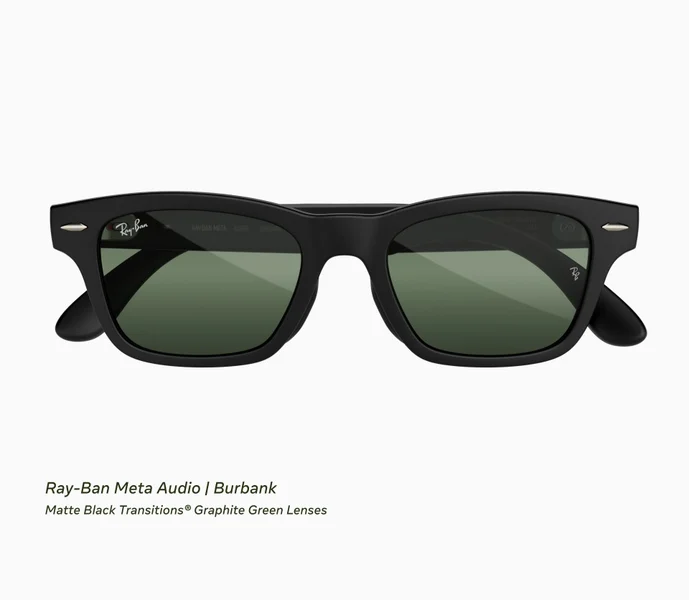
Key specs: Open-ear speakers, voice access to Meta AI, up to 12 hours per charge plus 48 more from the included case, 43 g, professional-adjustable temple tips, adjustable or swappable nose pads, overextension hinges. 23 color and lens combinations in the Clubmaster and Burbank styles, compatible with a wide range of prescriptions. Shipped October 13, 2026, from $349.
Think of these as earbuds you never have to put in. Meta says calls pick up your voice more clearly than earbuds do, and 12 hours covers a full workday of meetings and a commute home.
They are also the easiest Meta frame to wear in places where cameras cause friction: offices with strict rules, gyms, a friend’s wedding. People nearby have nothing to worry about.
The catch is obvious. No camera means no hands-free photos and no asking Meta AI what you are looking at. Open speakers also leak some sound at high volume, so a quiet library is the wrong place to play music loudly.
Buy the Ray-Ban Meta Audio now on Amazon
Even G2: the best smart glasses for prescriptions and privacy
The Even G2 are the best smart glasses for strong prescriptions and camera-shy wearers. They have no camera at all, weigh 36 grams, show a heads-up display for notes, translation and navigation, and take custom lenses from -12.00 to +12.00. They start at $599.
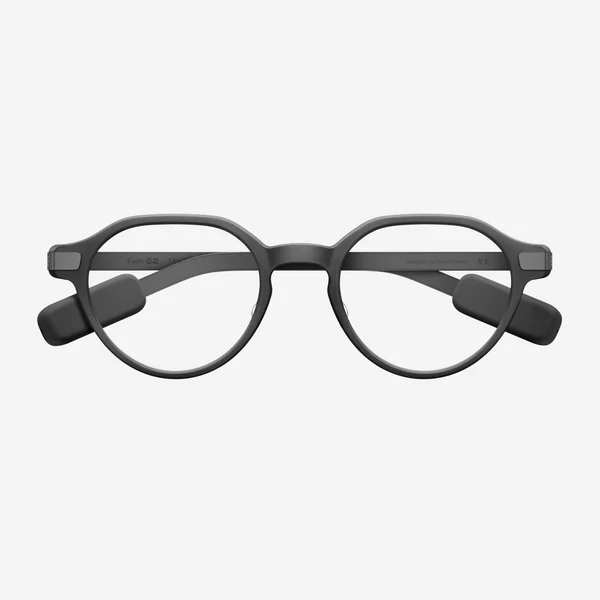
Key specs: Binocular waveguide display, green micro LED, 640 x 350 resolution, 27.5-degree field of view, 1,200 nits, 60 Hz, four microphones, Bluetooth 5.4, IP65, 36 g, no camera, up to two days of battery with a case that holds seven full charges. Prescription lenses from -12.00 to +12.00. From $599.
Even Realities built these for meetings and talks more than for social media. Teleprompt scrolls your notes as you speak, Conversate shows prompts during a conversation, and live translation puts subtitles in your view.
The prescription range is the widest here by a long way. Even also sells progressive lenses through its retail partners, and you can send in a new prescription later without replacing the frame.
The catches: the display is green only, so it shows text and simple graphics rather than photos. And without a camera, the AI cannot see what you see. For most people who choose the G2, that second point is the whole reason they bought it.
XREAL One Pro: the best display glasses for movies and gaming
The XREAL One Pro are the best display glasses for movies and gaming. Plug them into a phone, laptop, console or handheld and they show a giant virtual screen, held steady in the air by XREAL’s own X1 chip. They launched at $599.
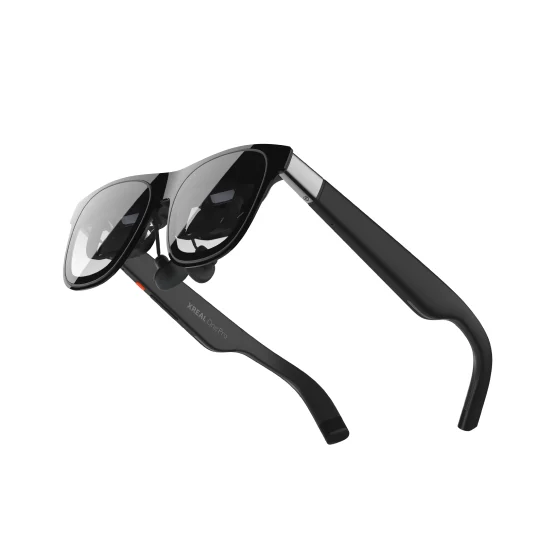
Key specs: 0.55-inch Sony micro-OLED displays, 57-degree field of view with X Prism optics, up to a 171-inch virtual screen at 4 meters, 120 Hz, X1 chip with 3 ms motion-to-photon latency, native 3DoF anchoring, three levels of electrochromic dimming, sound tuned by Bose, two IPD sizes (57 to 66 mm and 66 to 75 mm). Connects over USB-C to devices with DisplayPort output. Launch price $599.
These are a different product from Meta’s glasses. There is no camera and no assistant. Instead, they are a portable monitor you wear, and the picture stays put when you turn your head, which helps on planes and trains.
Gamers like them with handhelds. A Steam Deck or ROG Ally on a tray table becomes a huge screen, and the handheld gaming PCs we rank all output video over USB-C. A Nintendo Switch needs XREAL’s separate hub.
The catches: you need a USB-C port that outputs video, and the glasses run off your device’s battery. XREAL also now sells the brighter XREAL 1 Pro+ (1,200 nits, 57 degrees) and the lighter XREAL 1S (82 g, 1200p, 700 nits), so compare all three before you buy.
Buy the XREAL One Pro now on Amazon
VITURE Pro 2: the best cheap display glasses
The VITURE Pro 2 are the best cheap display glasses, and the best pick for nearsighted people who hate prescription inserts. Twin dials adjust each lens from 0 to -5.0 diopters, the frame weighs 63 grams, and the screen reaches 1,600 nits. They cost $299.
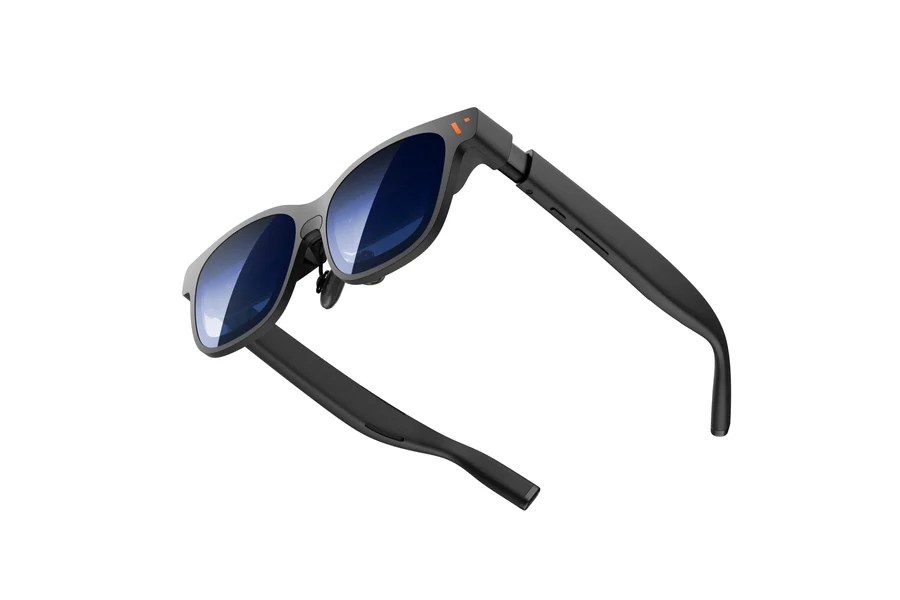
Key specs: Sony micro-OLED display, UltraClarity 3.0 birdbath optics, 146-inch virtual screen, 50-degree field of view, 120 Hz, up to 1,600 nits, independent diopter dials per eye from 0 to -5.00D, 63 g, seven nose pad settings, SGS Eye Care certification, lens shade included. List price $299.
The built-in dials are the selling point. Most screen glasses need custom prescription inserts that cost extra and take time to arrive. With the Pro 2, a nearsighted wearer turns two knobs until the picture is sharp.
VITURE says the Pro 2 is 20% lighter and 16% thinner than the original VITURE Pro, which matters in the second hour of a movie.
The catch is stability. VITURE itself says the diopter adjustment can interfere with head tracking, so its pricier Beast model handles a fixed, anchored screen better. For lying back with a film, that rarely matters.
Buy the VITURE Pro 2 now on Amazon
XREAL AURA: the best smart glasses for spatial computing
The XREAL AURA are the best smart glasses for spatial computing. They run Google’s Android XR with Gemini, track your hands, pin apps in the room and pair a 70-degree view with a pocket puck. List price is $1,279, with a $1,099 offer through 2026.
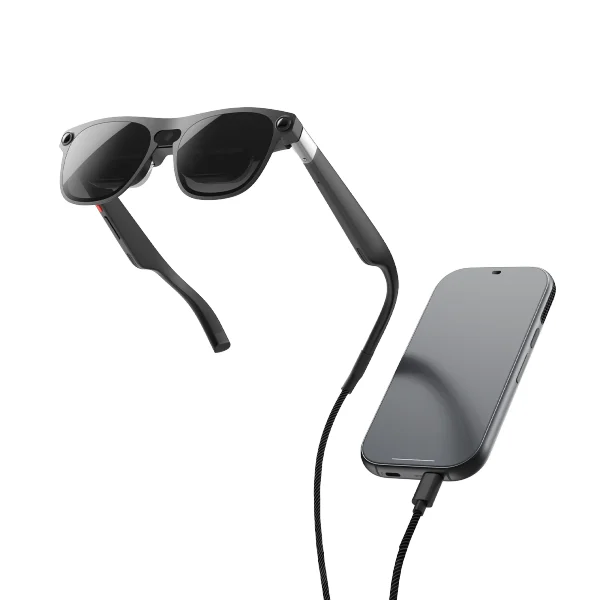
Key specs: Optical see-through glasses, Sony micro-OLED at 1920 x 1200 pixels per eye, 70-degree field of view, up to 1,050 nits, up to 120 Hz, X1S spatial coprocessor, two tracking cameras with 6DoF anchoring and hand tracking, RGB camera with a privacy LED, five levels of electrochromic dimming, 95 g glasses. Puck: Snapdragon Reality Elite, 12 GB/256 GB or 16 GB/512 GB, 4,455 mAh battery, Wi-Fi 6/6E, 265 g. List prices $1,279 and $1,499.
AURA sits between screen glasses and a full headset. You see the real room through the lenses, not through a camera, while Android apps from Google Play float in front of you. Gemini can answer questions about what you are looking at.
XREAL says buyers who paid the original price get a refund for the difference, which tells you how fast this market is moving.
The catch is price and weight. At 95 g on your face plus a 265 g puck in your pocket, AURA is the heaviest setup here, and most people do not need a computer on their face yet. Anyone weighing a full headset should also read about the VR headsets AURA competes with.
Buy the XREAL AURA now on Amazon
Camera, display and screen glasses are three different products
Smart glasses split into three products that share a name. Camera AI glasses capture photos and talk to an assistant. Display glasses add a small heads-up screen for messages and directions. Tethered screen glasses plug into a device and show a giant virtual monitor for video and games.
Camera AI glasses such as the Ray-Ban Meta (Gen 3), Oakley Meta and Meta Adventurer have no screen. Everything happens through voice and sound: you ask, and the answer comes through the speakers. They are the most natural to wear all day.
Display glasses such as the Meta Ray-Ban Display and Even G2 put a small image in one or both lenses. Use them for glances: a message, the next turn, a caption. Neither one is built for watching a film.
Screen glasses such as the XREAL One Pro and VITURE Pro 2 are the opposite. They block out more of the world, need a cable to a device, and give you a huge private screen. AURA blends the screen type with a built-in computer.
More is coming. Google lists intelligent eyewear from Warby Parker and Gentle Monster for pre-order, with Gemini, a 12 MP camera, 3K video and up to 9 hours of battery. Meta’s tethered Meta VR Glasses weigh about 100 grams and go on sale in spring 2027 for $1,299.99.
Privacy LEDs tell people when smart glasses are recording
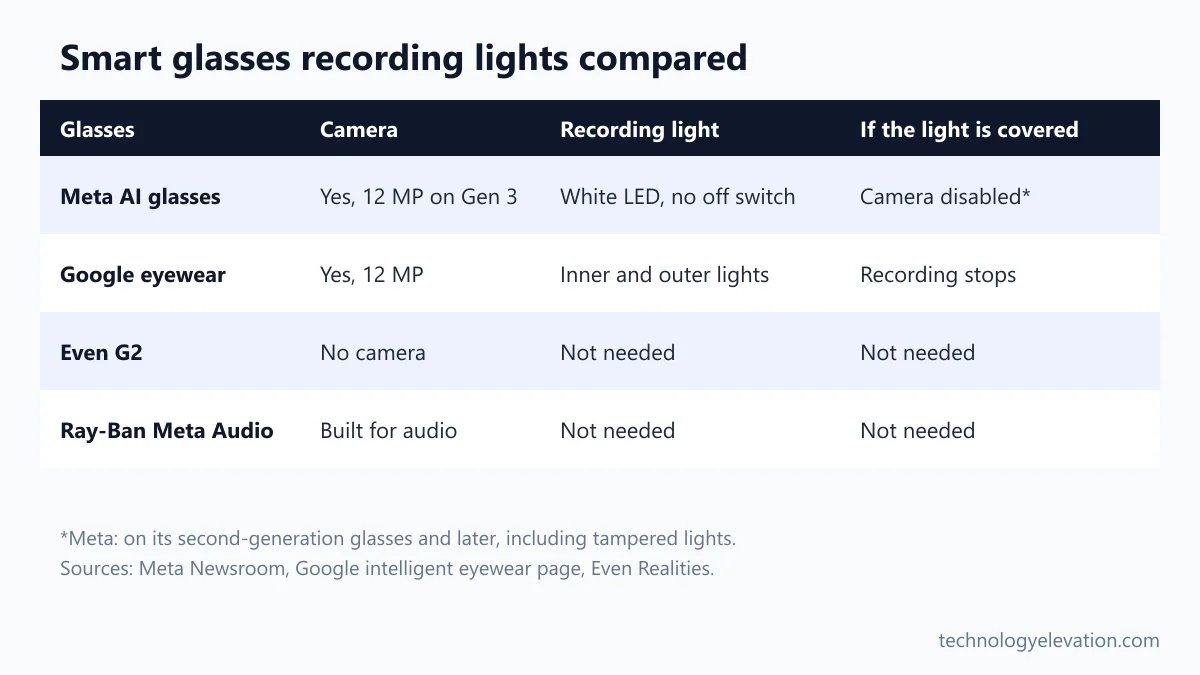
Every camera pair here has a light that shows when it is recording. Meta’s white capture LED has no off switch, and from the second generation onward the camera stops working if the LED is covered or tampered with. Google’s eyewear stops recording if its outer light is blocked.
Meta explains the details in its answers about its AI glasses. The LED blinks briefly for a photo and keeps blinking during a video. The wearer also hears a shutter sound, though people a few feet away will not.
Photos and videos stay on the glasses until you import them to your phone. Meta says nobody else sees them unless you share them, either on social media or with Meta AI.
Good manners still matter more than any light. Ask before filming people up close, take camera glasses off in changing rooms and at the doctor’s, and expect some venues to ban them. If being near a camera bothers you or the people you work with, the Ray-Ban Meta Audio and Even G2 avoid the question.
Prescription options differ a lot between smart glasses
Most smart glasses take prescription lenses, but the range and the process vary. Even G2 covers -12.00 to +12.00. Meta frames go through Meta, Ray-Ban and optical retailers. VITURE Pro 2 has built-in dials for nearsightedness, and XREAL works with partner lens makers.
Meta announced its first prescription-focused frames, the Ray-Ban Meta Blayzer Optics and Scriber Optics (Gen 2), in March 2026 from $499. Meta says they support nearly all prescriptions and add overextension hinges and interchangeable nose pads for a tailored fit.
Screen glasses work differently. The image comes from a display inside the frame, so the lens has to correct your eyes for that image too. VITURE solves it with dials up to -5.0D. XREAL sells prescription lenses through optical partners in the US, EU and UK, and offers two IPD (eye distance) sizes on the One Pro and AURA.
Astigmatism and progressives are the hard cases. Even sells progressive lenses through retail partners, and Meta’s optical stores fit lenses in person. Get a fitting if your prescription is complicated, and buy from a store with an easy return policy.
Use, phone and fit decide the right smart glasses
Choose smart glasses by what you want them to do first, then by your phone and your eyes. Capture and AI questions point to Meta camera glasses, glanceable messages to a display pair, and movies or games to tethered screen glasses from XREAL or VITURE.
- Pick the job. Photos and an assistant suit the Ray-Ban Meta (Gen 3). Messages and directions suit the Meta Ray-Ban Display or Even G2. Flights and handheld gaming suit the XREAL One Pro or VITURE Pro 2.
- Decide on a camera. If you or the people around you dislike cameras, pick the Ray-Ban Meta Audio, Even G2 or a screen pair.
- Check your phone. Meta glasses work through the Meta AI app on iPhone and Android. Google’s intelligent eyewear works with Pixel, Galaxy and iOS phones. Screen glasses need a USB-C port that outputs video.
- Sort out your prescription. Check the lens range before you buy, especially above -5.0D or with astigmatism.
- Count the hours. Audio glasses reach 12 hours, camera glasses about 8 to 9, and the Display about 6 of mixed use. Screen glasses draw power from your device.
- Try the fit. Frames come in sizes, and screen glasses come in IPD sizes. A pair that sits wrong gives a blurry picture.
Travel is where smart glasses earn their keep. Display glasses drain a phone fast, so a charged power bank in your carry-on helps, and the airline power bank rules limit what you can bring. If you mainly want health tracking, a smart ring does that job better than any pair of glasses.
Shopping this week? Prices on smart glasses move fast around Black Friday, and the Black Friday tech buying advice explains how to tell a real deal from a fake one.
Frequently asked questions about smart glasses
What are the best smart glasses?
The Ray-Ban Meta (Gen 3) are the best smart glasses for most people. They look like regular Ray-Bans, shoot 12 MP photos and 3K video, last up to 9 hours and accept prescription lenses, starting at $449.
Can smart glasses record without people knowing?
Meta and Google glasses show a light while recording. Meta’s capture LED has no off switch, and its glasses from the second generation onward disable the camera if the LED is covered. Google’s eyewear stops recording if its outer light is blocked.
Can you get smart glasses with a prescription?
Yes, most smart glasses take prescription lenses. Even G2 supports -12.00 to +12.00, Meta’s Blayzer and Scriber Optics frames support nearly all prescriptions, and the VITURE Pro 2 has built-in dials from 0 to -5.0D for nearsightedness.
Do smart glasses work with iPhone?
Yes, Meta’s AI glasses work with iPhone and Android through the Meta AI app. Google says its intelligent eyewear supports Pixel, Galaxy and iOS phones. XREAL and VITURE screen glasses work with any iPhone that has a USB-C port with video output.
What is the difference between AI glasses and AR glasses?
AI glasses like the Ray-Ban Meta use a camera, microphones and speakers to talk to an assistant, with no screen. AR and display glasses add an image you can see, from a small heads-up display to a full virtual screen.
Which smart glasses have no camera?
The Even G2 have no camera, by design. The Ray-Ban Meta Audio are built around speakers and microphones rather than a camera, and screen glasses such as the XREAL One Pro and VITURE Pro 2 are video displays without one.
How long do smart glasses last on a charge?
Ray-Ban Meta Audio last up to 12 hours, the Ray-Ban Meta (Gen 3) and Oakley Meta Vanguard up to 9 hours, and the Meta Ray-Ban Display about 6 hours of mixed use. Each comes with a charging case that adds more.
Last checked and sources
Last checked on 19 November 2026 by Abdullah Kabeer. We compared the published specs, launch dates, prices, privacy features and prescription options of current smart glasses using manufacturer pages and announcements.
- Meta Newsroom: Ray-Ban Meta Audio and Ray-Ban Meta (Gen 3) announcement, September 23, 2026
- Meta Newsroom: Meta Ray-Ban Display and Meta Neural Band announcement, September 17, 2025, and Connect 2026 feature update
- Meta Newsroom: Oakley Meta Vanguard announcement, September 2025, and Oakley Meta HSTN announcement, June 2025
- Meta Newsroom: Meta Glasses launch, June 23, 2026; prescription frames, March 31, 2026; AI glasses privacy questions, July 7, 2026; Meta VR Glasses, September 23, 2026
- XREAL product pages for the One Pro, 1 Pro+, 1S and AURA
- VITURE lineup guide and Pro 2 product page
- Even Realities Even G2 product page and store
- Google intelligent eyewear page and Android XR page
- CPSC recall database: no recalls listed for these brands
We update this buying guide when new smart glasses launch, older models are discontinued or prices change.
Technology Elevation is reader-supported. As an Amazon Associate, we earn from qualifying purchases. When you buy through links on this page, we may earn a small commission at no extra cost to you.

GIPHY App Key not set. Please check settings