

 Abdullah Kabeer
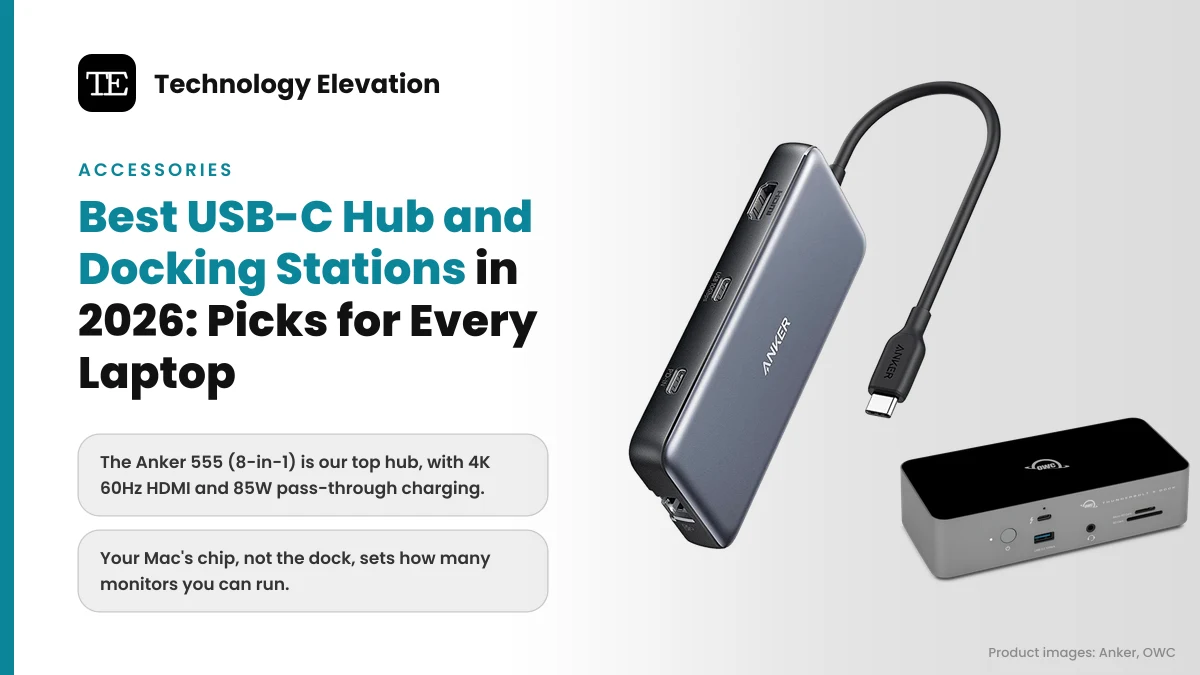
Plug a monitor, a keyboard and a charger into a thin laptop and you run out of ports in about ten seconds. The best USB-C hub fixes that with one cable, but only if it matches what your laptop can actually do. A $50 hub and a $500 dock can look almost identical on Amazon, and the wrong one leaves a monitor dark or a laptop charging slower than it drains.
Most of the confusion comes from four names printed on the same oval plug: USB-C, USB4, Thunderbolt 4 and Thunderbolt 5. They share a connector, not a speed. Intel’s own figures put Thunderbolt 4 at 40Gbps and Thunderbolt 5 at 80Gbps, with a Bandwidth Boost mode that reaches 120Gbps for heavy display traffic.
Mac owners have one more trap. A base M1 or M2 MacBook Air drives only one external monitor natively, and no Thunderbolt dock changes that. Dual monitors on those machines need DisplayLink, a driver-based trick we explain below.
So we sorted these picks by laptop first, then by desk.
The best USB-C hub for most laptops is the Anker 555 (8-in-1)
The Anker 555 USB-C Hub (8-in-1) is the best USB-C hub for most people. It adds a 4K 60Hz HDMI port, three 10Gbps USB ports, Gigabit Ethernet and two card slots, and passes up to 85W to your laptop. Heavier desk setups need a Thunderbolt dock instead.
Every pick, by the job it does best:
- Best USB-C hub overall: Anker 555 USB-C Hub (8-in-1)
- Best Thunderbolt 4 dock: CalDigit TS4
- Best Thunderbolt 5 dock: CalDigit TS5 Plus
- Best value Thunderbolt 5 dock: OWC Thunderbolt 5 Dock
- Best dual monitor docking station for base MacBook Air models: Plugable UD-6950PDH
| Model | Connection | Laptop charging | Video outputs | Network | Launch or list price |
|---|---|---|---|---|---|
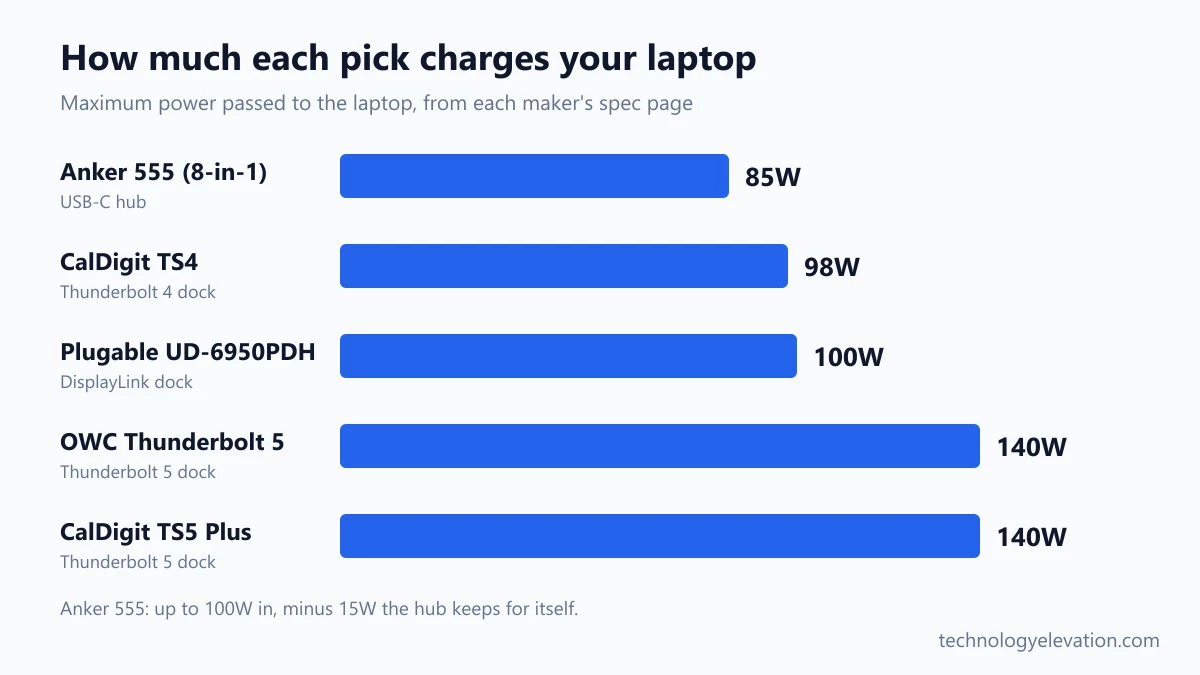
| Anker 555 (8-in-1) | USB-C | 85W | 1x HDMI, 4K 60Hz | Gigabit | Under $100 |
| CalDigit TS4 | Thunderbolt 4 | 98W | DisplayPort 1.4 plus Thunderbolt | 2.5 Gigabit | $359.95 launch |
| CalDigit TS5 Plus | Thunderbolt 5 | 140W | DisplayPort 2.1 plus Thunderbolt | 10 Gigabit | $499.99 list |
| OWC Thunderbolt 5 Dock | Thunderbolt 5 | 140W | Thunderbolt ports only | 2.5 Gigabit | $329.99 launch |
| Plugable UD-6950PDH | USB-C, DisplayLink | 100W | 2x HDMI and 2x DisplayPort, two at a time | Gigabit | $279.99 list |
Hub and dock prices fall hard around Black Friday and Prime Day. Treat the prices above as a ceiling and the charging column as the fixed point.
Anker 555 USB-C Hub (8-in-1): the best USB-C hub overall
The Anker 555 is the best USB-C hub for a laptop bag or a simple one-monitor desk. It covers the ports thin laptops dropped, runs its data ports at 10Gbps instead of the slower 5Gbps common on cheap hubs, and still charges the laptop through the same cable.
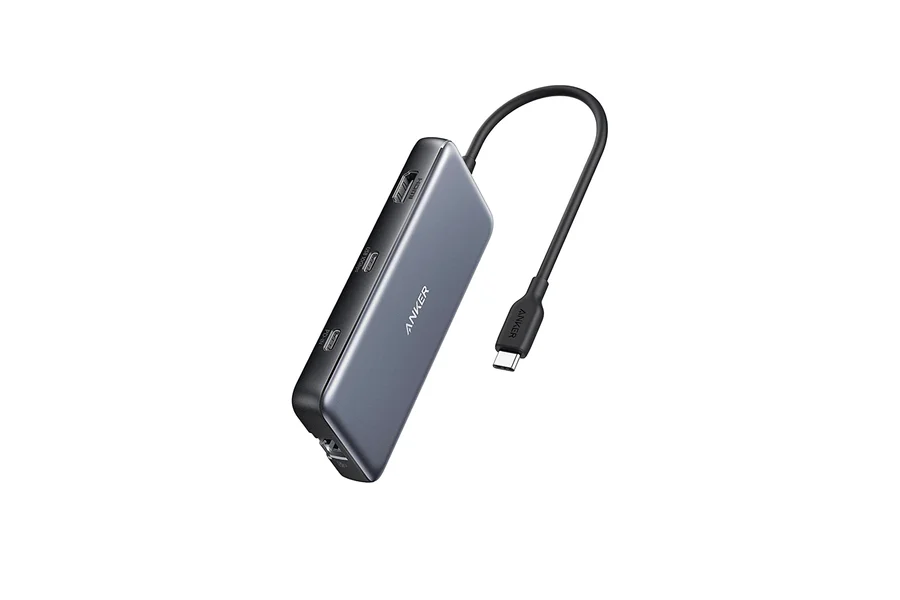
Key specs: USB-C Power Delivery input up to 100W (85W reaches the laptop), one HDMI 2.0 port at up to 4K 60Hz, one USB-C and two USB-A data ports at 10Gbps, Gigabit Ethernet, SD and microSD slots (UHS-I).
The 85W figure matters. Anker says the hub keeps 15W of whatever comes in for itself, so a 100W charger gives your laptop 85W. Pair it with a 65W charger and the laptop gets about 50W, which is fine for a MacBook Air and slow for a big gaming laptop.
The 4K 60Hz HDMI port is the other reason it beats bargain hubs. Many cheaper hubs top out at 4K 30Hz, and the mouse pointer visibly lags at that refresh rate.
Now the catch. Only the HDMI port carries video. The USB-C data port will not run a second monitor, even with an adapter cable. Anker also notes the hub can reach about 149°F on the surface when every port is busy, which is normal for its size but worth knowing before you leave it on a fabric sofa.
Check the Anker 555 USB-C Hub (8-in-1) price on Amazon
CalDigit TS4: the best Thunderbolt 4 dock for a permanent desk
The CalDigit TS4 is the best Thunderbolt 4 dock for a desk you sit at every day. It packs 18 ports, charges laptops at up to 98W, adds 2.5 Gigabit Ethernet and runs two 4K 60Hz monitors from one cable on supported laptops.
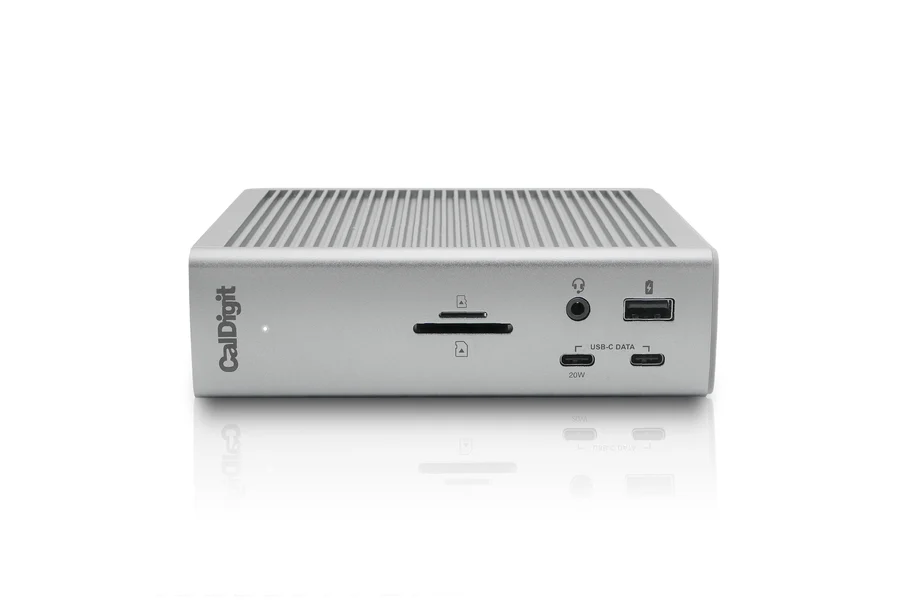
Key specs: three Thunderbolt 4 ports (one to the laptop, two for devices), three USB-C and five USB-A ports at 10Gbps, DisplayPort 1.4, SD and microSD 4.0 (UHS-II), 2.5 Gigabit Ethernet, three audio jacks, 98W host charging, 0.8m Thunderbolt 4 cable in the box. Launched in February 2022 at $359.95.
Port count is the whole pitch. Eight USB data ports means a webcam, keyboard, mouse, microphone, printer and two backup drives can all stay plugged in, with room to spare. The UHS-II card slots also suit anyone pulling photos off a camera.
The honest catch is display support on base Macs. CalDigit’s own page notes that M1 and M2 Macs get one monitor over Thunderbolt, dock or not. On those machines, the TS4 is a great port expander and a poor dual-monitor solution.
Pair it with one of the 5K and 8K monitors over Thunderbolt and you get a single-cable desk that looks clean every morning.
Check the CalDigit TS4 price on Amazon
CalDigit TS5 Plus: the best Thunderbolt 5 dock
The CalDigit TS5 Plus is the best Thunderbolt 5 dock if your laptop has Thunderbolt 5 ports. It has 20 ports, 140W charging, 10 Gigabit Ethernet and a DisplayPort 2.1 output, so it suits video editors, photographers and anyone moving huge files.
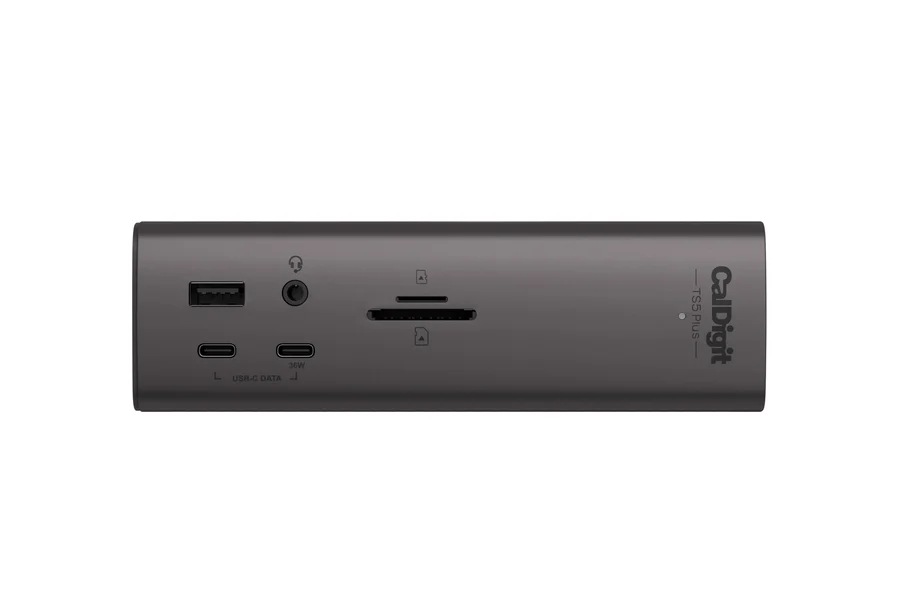
Key specs: one Thunderbolt 5 host port (up to 120Gbps), two Thunderbolt 5 device ports (80Gbps), five USB-C and five USB-A ports at 10Gbps, DisplayPort 2.1, SD and microSD 4.0 (UHS-II), 10 Gigabit Ethernet, three audio jacks, 140W host charging, 1m Thunderbolt 5 cable included. List price: $499.99.
The 140W charging is the quiet upgrade. Thunderbolt 4 docks top out around 98W to 100W, which leaves a big workstation laptop slowly draining under heavy load.
Check your laptop before spending $500. Only Macs with M4 Pro, M4 Max, M5 Pro, M5 Max or M3 Ultra chips have Thunderbolt 5. The regular M4 and M5 chips, including the M5 MacBook Air, use Thunderbolt 4. Plug a Thunderbolt 5 dock into one of those and it simply runs at Thunderbolt 4 speed.
Anker’s Prime TB5 Docking Station (14-in-1) is the closest rival, at $399.99 with 140W charging and HDMI 2.1 or DisplayPort 2.1 video. CalDigit wins on port count and network speed.
Check the CalDigit TS5 Plus price on Amazon
OWC Thunderbolt 5 Dock: the best value Thunderbolt 5 dock
The OWC Thunderbolt 5 Dock is the best value Thunderbolt 5 dock. It launched in May 2025 at $329.99, $170 less than the TS5 Plus, and keeps the important parts: 140W charging, three Thunderbolt 5 ports, 2.5 Gigabit Ethernet and fast card slots.
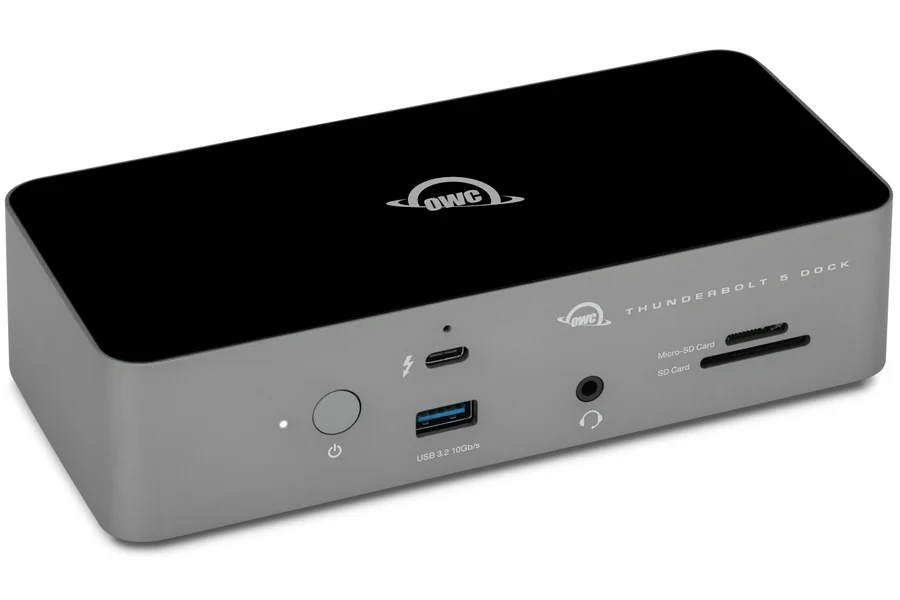
Key specs: 11 ports, including three Thunderbolt 5 ports (one to the laptop), two USB-A ports at 10Gbps and one at 5Gbps, 2.5 Gigabit Ethernet, SD 4.0 (UHS-II) and microSD slots, a 3.5mm audio combo jack, up to 140W laptop charging, a certified 1m Thunderbolt 5 cable included.
OWC built this for creators who live on fast external drives. Two spare Thunderbolt 5 ports can each run an SSD at full speed, which matters far more than a pile of USB-A ports if you edit video. A fast portable SSD on one of those ports behaves almost like internal storage.
Displays connect through the Thunderbolt ports, not HDMI or DisplayPort. OWC quotes dual 6K displays on a Mac and up to three 8K displays on supported Windows laptops. You need monitors with USB-C or Thunderbolt inputs, or adapter cables for the ones you already own.
The other catch is the short USB list. Three USB-A ports fill up fast with a keyboard, mouse and webcam.
Check the OWC Thunderbolt 5 Dock price on Amazon
Plugable UD-6950PDH: the best dual monitor docking station for base MacBook Air models
The Plugable UD-6950PDH is the best dual monitor docking station for a base M1 or M2 MacBook Air. It uses DisplayLink to run two 4K 60Hz monitors past Apple’s one-display limit, charges at up to 100W and works with Windows laptops too.
Key specs: DisplayLink graphics for two monitors at up to 4K 60Hz, two HDMI and two DisplayPort outputs (use any two), up to 100W laptop charging, Gigabit Ethernet, USB-C host connection that also works with USB4 and Thunderbolt 3 or 4 ports, macOS 11 or later. List price: $279.99.
DisplayLink works differently from a normal dock. Instead of using the laptop’s own video outputs, it sends the picture as data over a regular USB connection, and a chip in the dock turns it back into video.
On a Mac, you install the DisplayLink Manager app first and keep it running. Spreadsheets, email and video calls feel normal, though DisplayLink suits office work better than games.
Owners of an M4 or M5 MacBook Air can skip DisplayLink entirely. Those models drive two external displays natively through Thunderbolt, so a TS4 is the cleaner choice.
Check the Plugable UD-6950PDH price on Amazon
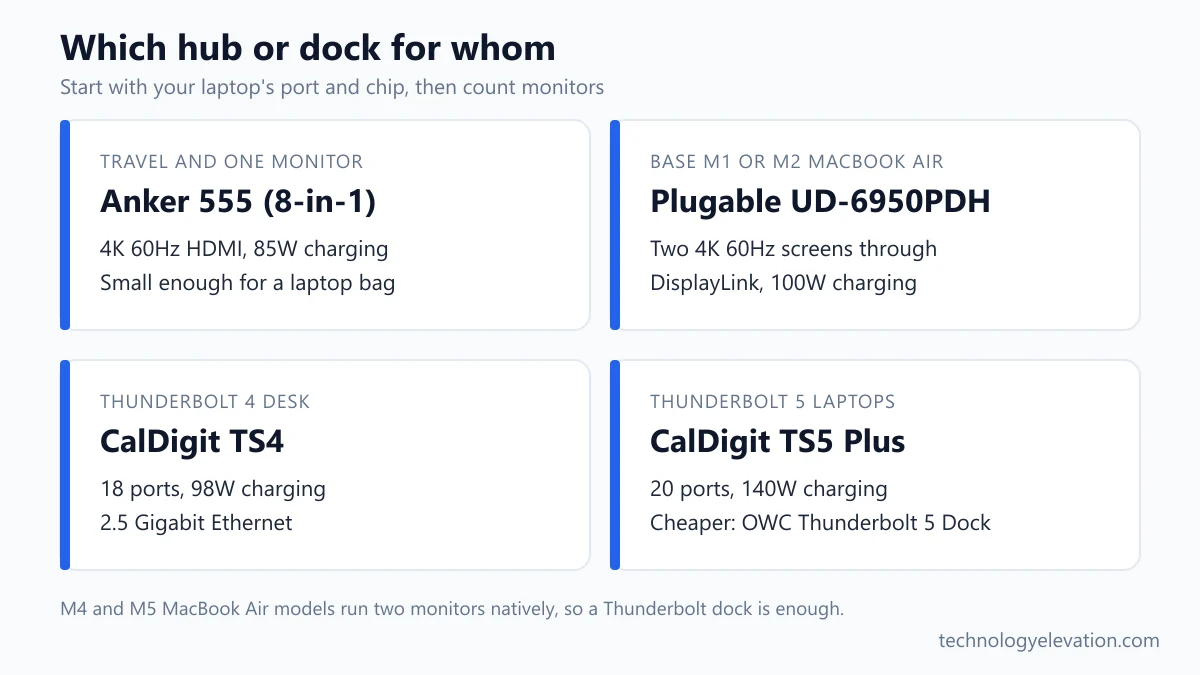
USB-C, USB4, Thunderbolt 4 and Thunderbolt 5 are not the same port
USB-C is only the shape of the plug. A plain USB-C port often runs at 10Gbps, USB4 reaches 40Gbps or more, Thunderbolt 4 guarantees 40Gbps, 100W charging and dual 4K screens, and Thunderbolt 5 doubles the speed to 80Gbps with 140W charging.
Thunderbolt’s real value is the guarantee. Intel sets minimums every certified Thunderbolt 4 laptop must meet: 40Gbps, support for two 4K monitors and 100W laptop charging. A port that only says USB-C can be anything from a fast video port to a slow charging socket.
USB4 sits in between. The USB Implementers Forum, the group that writes the USB standard, says USB4 works with older USB 3.2, USB 2.0 and Thunderbolt 3 gear and reaches up to 80Gbps over cables certified for that speed.
Thunderbolt 5 adds Bandwidth Boost. When a laptop sends lots of video, the link shifts to 120Gbps toward the monitors and 40Gbps back. Intel also raises the required laptop charging to 140W, with up to 240W on some devices.
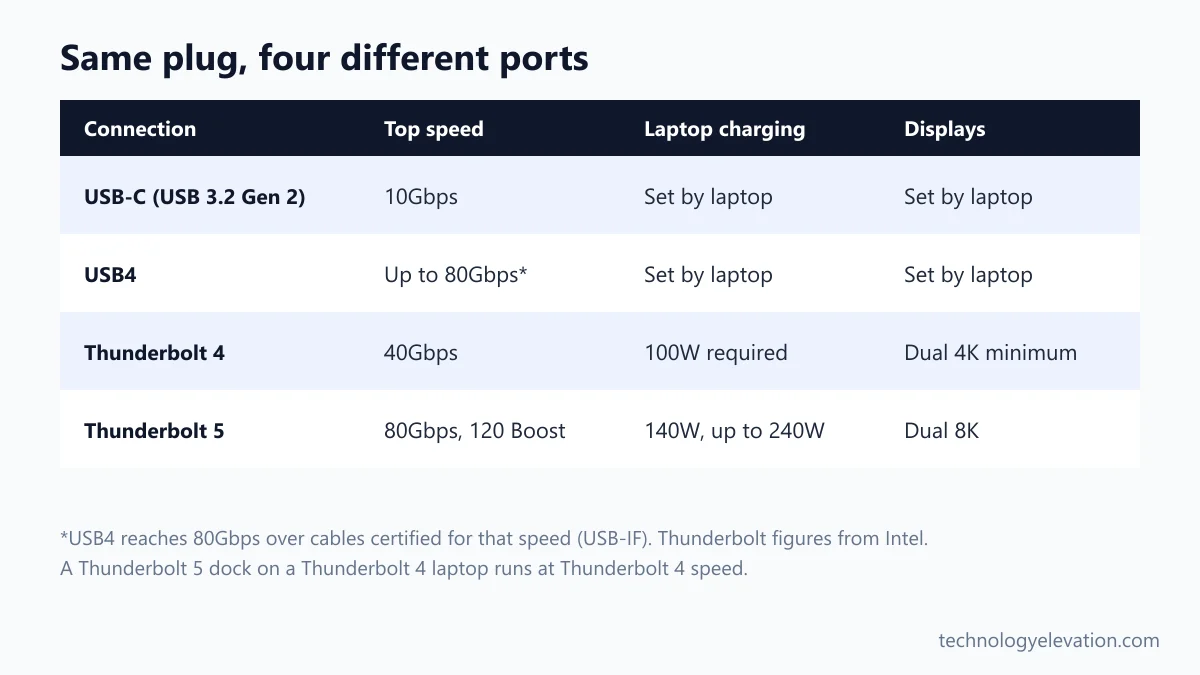
Mac display limits decide which dock a MacBook needs
Your Mac’s chip, not the dock, sets how many monitors you can run. Base M1 and M2 Macs drive one external display, M3 MacBook Airs drive two with the lid closed, and M4 and M5 MacBook Airs drive two with the lid open.
Apple’s support page on how many displays a MacBook Air supports sets the M4 and M5 limits clearly: one display at up to 8K 60Hz, or two at up to 6K 60Hz or 4K 144Hz. Apple adds that closing the lid on those models does not add a third.
The M3 MacBook Air is the odd one. Apple allows a second external monitor only with the lid closed, an external keyboard and mouse connected, and the laptop on power. Open the lid and the second screen goes dark.
Dual-HDMI hubs cause the most returns from Mac owners. Many of them split one signal using a feature called MST (multi-stream transport), which macOS does not support for separate screens. On a Mac, the two monitors usually show the same picture. Windows laptops handle MST fine.
Pro and Max chips go further, and the TS5 Plus can run three or four monitors on M5 Pro and M5 Max machines. A good monitor stand becomes the next thing you buy once two or three screens share a desk.
Six checks for choosing a USB-C hub or docking station
Choose a USB-C hub or docking station by matching it to your laptop’s port, then counting monitors, charging watts and the ports you use daily. Buy the cable rating to match. Brand matters less than those numbers.
- Identify your laptop’s port. Look for a Thunderbolt symbol, or check the spec sheet for USB4 or Thunderbolt 4 or 5. A plain USB-C laptop suits a hub like the Anker 555 or a DisplayLink dock.
- Count your monitors. One monitor works with almost anything. Two monitors on a base M1 or M2 Mac need DisplayLink. Two on Windows can use a Thunderbolt dock or MST.
- Match the charging watts. A dock should give at least as much power as your laptop’s own charger. Check the wattage printed on your laptop charger. Some 16-inch laptops ship with 140W chargers.
- Check the refresh rate. HDMI at 4K 30Hz feels laggy. Look for 4K 60Hz or better on every video port.
- List the ports you plug in daily. Ethernet, card readers and USB-A ports are the usual missing pieces. Buy for today’s desk plus one gadget.
- Use the cable in the box. A random phone cable can cut a Thunderbolt dock to slow USB speeds.
The USB-IF says 100W charging needs a USB-C cable rated at 5A, and the newer 240W charging uses its own higher-rated cables. Intel says Thunderbolt 5 cables carry the full 120Gbps at up to 2 meters. Keep the short dock cable for the laptop and use longer HDMI cables for the monitor side, where length matters less.
Hub and dock safety starts with the charger behind them
None of our picks appears in a US Consumer Product Safety Commission recall. Most recent recalls in this space hit power banks and chargers, not hubs, so the charger feeding your dock is the part to check first.
Anker is the best-known example. In June 2025, the CPSC announced a recall of more than one million Anker PowerCore 10000 power banks, model A1263, over fire and burn hazards. Owners should stop using them, check the serial number at anker.com/product-recalls and register for a free replacement. Anker’s hubs and docks are not part of that recall.
A few habits keep any desk setup safer:
- Use a charger from a known brand rated for at least your laptop’s wattage.
- Give compact hubs some air. A hub tucked under a laptop on a bed or sofa runs hotter.
- Unplug a hub that smells hot or disconnects at random, and contact the maker.
Cheap hub listings that mislead
Skip hubs that list 4K at 30Hz, 5Gbps data ports or no laptop charging figure at all. Listing titles are where cheap hubs mislead most, and a “100W PD” claim usually describes what the hub accepts, not what your laptop receives.
Anker is open about its 15W cut. Many no-name brands keep the same cut without saying so. An older Thunderbolt 3 dock such as the CalDigit TS3 Plus, which led the earlier version of this list, is a safer clearance buy than an unknown new hub.
iPad owners have different needs again. A small iPad Pro and iPad Air USB-C hub that clips to the tablet is more practical than a desk dock.
Frequently asked questions about USB-C hubs and docking stations
What is the best USB-C hub?
The Anker 555 USB-C Hub (8-in-1) is the best USB-C hub for most laptops. It adds 4K 60Hz HDMI, three 10Gbps USB ports, Gigabit Ethernet and card slots, and passes up to 85W of charging to the laptop.
What is the difference between a USB-C hub and a docking station?
A hub is small and usually powered by your laptop’s charger, while a dock has its own power supply and more ports. Docks also tend to charge at higher wattage and run more monitors, which suits a permanent desk.
Is a Thunderbolt 5 dock worth it over Thunderbolt 4?
Only if your laptop has Thunderbolt 5 ports. On a Thunderbolt 4 laptop, a Thunderbolt 5 dock runs at Thunderbolt 4 speed. The real gains are 140W charging and faster external drives on Thunderbolt 5 machines.
Can a MacBook Air run two monitors through a dock?
Yes, depending on the chip. M4 and M5 MacBook Airs run two monitors natively, and M3 models do it with the lid closed. Base M1 and M2 models need a DisplayLink dock such as the Plugable UD-6950PDH.
Why do both monitors show the same picture on my Mac?
Your hub probably uses MST to split one video signal, and macOS does not support MST for separate screens. Use a Thunderbolt dock on a Mac that supports two displays, or a DisplayLink dock.
Do I need a special cable for a Thunderbolt dock?
Yes, use the certified cable that comes in the box. Ordinary USB-C phone cables can drop a dock to much slower speeds. For 100W charging, the USB-IF requires a cable rated at 5A.
Last checked and sources
Last checked on 15 November 2026 by Abdullah Kabeer. We compared hubs and docks on sale in the US using manufacturer spec pages and launch announcements, checked display limits against Apple’s support pages, and searched the CPSC recall database for every brand on this list.
- Anker, Anker 555 USB-C Hub (8-in-1) product page and support FAQ
- CalDigit, TS4, TS5 Plus and Thunderbolt 4 Element Hub product pages, and the TS4 launch announcement
- OWC, Thunderbolt 5 Dock product page and May 2025 launch announcement
- Plugable, UD-6950PDH details and knowledge base articles on Mac display limits and MST
- Apple, MacBook Air display support pages for M3, M4 and M5 models
- Intel, Thunderbolt technology overview
- USB Implementers Forum, USB4 and USB Power Delivery pages
- US Consumer Product Safety Commission, recall database and the June 2025 Anker power bank recall
- Independent coverage by MacRumors and AppleInsider for OWC launch pricing, and by Macworld for Thunderbolt 5 Mac models
We update this buying guide when new docks launch, when Apple changes display limits, or when a recall affects a pick.
Technology Elevation is reader-supported. As an Amazon Associate, we earn from qualifying purchases. When you buy through links on this page, we may earn a small commission at no extra cost to you.


GIPHY App Key not set. Please check settings
2 Comments