

 Abdullah Kabeer
Switch off the lamps, start a space movie, and watch the black bars above and below the picture. On a good OLED they vanish into the wall. On a cheap LCD they glow a faint grey, and once you notice that glow you never stop seeing it. The best TV for dark rooms is the one that keeps black looking like black.
Brightness, the number TV ads shout about, matters far less once the curtains are shut. Your eyes adjust, so a highlight that looks dim at noon looks dazzling at 11pm. Contrast, the gap between the darkest and brightest parts of the picture, does the heavy lifting.
The other part of the job is showing a film the way it was made. The UHD Alliance says its Filmmaker Mode turns off motion smoothing, sharpening and noise reduction while keeping the original colors, aspect ratio and frame rate. Most of the TVs below have it, and one big name does its own thing instead.
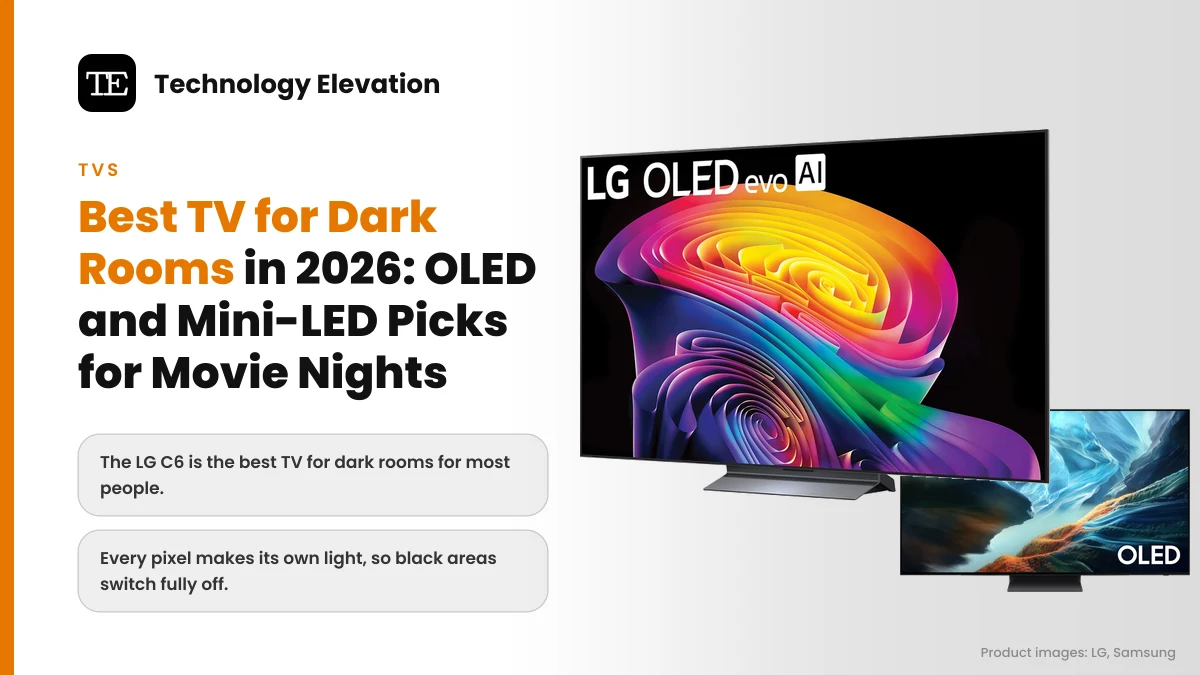
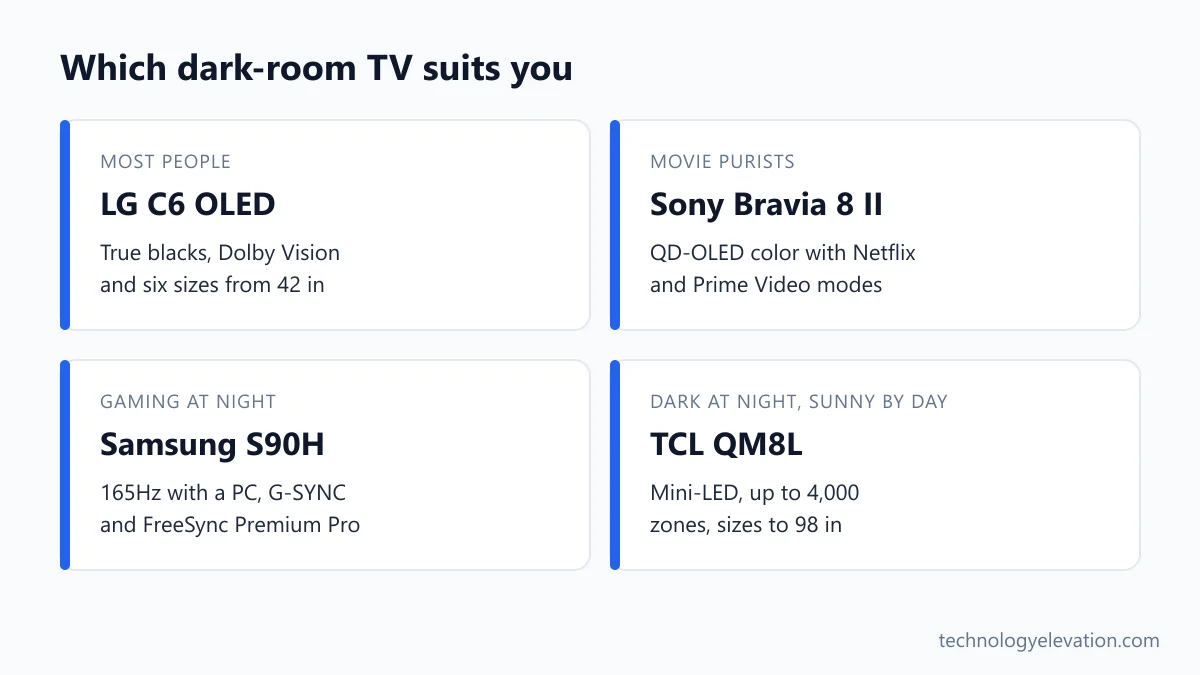
The best TV for dark rooms is the LG C6 OLED
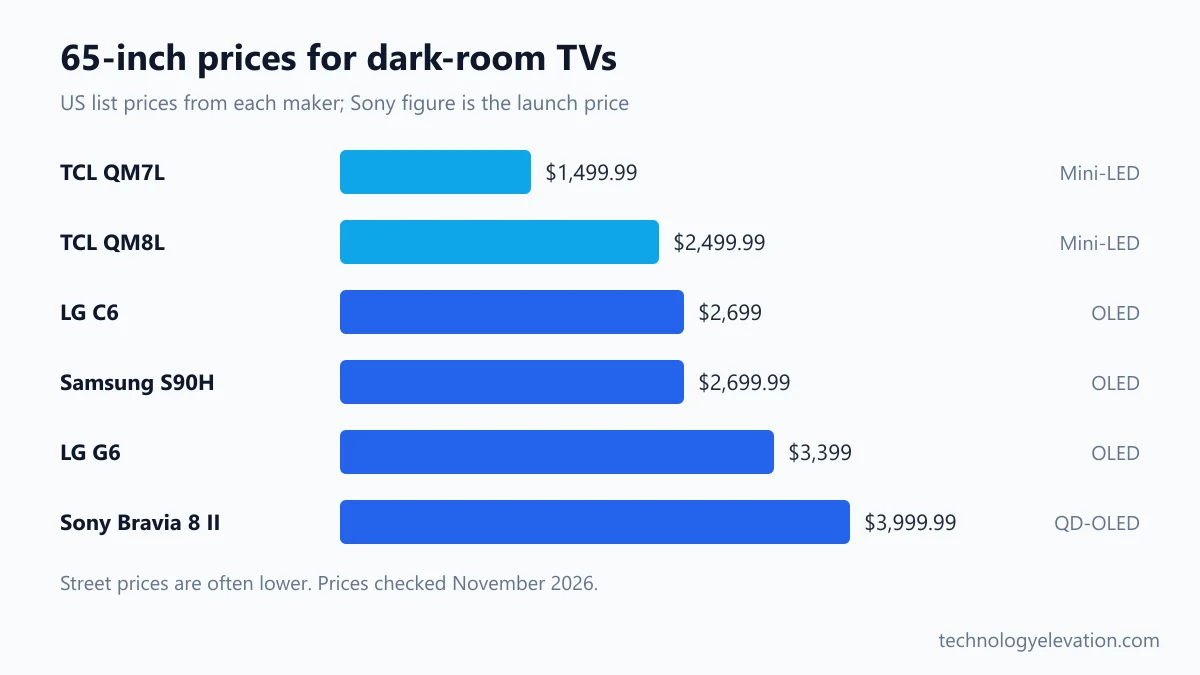
The LG C6 is the best TV for dark rooms for most people. Every pixel makes its own light, so black areas switch fully off, and it supports Dolby Vision, 165Hz gaming and six sizes. The 65-inch launched at $2,699, the same price as last year’s C5.
Every pick, by the job it does best:
- Best overall: LG C6 OLED
- Best premium OLED: LG G6 OLED
- Best for movie purists: Sony Bravia 8 II
- Best for gaming at night: Samsung S90H OLED
- Best mini-LED for dark rooms: TCL QM8L
- Best on a budget: TCL QM7L
| Model | Panel | Sizes | Dolby Vision | HDR10+ | 65-inch price |
|---|---|---|---|---|---|
| LG C6 | OLED | 42 to 83 in | Yes | No | $2,699 list |
| LG G6 | OLED | 55 to 97 in | Yes | No | $3,399 list |
| Sony Bravia 8 II | QD-OLED | 55 and 65 in | Yes | No | $3,999.99 launch |
| Samsung S90H | OLED | 42 to 83 in | No | Yes | $2,699.99 list |
| TCL QM8L | Mini-LED | 65 to 98 in | Yes | Yes | $2,499.99 list |
| TCL QM7L | Mini-LED | 55 to 98 in | Yes | Yes | $1,499.99 list |
TV list prices fall fast once a model has been out for a few months. The 65-inch LG C6 launched at $2,699 and was selling for well under $2,000 during autumn 2026 sales, so treat every list price here as a ceiling and set a price alert before you buy.
LG C6 OLED: the best TV for dark rooms overall
The LG C6 is the best all-round TV for dark rooms because it pairs perfect OLED blacks with a sensible price. You get Dolby Vision for streaming films, 4K at 165Hz for games, and a size range from a 42-inch bedroom set to an 83-inch basement screen.
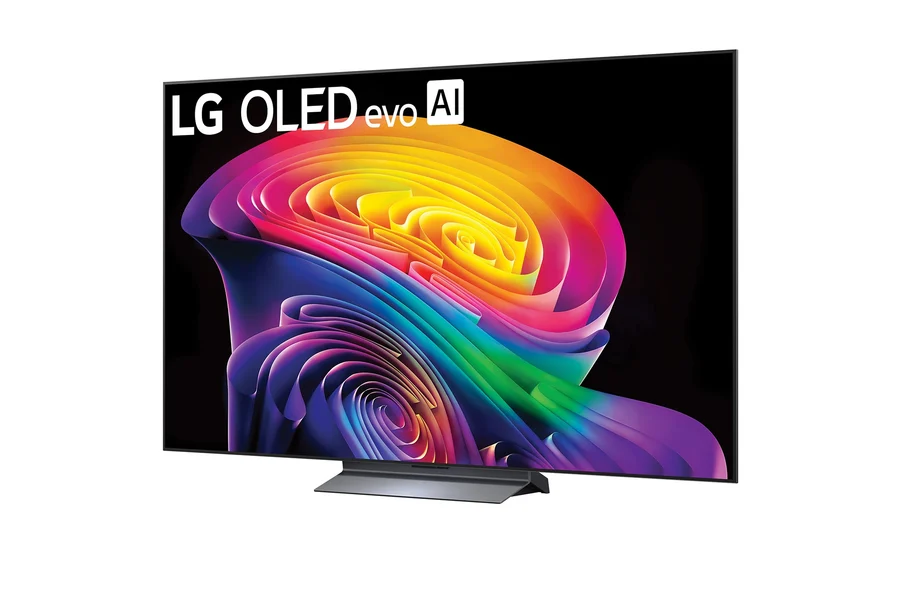
Key specs: OLED evo panel, Alpha 11 AI Processor Gen3, 4K at up to 165Hz with VRR, Dolby Vision and Dolby Atmos, Filmmaker Mode. Sizes 42 to 83 inches. List price: $2,699 for the 65-inch, $1,999 for the 55-inch.
OLED is the reason this TV wins. Each of the 8.3 million pixels in a 4K screen lights itself, so a starfield is just tiny dots of light on true black. No backlight sits behind the panel, so nothing leaks into the dark parts of the picture.
Now the catch. LG’s own announcement lists its Hyper Radiant Color Tech only on the 77- and 83-inch C6, and reviewers found the 42- to 65-inch sets use a panel close to the C5’s. At 65 inches, a discounted C5 is a smart alternative if you find one at a big saving.
LG also skips HDR10+, so Prime Video shows mastered in it play in standard HDR10.
Check the LG C6 OLED price on Amazon
LG G6 OLED: the best premium OLED for home theaters
The LG G6 is the best premium OLED for a home theater that also gets daytime use. LG’s Brightness Booster Ultra makes it the brightest LG OLED, it adds Filmmaker Mode with Ambient Light Compensation, and LG lists a five-year panel warranty in its launch announcement.

Key specs: OLED evo panel with Hyper Radiant Tech, Alpha 11 Dual AI Engine Processor, 4K at up to 165Hz (120Hz on the 97-inch), Dolby Vision and Dolby Atmos, Filmmaker Mode with Ambient Light Compensation. Sizes 55 to 97 inches. List price: $3,399 for the 65-inch.
Ambient Light Compensation suits a room that is dark only some of the time. The TV reads the room’s light and lifts Filmmaker Mode slightly when a lamp is on.
The panel warranty is the quiet reason to pay more. Burn-in, a faint ghost of a logo or a score bar that stays on screen, is the one real long-term risk with OLED. LG’s five-year coverage on the G6 is five times the one-year manufacturer warranty Samsung includes with its OLEDs.
In a pitch-black room, though, the extra brightness is mostly wasted. A C6 shows the same perfect blacks for $700 less at 65 inches.
Check the LG G6 OLED price on Amazon
Sony Bravia 8 II: the best TV for movie purists
The Sony Bravia 8 II is the best TV for people who mainly watch films in the dark. Its QD-OLED panel delivers deep blacks and rich color, Sony’s processing is famously natural, and it has calibrated modes for Netflix and Prime Video. The 65-inch launched at $3,999.99.
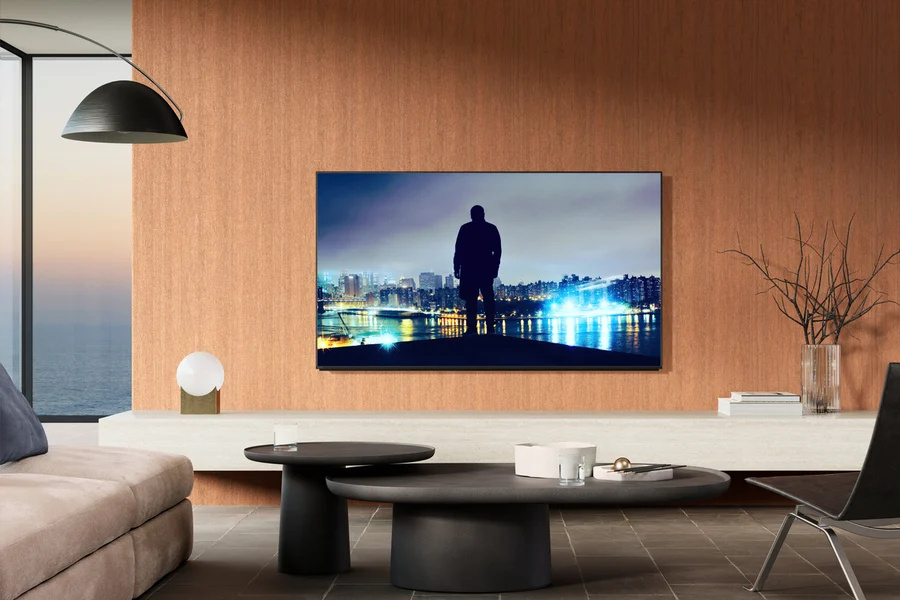
Key specs: 4K QD-OLED panel, 4K at 120Hz with VRR, Dolby Vision, HDR10 and HLG, Netflix Adaptive Calibrated Mode and Prime Video Calibrated Mode. Four HDMI inputs, two of them HDMI 2.1. Sizes 55 and 65 inches. Launch price: $3,999.99 for the 65-inch.
QD-OLED is a variation on OLED. Each pixel still lights itself, but quantum dots, tiny particles that turn blue light into pure red and green, produce the color. You get very saturated color with no loss of black level.
Sony has never adopted Filmmaker Mode. Its Professional picture mode does the same job, and reviewers found it the most accurate preset out of the box. If you mostly stream, the Netflix and Prime Video calibrated modes save you from touching a menu at all.
Two catches stand out. Only two of the four HDMI ports run at full HDMI 2.1 speed, and one of them is the eARC port your soundbar uses. Sony also skips HDR10+ and stops at 65 inches, so a big basement wall needs a different TV.
Check the Sony Bravia 8 II price on Amazon
Samsung S90H OLED: the best TV for gaming at night
The Samsung S90H is the best OLED for gaming in a dark room. It runs 4K at up to 165Hz with a PC, supports NVIDIA G-SYNC Compatible and FreeSync Premium Pro, and adds Samsung’s Glare Free screen for daytime. The 65-inch lists at $2,699.99.
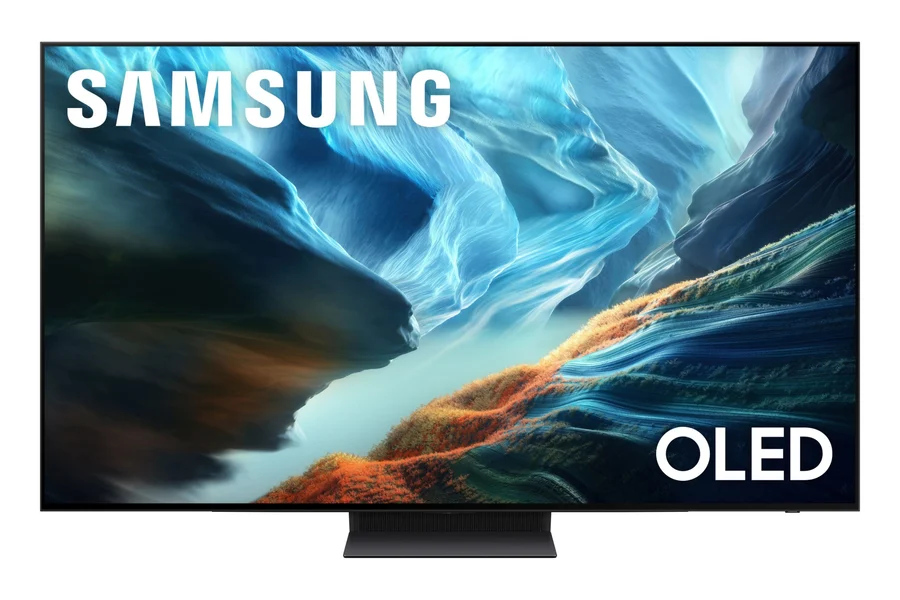
Key specs: OLED panel with Glare Free coating, Motion Xcelerator 165Hz, NVIDIA G-SYNC Compatible and FreeSync Premium Pro (FreeSync Premium on the 42-inch), HDR10 and HDR10+, Dolby Atmos, Filmmaker Mode. Sizes 42 to 83 inches. List price: $2,699.99 for the 65-inch.
Samsung’s 2026 OLED announcement lists every S90H size, from a $1,399.99 42-inch to a $5,299.99 83-inch.
Gaming at night is where OLED shines brightest, in a sense. Pixel response is close to instant, so fast motion stays sharp, and dark corners in horror games stay truly black rather than murky grey.
Here’s the big catch: Samsung TVs still do not support Dolby Vision. Films in that format play in plain HDR10, since Samsung backs HDR10+ and its newer HDR10+ Advanced. Samsung also does not confirm which OLED panel type it uses in each S90H size, and reviewers measuring the 65-inch believe it differs from last year’s S90F.
Samsung’s 165Hz figure applies only to PC games. A PS5 or Xbox Series X tops out at 120Hz, like on every other TV here.
Check the Samsung S90H price on Amazon
TCL QM8L: the best mini-LED TV for dark rooms
The TCL QM8L is the best mini-LED TV for a room that is dark at night and bright by day. TCL rates it at up to 4,000 local dimming zones and up to 6,000 nits, and the 65-inch lists at $2,499.99 with Dolby Vision and HDR10+.
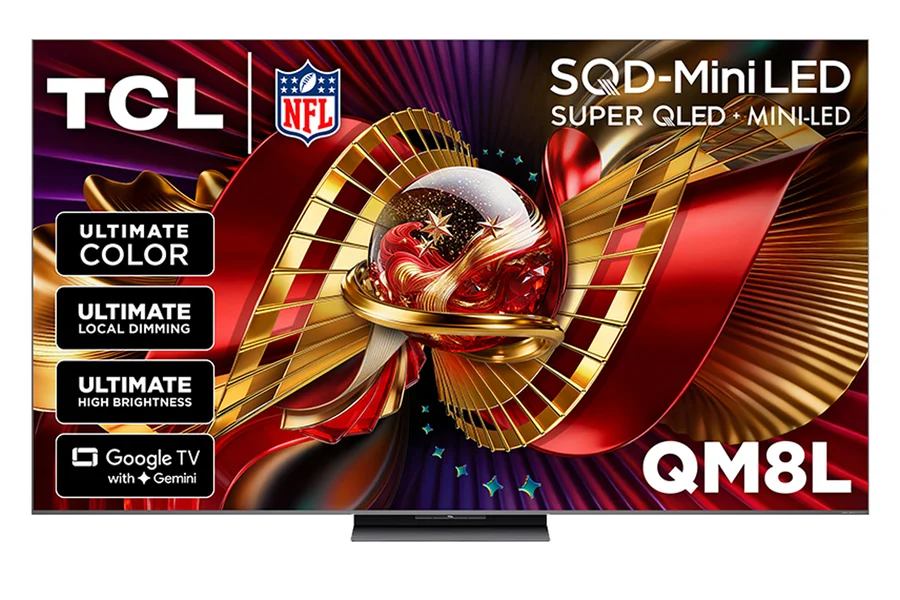
Key specs: SQD-Mini LED backlight, CSOT WHVA 2.0 Ultra panel, up to 4,000 local dimming zones, up to 6,000 nits peak brightness (TCL figures for the series), Enhanced Halo Control System, Dolby Vision IQ, HDR10+, Filmmaker Mode, Google TV. Sizes 65 to 98 inches. List price: $2,499.99 for the 65-inch, $5,999.99 for the 98-inch.
TCL’s SQD-Mini LED announcement gives these as series maximums, so smaller sizes may have fewer zones.
Mini-LED is still LCD at heart. Thousands of tiny LEDs sit behind the screen in groups called dimming zones, and each zone dims or brightens to match the picture. More zones mean tighter control over light.
Even 4,000 zones is a long way from 8.3 million pixels, though, so each zone covers roughly 2,000 pixels. A bright subtitle on a black background lights the whole zone around it, and you see a soft halo. Reviewers call that blooming, and in a dark room it is easy to spot.
TCL’s Halo Control processing works to hide it, and the payoff is size and brightness. At 98 inches, the QM8L costs a fraction of LG’s $24,999 97-inch G6.
Check the TCL QM8L price on Amazon
TCL QM7L: the best budget TV for dark rooms
The TCL QM7L is the best budget TV for dark rooms. It brings mini-LED local dimming with up to 2,100 zones, Dolby Vision IQ and TCL’s Halo Control to a 65-inch screen that lists at $1,499.99, about $1,200 less than a 65-inch LG C6.
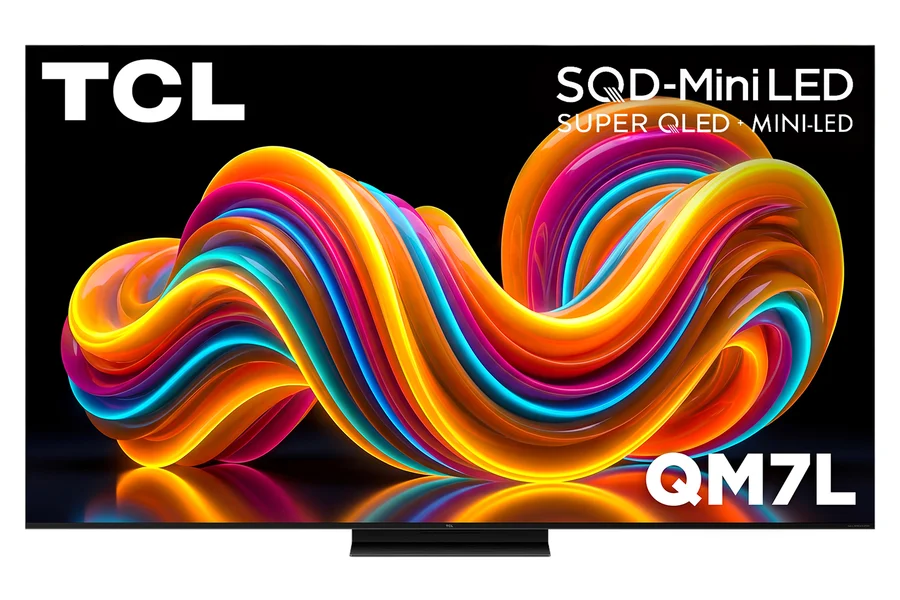
Key specs: SQD-Mini LED backlight, HVA 2.0 Pro panel, up to 2,100 local dimming zones, up to 3,000 nits peak brightness (TCL figures for the series), Enhanced Halo Control System, Dolby Vision IQ and HDR10+, Filmmaker Mode, Google TV. Sizes 55 to 98 inches. List price: $1,499.99 for the 65-inch, $1,199.99 for the 55-inch.
Local dimming is what separates a dark-room TV from a cheap one. A basic LCD cannot dim the black bars on a film, so they glow. The QM7L can.
Expect more blooming than on the QM8L, since it has about half the zones. For a basement or a kid’s den, that trade is worth it.
Check the TCL QM7L price on Amazon
OLED vs mini-LED in a dark room comes down to blooming
OLED vs mini-LED in a dark room is mostly a question of blooming. OLED lights each pixel on its own, so bright objects never leak light into black areas. Mini-LED lights the screen in zones, so it gets brighter and bigger for less money but can show halos.
Picture white end credits on a black screen. On an OLED, the letters float on nothing. On a mini-LED TV, each line sits inside a faint grey cloud. Better dimming means a smaller cloud.
Peak brightness flips the result in a sunny room. Mini-LED sets reach far higher brightness than OLED, which is why the best TVs for bright rooms are often LCDs. With the lights off, that headroom matters much less, because your eyes have adjusted to the dark.
OLED has one quirk of its own. Whole bright scenes, like a snowfield, dim slightly because the TV limits power across the full screen. In a dark room most people never notice.
HDR formats and Filmmaker Mode matter more in the dark
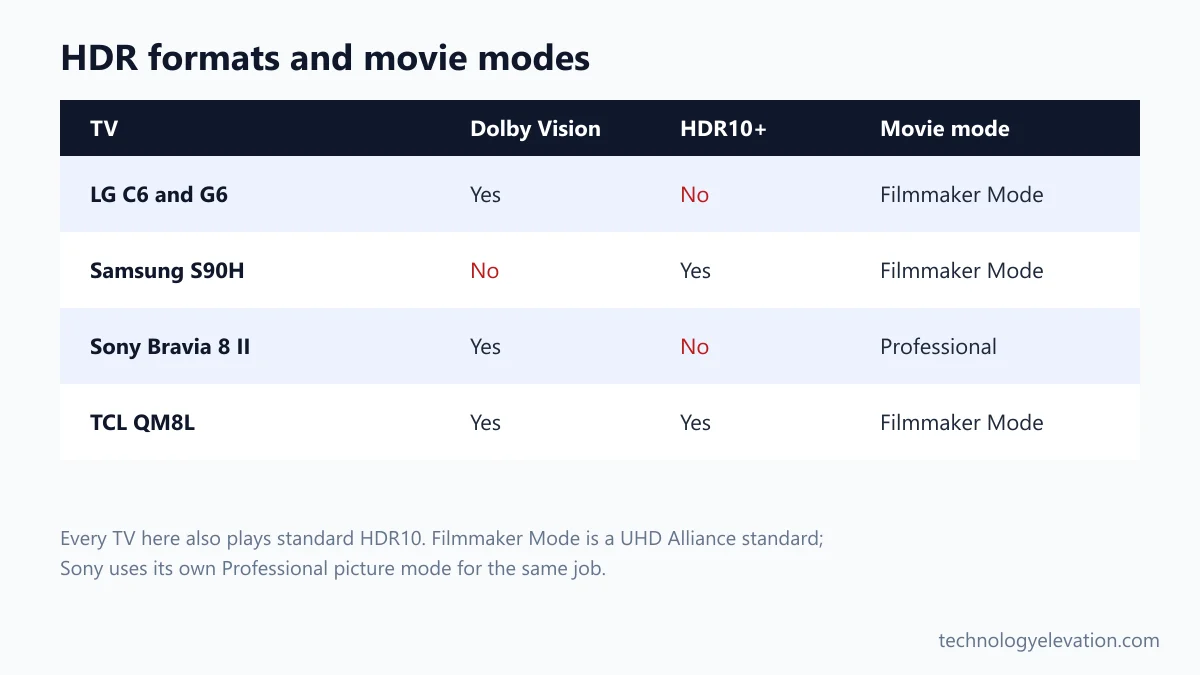
HDR formats and picture modes matter more in a dark room because small errors are easier to see. Dolby Vision and HDR10+ send shot-by-shot brightness data to the TV, and Filmmaker Mode switches off processing so films look as their makers intended.
HDR, short for high dynamic range, stores brighter highlights and more shades in between. HDR10 is the basic version every HDR TV plays. Dolby Vision and HDR10+ add instructions for each scene, so a dark cave and a bright desert each get the right treatment.
Brand support splits neatly. LG, Sony and TCL play Dolby Vision. Samsung and TCL play HDR10+. TCL is the only brand among our picks that covers both, which makes the QM8L and QM7L the safest bets if your shelf of 4K Blu-ray discs mixes the two.
Filmmaker Mode is the setting to use for movies. The UHD Alliance lists LG, Samsung, TCL, Hisense and Panasonic among the brands that support it. Sony’s version is called Professional mode. Both switch off motion smoothing, which invents extra frames and gives films a cheap “soap opera” look.
Six steps for choosing a TV for a dark room
Choose a dark-room TV by how dark the room really gets, then size, then HDR format and inputs. A room used only at night suits OLED best, while a room with daytime sun suits mini-LED. Size comes from seating distance, not wall width.
- Judge the room. Dark most of the time means OLED. Dark at night but sunny by day points to mini-LED or the brighter LG G6.
- Pick the size. At about 8 feet from the screen, 65 inches suits most rooms. Basements with 10 feet or more can take 77 to 98 inches.
- Match your HDR format. Heavy Netflix, Disney+ or Apple TV users want Dolby Vision. Prime Video fans gain from HDR10+.
- Count HDMI 2.1 ports. Two consoles plus a soundbar need more than the two full-speed ports the Bravia 8 II offers.
- Check the warranty. Read the panel terms, especially for OLED. Coverage ranges from one year to LG’s five years on the G6.
- Plan the sound. Thin TVs have thin speakers, so budget for audio if movie nights are the point.
A soundbar makes the biggest difference for the money, and Dolby Atmos soundbars add height effects that suit a dedicated movie room. Pair the TV with good HDMI cables for gaming if you run a console at 120Hz.
Older and other TVs you will still see for sale
Older 2025 models and a few other brands still appear in stores, and some are good dark-room buys at a discount. The LG C5, Samsung S90F and S95F, Hisense’s mini-LED range and Panasonic’s OLEDs are the common ones.
The LG C5 launched in March 2025 at $2,699 for the 65-inch, the same price as the C6. Reviewers found the two close at 65 inches and smaller, so a C5 at a large discount is a fine dark-room TV.
Samsung’s 2025 S90F launched at $2,499 and the S95F at $3,299 for the 65-inch. Both lack Dolby Vision, like the 2026 sets.
Hisense has moved its top UR8 and UR9 TVs to RGB mini-LED, which lights the screen with separate red, green and blue LEDs. Panasonic returned to the US in 2024 and sells its OLEDs mainly through Amazon, built around Fire TV.
Sony’s Bravia 9 II is a new 2026 flagship with True RGB LED backlighting, in sizes up to 115 inches. For a bigger picture for less, budget projectors under $1,000 need a dark room anyway.
Shoppers who want a more general pick should compare the best 4K TVs on the market, which weigh bright-room and gaming performance too.
Frequently asked questions about TVs for dark rooms
What type of TV is best for a dark room?
OLED is the best type of TV for a dark room. Each pixel makes its own light and switches fully off for black, so there is no glow or halo around bright objects. Mini-LED is the brighter alternative but can show blooming.
Is OLED or mini-LED better for watching movies at night?
OLED is better for watching movies at night. Black bars, night skies and end credits look truly black, with no light leaking around bright details. Mini-LED wins in rooms with daytime sun, where its extra brightness counts.
Do Samsung TVs support Dolby Vision?
No. Samsung’s 2026 TVs, including the S90H and S95H OLEDs, support HDR10 and HDR10+ but not Dolby Vision. Films mastered in Dolby Vision still play on a Samsung, but in the basic HDR10 format.
Which TVs have the best local dimming for dark-room movies?
Among mini-LED TVs, the TCL QM8L has the strongest local dimming in our picks, with up to 4,000 zones and TCL’s Halo Control system. OLED TVs need no local dimming at all, because every pixel dims on its own.
Is peak brightness important in a dark room?
Peak brightness matters much less in a dark room. Your eyes adjust to low light, so highlights look bright even on a dimmer OLED. Contrast and black level decide how good the picture looks once the lights are off.
What picture mode should I use in a dark room?
Use Filmmaker Mode in a dark room. It turns off motion smoothing, sharpening and noise reduction and keeps the original colors and frame rate. On Sony TVs, the Professional picture mode does the same job.
Will an OLED TV get burn-in?
Burn-in is possible on an OLED TV but rare with normal mixed viewing. The risk rises if the same logo or game display stays on screen for many hours every day. LG lists a five-year panel warranty for its G6.
Last checked and sources
Last checked on 15 November 2026 by Abdullah Kabeer. We compared the 2026 OLED and mini-LED TVs sold in the US using the manufacturers’ launch announcements, press releases and specs, cross-checked features against independent reviews, and checked cpsc.gov and the makers’ support pages for recalls and safety notices.
- LG, March 2026 pricing and availability announcement for the OLED evo C6 and G6
- Samsung Newsroom US, April 2026 OLED lineup announcement for the S95H, S90H and S85H
- TCL, April 2026 SQD-Mini LED announcement for the QM8L and QM7L
- Sony, Bravia 8 II and 2026 Bravia announcements and help guide
- UHD Alliance, Filmmaker Mode technical specifications and partner list
- Reviews of the LG C6, Samsung S90H, Sony Bravia 8 II and TCL QM8L by TechRadar, What Hi-Fi, Tom’s Guide, CEPro and Notebookcheck
- US Consumer Product Safety Commission recall database
We update this buying guide when new TVs launch or are discontinued.
Technology Elevation is reader-supported. As an Amazon Associate, we earn from qualifying purchases. When you buy through links on this page, we may earn a small commission at no extra cost to you.



GIPHY App Key not set. Please check settings